Pertimbangkan masalah komisioning hipotetis berikut: seorang teknisi panel di Dubai menutup sebuah kabinet distribusi yang baru saja dimuat, dan suatu rangkaian yang beroperasi selama pemeriksaan dengan pintu terbuka mulai trip pada kemudian hari dalam siklus kerja. Mengganti pemutus arus dengan spesifikasi yang sama tidak menjelaskan perbedaan tersebut. Pertanyaan yang relevan adalah apa yang berubah di sekitarnya: suhu dalam kabinet, beban di sekitarnya, kondisi kabel, atau sambungan itu sendiri. Ruangan yang sejuk dan kompartemen pemutus arus yang panas bukanlah lingkungan operasi yang sama.
Ringkasan: Penurunan rating pemutus sirkuit berarti menggunakan arus yang diizinkan oleh pabrikan sesuai dengan kondisi instalasi yang sebenarnya. Tabel tripping yang diterbitkan untuk PXB6-63 menggunakan suhu referensi 30°C. Suhu referensi tersebut bukanlah suhu lingkungan maksimum universal maupun faktor koreksi. Dapatkan data suhu rating yang tepat, evaluasi kabinet yang terbebani, dan periksa kembali proteksi kabel sebelum meningkatkan ukuran pemutus sirkuit.
Suhu mana yang harus Anda gunakan untuk penurunan rating pemutus sirkuit?
Yang relevan peringkat suhu pemutus sirkuit harus dibaca dengan memperhatikan kondisi referensi yang telah ditetapkan. Termometer dinding mengukur suhu ruangan, tetapi tidak menentukan suhu udara di sekitar perangkat yang terdapat di dalam kabinet yang berisi beban, terutama jika berada dekat sumber panas lain. Demikian pula, citra termal sebuah terminal menunjukkan suhu permukaan, yang tidak dapat langsung dimasukkan ke dalam tabel koreksi suhu lingkungan.
Karakteristik tripping yang diterbitkan oleh PXB6-63 menetapkan 30°C sebagai suhu kalibrasi referensi. Tabel tersebut juga membedakan kondisi start dingin dari uji yang dilakukan setelah tahap pemuatan sebelumnya. Detail-detail tersebut penting saat menafsirkan operasi. Kelipatan arus dan batas waktu merupakan bagian dari urutan uji tertentu, bukan untuk menggambarkan setiap kondisi di lapangan.
Catat tempat pengukuran suhu dilakukan, rangkaian mana yang sedang diberi beban, apakah pintu tertutup, serta apakah kipas atau filter berada dalam kondisi layanan normal. Gunakan petunjuk dari pabrikan untuk menentukan metode dan lokasi pengukuran yang tepat. Personel yang berkualifikasi wajib merencanakan semua pengukuran di sekitar peralatan listrik; membuka panel yang masih bertegangan hanya untuk memperoleh pembacaan yang mudah bukanlah merupakan metode komisioning.
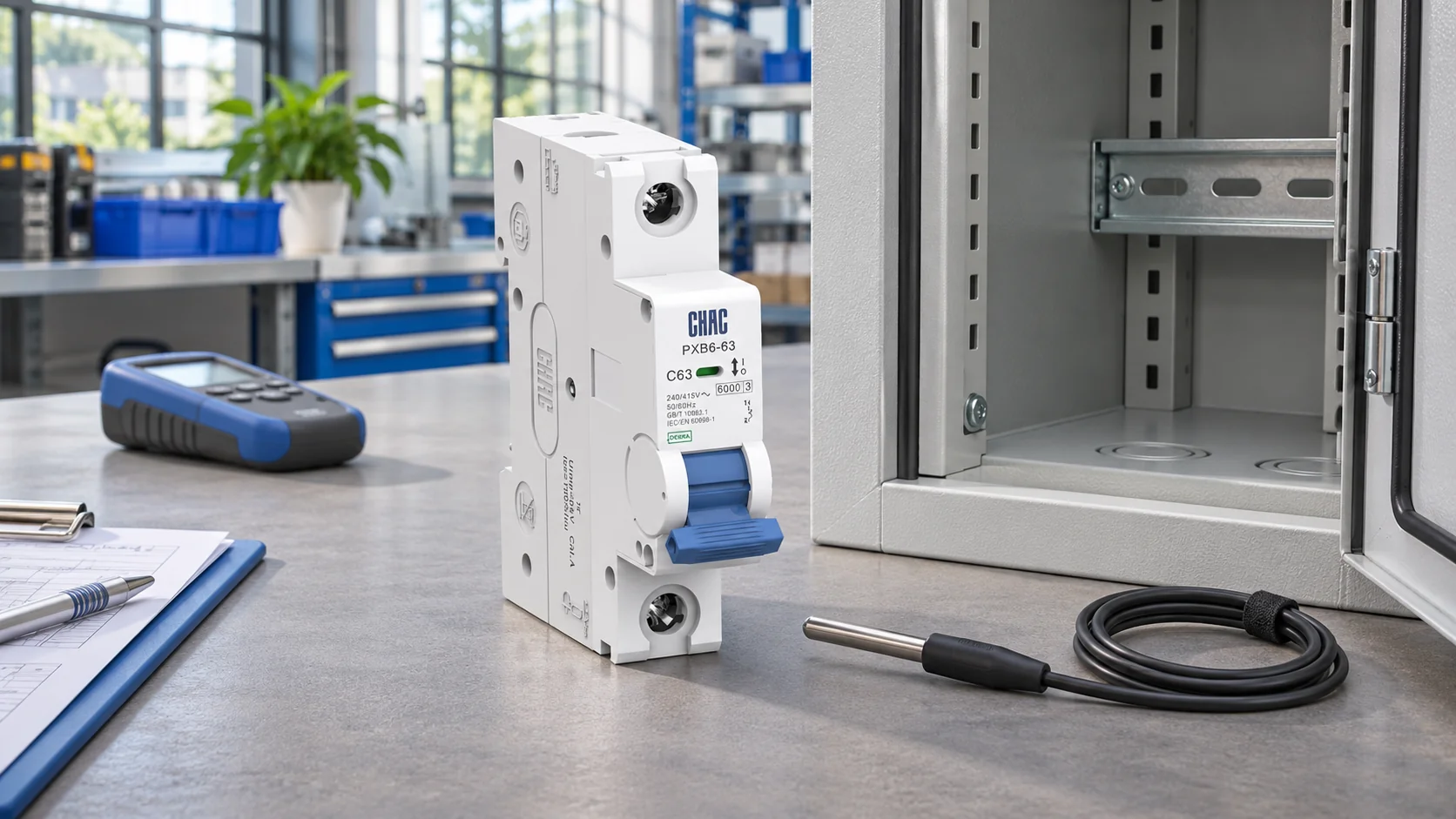
Periksa penurunan rating pemutus arus sejalan dengan batas arus kabel dan rakitan.
Penurunan suhu membahas salah satu faktor yang memengaruhi arus yang dapat digunakan. Pengelompokan konduktor, metode pemasangan kabel, kesesuaian terminal, serta performa kenaikan suhu pada rakitan tersebut menimbulkan batasan-batasan lainnya. Koreksi yang diterapkan pada kabel tidak dapat diterapkan pada MCB, dan koreksi untuk MCB pun tidak dapat menentukan kapasitas keseluruhan panel.
IEC 61439-1:2020 secara khusus membahas rakitan dan memperkenalkan arus pengenal kelompok sehubungan dengan verifikasi kenaikan suhu. Ruang lingkupnya menjelaskan mengapa pemeriksaan terhadap satu komponen saja tidak menyelesaikan masalah rakitan. Terapkan bagian rakitan yang relevan bersama dengan aturan umum; verifikasi yang tepat bergantung pada desain dan penggunaan yang dimaksud.
| Pertanyaan | Apa yang digambarkan olehnya | Bukti yang dibutuhkan |
|---|---|---|
| Berapa arus pengenal pemutus sirkuit? | Peringkat perangkat yang dipilih dalam kondisi yang telah dinyatakan | Model yang tepat, tiang, kurva, dan peringkat |
| Berapa arus yang diizinkan pada suhu ini? | Koreksi suhu dari pabrikan | Tabel yang berlaku dan kondisi acuannya |
| Apa yang dapat dibawa oleh kabel tersebut? | Kapasitas konduktor dalam pemasangannya | Perhitungan kabel termasuk koreksi yang berlaku |
| Apa yang dapat dibawa oleh rakitan yang telah dimuat? | Keseluruhan susunan kandang dan rangkaian tersebut | Asumsi verifikasi perakitan dan pembebanan yang berlaku |
Apabila suatu produsen secara eksplisit menetapkan faktor multiplikatif, perhitungannya mungkin cukup sederhana. Sebagai ilustrasi, faktor hipotetis 0.90 yang diterapkan pada 32 A menghasilkan 28.8 A. Ini bukan data koreksi PXB6, beban yang direkomendasikan, atau bukti bahwa beberapa faktor koreksi dapat dikalikan bersama. Metode yang digunakan oleh produsen menentukan apakah dan bagaimana faktor-faktor tersebut dapat digabungkan.
Periksa pemanas panel sebelum meningkatkan rating pemutus arus.
Meningkatkan pemutus arus dari 32 A menjadi 40 A mengubah keputusan proteksi. Hal ini dapat menyebabkan konduktor yang ada tidak terlindungi secara memadai, meskipun mencegah terjadinya pemutusan yang tidak diinginkan. Mengubah dari kurva B ke C atau D juga mengubah karakteristik trip magnetik; hal ini tidak memberikan solusi umum untuk perilaku beban lebih yang berkaitan dengan panas. The Panduan kurva B, C, dan D explains that separate selection issue.
Review the measured load profile and investigate abnormal heating or connection defects before treating every trip as a derating problem. A poorly made termination requires correction under the manufacturer’s installation instructions. More ventilation cannot make an unsuitable termination acceptable. Equally, a larger enclosure or revised spacing needs to be evaluated as an assembly change, including any effect on ingress protection and maintenance.
| Observed condition | Useful review | Avoid assuming |
|---|---|---|
| Operation changes after other circuits are loaded | Actual simultaneous loading and local thermal conditions | Every circuit can carry its headline current simultaneously |
| One termination is abnormally hot | Conductor, terminal condition and approved connection procedure | A general derating factor repairs a connection fault |
| Behaviour changes with the cabinet door open | Normal closed-door service conditions | An open-door trial validates the finished panel |
| A higher-current replacement is proposed | Cable protection, fault duty and assembly verification | A larger rating is an equivalent replacement |
The purchasing cost includes engineering time as well as hardware. A low-cost replacement followed by another site visit can cost more than resolving the enclosure design before manufacture. Compare corrective options by their effect on protection, assembly requirements, downtime and future servicing; do not select the cheapest component change in isolation.
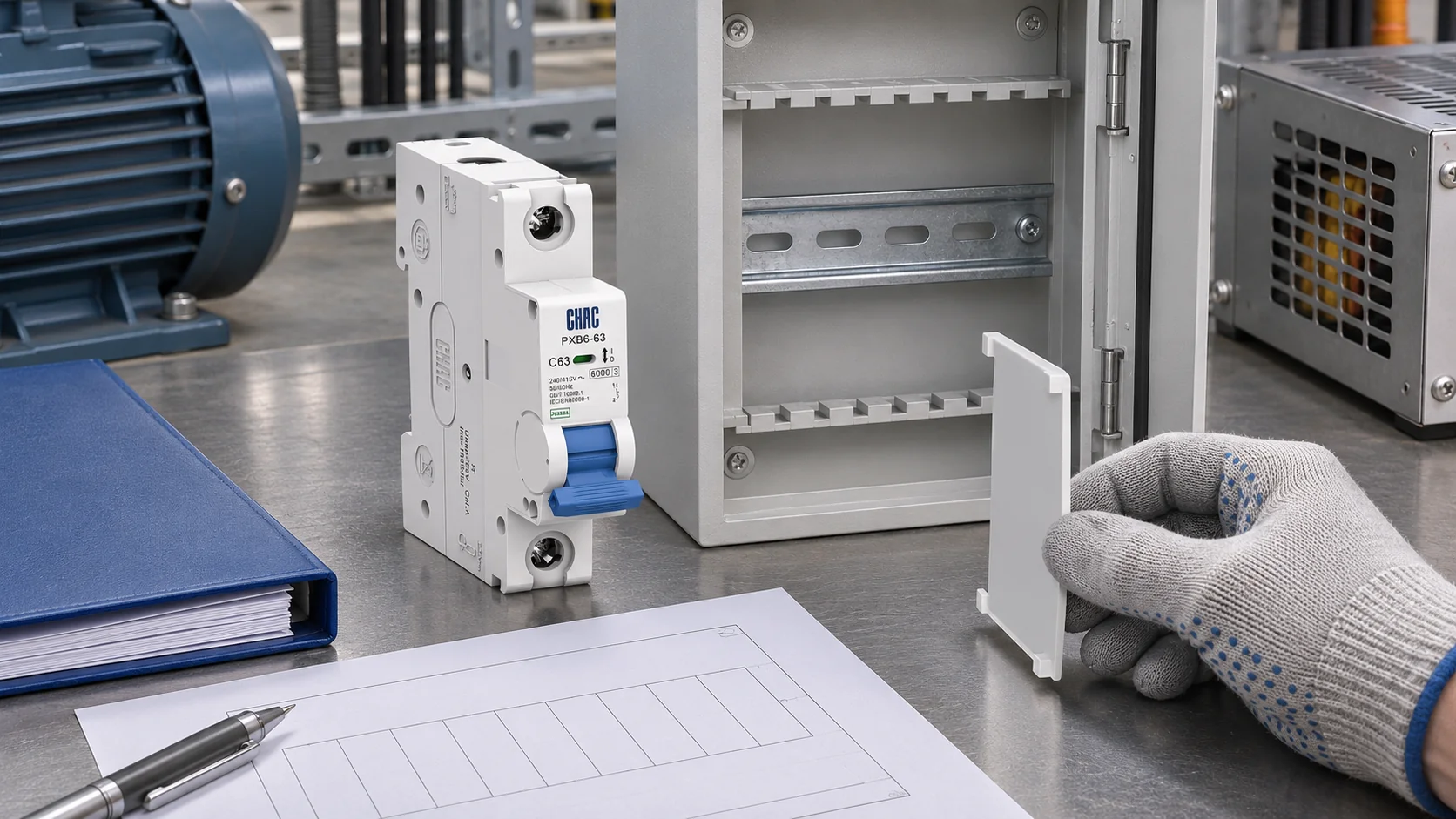
How to request temperature correction data for your PXB6 configuration
CHAC PXB6-63 product information lists current options from 6 A to 63 A, pole options from 1P to 4P, and B, C and D curves. Those choices identify different order configurations. The public 30°C tripping reference does not supply a complete current-versus-temperature table for every configuration.
Send the exact PXB6 designation, intended load, pole arrangement, local ambient-temperature estimate, enclosure arrangement and simultaneous-loading assumptions when requesting the applicable correction data. Ask whether the supplied method accounts for adjacent devices and whether additional assembly checks remain necessary. Keep the response and revision with the panel design.
IEC TR 61439-0:2022 provides guidance for specifying assembly functions and characteristics, including current-rating considerations. Use that specification discussion to agree the intended loading and service conditions with the assembly manufacturer. It is a technical report, not a product certificate or a source of a universal PXB6 correction factor.
IEC 60898-1 is the product-standard reference on the published PXB6 page. IEC 61439 addresses the assembly, while the applicable installation rules govern circuit and conductor protection. These are different scopes. A catalogue standard reference does not establish conformity of a modified panel or prove that an order carries every possible approval.
Common questions about PXB6 derating in hot panels
What does circuit breaker derating mean in a hot electrical panel?
It means limiting usable current according to the manufacturer’s data for the actual thermal conditions. It does not change the number printed on the breaker or automatically change its trip setting. The permitted circuit load must also satisfy conductor and assembly requirements.
Which ambient temperature should be used when reading a breaker’s derating table?
Use the ambient temperature and measurement conditions defined by that manufacturer’s table, normally relating to the environment around the device. Do not substitute room temperature or a measured terminal surface temperature without checking the instructions. Record the enclosure’s representative loaded condition.
How do adjacent devices and enclosure ventilation affect usable breaker current?
They can change the local thermal environment and the assembly’s temperature rise. The size of the effect depends on the actual arrangement, loading and approved correction method. Do not borrow a grouping factor from another product family.
Is temperature derating the same as changing the trip setting?
No. Derating concerns permitted use under particular conditions, while a trip setting determines a protection threshold where adjustment is available. A fixed-rating MCB does not acquire an adjustable overload setting because a correction table is used.
Where can I obtain the temperature correction data for the exact PXB6 rating?
Request it from CHAC with the complete model, current, curve, poles and panel conditions. Ask for the applicable document revision and any limits on using it. The published reference-temperature tripping table alone is insufficient to calculate every high-temperature operating case.
Can one temperature derating factor be applied to every MCB model?
No. Different products can have different reference conditions and thermal behaviour. Apply a factor only to the models and arrangements covered by its source, including any stated restrictions.
What assembly conditions should be checked before increasing a breaker rating?
Check the design load, cable capacity, terminations, simultaneous loading, enclosure ventilation, fault duty and coordination. Review the applicable assembly verification and local installation requirements. Resolve the cause of the original trip before approving a larger protective device.
Referensi
- IEC 61439-1:2020: assembly service conditions and verification, including group rated current.
- IEC 60947-2:2024: circuit-breaker scope for instructed or skilled users; a separate product-standard context.
- IEC TR 61439-0:2022: guidance for specifying assemblies.
The published PXB6-63 technical data linked above supplies the model range and the 30°C test reference. No PXB6-specific high-temperature correction factor is asserted in this article.
Specify the load and the conditions around the device together. For a PXB6 review, send CHAC your configuration and panel conditions so the appropriate technical information can be confirmed before ordering.