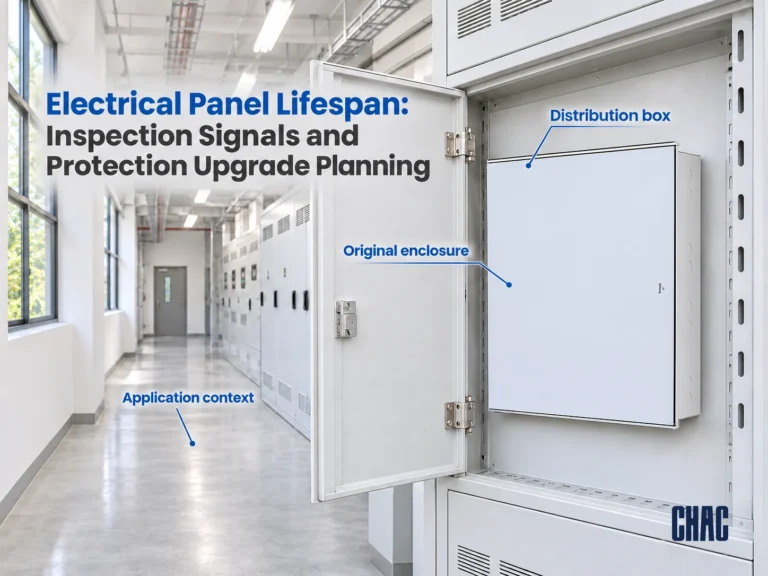
Considere este problema hipotético de comissionamento: um engenheiro de painéis em Dubai fecha um quadro de distribuição recém‑carregado, e um circuito que funcionava durante uma verificação com a porta aberta começa a disparar mais tarde, no decorrer do turno. Substituir o disjuntor por outro da mesma classificação não explica a diferença. A pergunta relevante é: o que mudou ao seu redor? A temperatura do invólucro, as cargas vizinhas, as condições dos cabos ou a própria conexão. Uma sala refrigerada e um compartimento de disjuntores aquecido não constituem o mesmo ambiente de operação.
Resumo: O derating do disjuntor significa utilizar a corrente permitida pelo fabricante para as condições reais de instalação. A tabela de disparo publicada pela PXB6-63 utiliza uma temperatura de referência de 30°C. Essa referência não é nem uma temperatura ambiente máxima universal nem um fator de correção. Obtenha os dados de temperatura da classificação exata, avalie o invólucro carregado e verifique novamente a proteção dos cabos antes de aumentar o tamanho do disjuntor.
Qual temperatura deve ser utilizada para o derating do disjuntor?
O relevante classificação de temperatura do disjuntor Deve ser interpretado levando em consideração as condições de referência especificadas. Um termômetro de parede mede a temperatura do ambiente; ele não determina a temperatura do ar que envolve um equipamento dentro de um gabinete carregado, especialmente nas proximidades de outra fonte de calor. Da mesma forma, uma imagem térmica de um terminal mostra apenas a temperatura superficial, que não pode ser simplesmente inserida em uma tabela de correção da temperatura ambiente.
As características de disparo publicadas do PXB6-63 identificam o 30°C como a temperatura de calibração de referência. A tabela também distingue uma condição de partida a frio de um teste realizado após uma etapa de carga anterior. Esses detalhes são importantes ao interpretar o funcionamento. Um múltiplo de corrente e um limite de tempo pertencem a uma sequência de teste específica, em vez de descreverem todas as condições de campo.
Registre o local onde a temperatura é medida, quais circuitos estão carregados, se a porta está fechada e se os ventiladores ou filtros encontram-se em condições normais de operação. Utilize as instruções do fabricante para definir o método e o local adequados de medição. Pessoal qualificado deve planejar quaisquer medições realizadas em equipamentos elétricos; abrir um painel energizado apenas para obter uma leitura conveniente não constitui um procedimento de comissionamento.
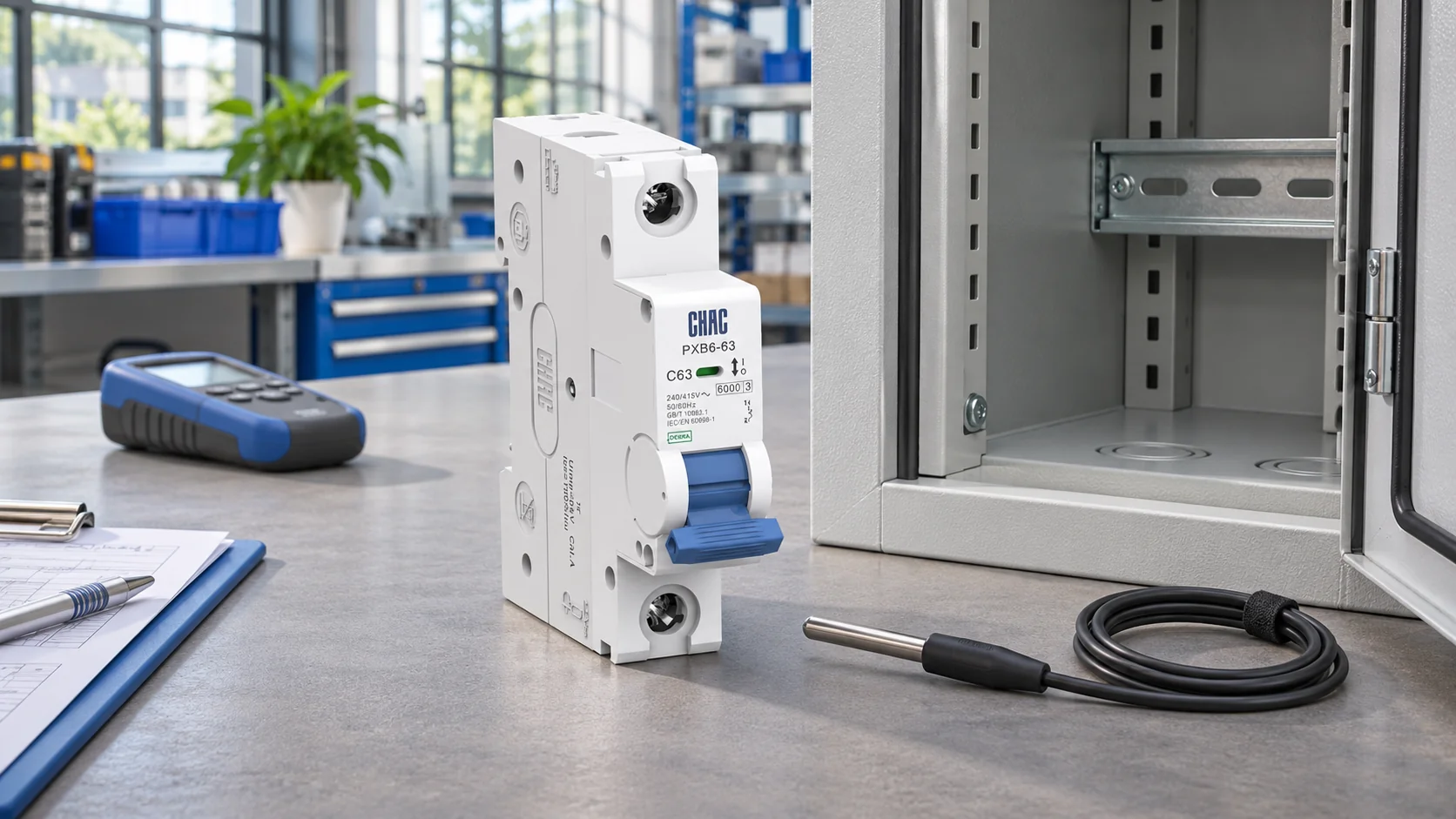
Verifique o derating do disjuntor juntamente com os limites de corrente do cabo e do conjunto.
Redução de desempenho por temperatura Aborda-se uma das influências sobre a corrente utilizável. O agrupamento dos condutores, o método de instalação do cabo, a adequação dos terminais e o desempenho em termos de elevação de temperatura do conjunto introduzem outros limites. Uma correção destinada a um cabo não pode ser aplicada a um disjuntor modular, e uma correção aplicada a um disjuntor modular não determina a capacidade do quadro elétrico completo.
A IEC 61439-1:2020 aborda expressamente os conjuntos e introduz a corrente nominal de grupo em relação à verificação da elevação de temperatura. Seu escopo explica por que verificar apenas um componente não resolve a questão do conjunto. Aplicar a parte relevante do conjunto juntamente com as regras gerais; a verificação adequada depende do projeto e do uso pretendido.
| Pergunta | O que descreve | É necessário evidência |
|---|---|---|
| Qual é a corrente nominal do disjuntor? | A classificação do dispositivo selecionado nas suas condições declaradas | Modelo exato, polos, curva e classificação |
| Qual é a corrente permitida a esta temperatura? | A correção de temperatura do fabricante | Tabela aplicável e suas condições de referência |
| O que o cabo pode transmitir? | Capacidade do condutor em sua instalação | Cálculo do cabo, incluindo as correções aplicáveis |
| O que o conjunto carregado pode transportar? | A caixa e a disposição do circuito em conjunto | Applicable assembly verification and loading assumptions |
Where a manufacturer explicitly defines a multiplicative factor, the arithmetic may be straightforward. For illustration only, a hypothetical factor of 0.90 applied to 32 A gives 28.8 A. This is not PXB6 correction data, a recommended load or evidence that several correction factors may be multiplied together. The manufacturer’s method determines whether and how those factors can be combined.
Investigate panel heating before increasing the breaker rating
Increasing a breaker from 32 A to 40 A changes the protection decision. It may leave the existing conductor insufficiently protected, even if it stops an inconvenient trip. Changing from curve B to C or D also changes the magnetic trip characteristic; it does not provide a general solution to heat-related overload behaviour. The B, C and D curve guide explains that separate selection issue.
Review the measured load profile and investigate abnormal heating or connection defects before treating every trip as a derating problem. A poorly made termination requires correction under the manufacturer’s installation instructions. More ventilation cannot make an unsuitable termination acceptable. Equally, a larger enclosure or revised spacing needs to be evaluated as an assembly change, including any effect on ingress protection and maintenance.
| Observed condition | Useful review | Avoid assuming |
|---|---|---|
| Operation changes after other circuits are loaded | Actual simultaneous loading and local thermal conditions | Every circuit can carry its headline current simultaneously |
| One termination is abnormally hot | Conductor, terminal condition and approved connection procedure | A general derating factor repairs a connection fault |
| Behaviour changes with the cabinet door open | Normal closed-door service conditions | An open-door trial validates the finished panel |
| A higher-current replacement is proposed | Cable protection, fault duty and assembly verification | A larger rating is an equivalent replacement |
The purchasing cost includes engineering time as well as hardware. A low-cost replacement followed by another site visit can cost more than resolving the enclosure design before manufacture. Compare corrective options by their effect on protection, assembly requirements, downtime and future servicing; do not select the cheapest component change in isolation.
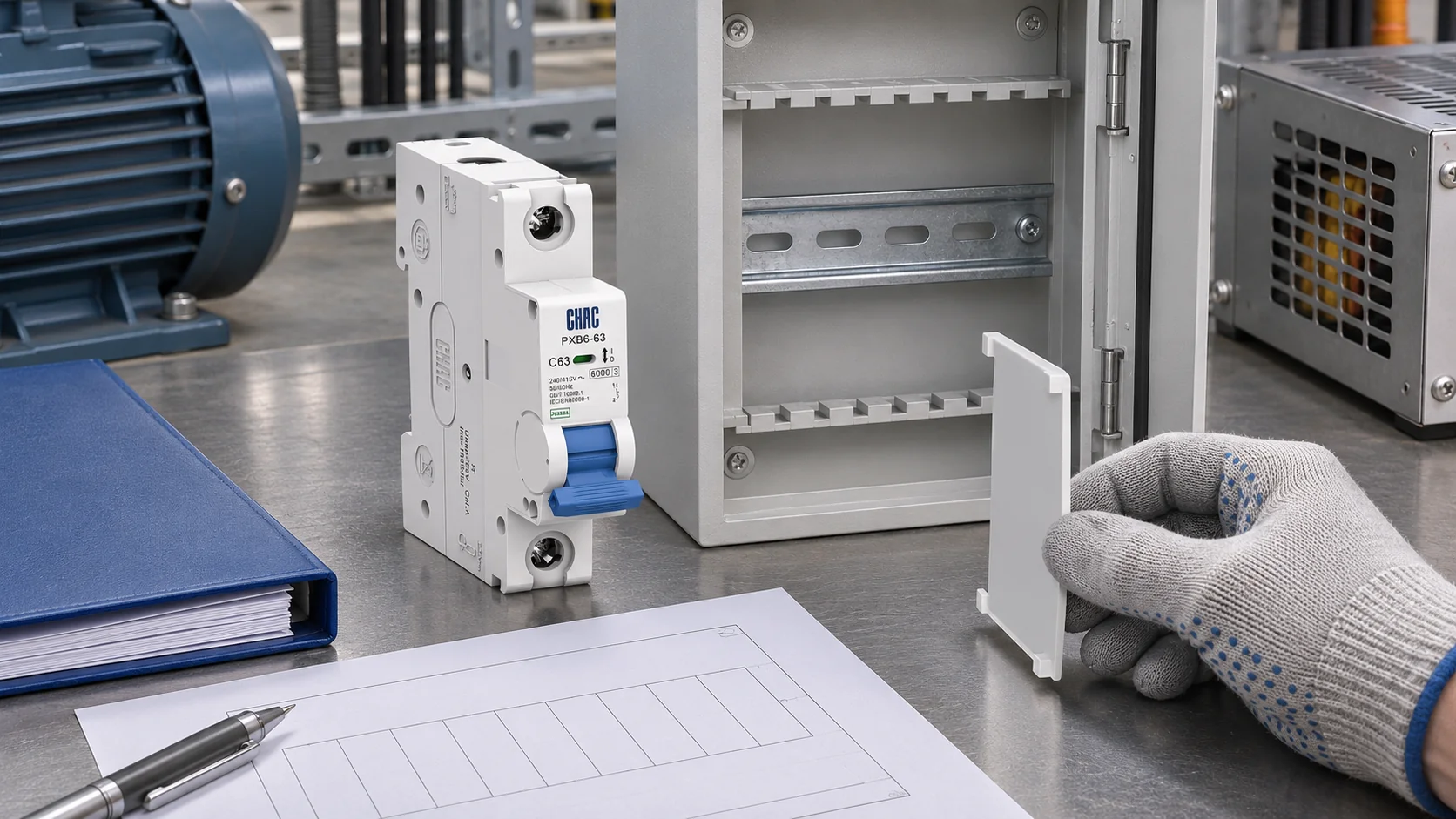
How to request temperature correction data for your PXB6 configuration
CHAC’s PXB6-63 product information lists current options from 6 A to 63 A, pole options from 1P to 4P, and B, C and D curves. Those choices identify different order configurations. The public 30°C tripping reference does not supply a complete current-versus-temperature table for every configuration.
Send the exact PXB6 designation, intended load, pole arrangement, local ambient-temperature estimate, enclosure arrangement and simultaneous-loading assumptions when requesting the applicable correction data. Ask whether the supplied method accounts for adjacent devices and whether additional assembly checks remain necessary. Keep the response and revision with the panel design.
IEC TR 61439-0:2022 provides guidance for specifying assembly functions and characteristics, including current-rating considerations. Use that specification discussion to agree the intended loading and service conditions with the assembly manufacturer. It is a technical report, not a product certificate or a source of a universal PXB6 correction factor.
IEC 60898-1 is the product-standard reference on the published PXB6 page. IEC 61439 addresses the assembly, while the applicable installation rules govern circuit and conductor protection. These are different scopes. A catalogue standard reference does not establish conformity of a modified panel or prove that an order carries every possible approval.
Common questions about PXB6 derating in hot panels
What does circuit breaker derating mean in a hot electrical panel?
It means limiting usable current according to the manufacturer’s data for the actual thermal conditions. It does not change the number printed on the breaker or automatically change its trip setting. The permitted circuit load must also satisfy conductor and assembly requirements.
Which ambient temperature should be used when reading a breaker’s derating table?
Use the ambient temperature and measurement conditions defined by that manufacturer’s table, normally relating to the environment around the device. Do not substitute room temperature or a measured terminal surface temperature without checking the instructions. Record the enclosure’s representative loaded condition.
How do adjacent devices and enclosure ventilation affect usable breaker current?
They can change the local thermal environment and the assembly’s temperature rise. The size of the effect depends on the actual arrangement, loading and approved correction method. Do not borrow a grouping factor from another product family.
Is temperature derating the same as changing the trip setting?
No. Derating concerns permitted use under particular conditions, while a trip setting determines a protection threshold where adjustment is available. A fixed-rating MCB does not acquire an adjustable overload setting because a correction table is used.
Where can I obtain the temperature correction data for the exact PXB6 rating?
Request it from CHAC with the complete model, current, curve, poles and panel conditions. Ask for the applicable document revision and any limits on using it. The published reference-temperature tripping table alone is insufficient to calculate every high-temperature operating case.
Can one temperature derating factor be applied to every MCB model?
No. Different products can have different reference conditions and thermal behaviour. Apply a factor only to the models and arrangements covered by its source, including any stated restrictions.
What assembly conditions should be checked before increasing a breaker rating?
Check the design load, cable capacity, terminations, simultaneous loading, enclosure ventilation, fault duty and coordination. Review the applicable assembly verification and local installation requirements. Resolve the cause of the original trip before approving a larger protective device.
Referências
- IEC 61439-1:2020: assembly service conditions and verification, including group rated current.
- IEC 60947-2:2024: circuit-breaker scope for instructed or skilled users; a separate product-standard context.
- IEC TR 61439-0:2022: guidance for specifying assemblies.
The published PXB6-63 technical data linked above supplies the model range and the 30°C test reference. No PXB6-specific high-temperature correction factor is asserted in this article.
Specify the load and the conditions around the device together. For a PXB6 review, send CHAC your configuration and panel conditions so the appropriate technical information can be confirmed before ordering.