Rozważmy następujący hipotetyczny problem z uruchomieniem: inżynier ds. rozdzielnic w Dubaju zamyka świeżo załadowaną szafę rozdzielczą, a obwód, który działał podczas kontroli przy otwartych drzwiach, zaczyna wyłączać się w późniejszej fazie zmiany. Wymiana wyłącznika na model o tej samej klasyfikacji nie wyjaśnia różnicy. Istotne pytanie brzmi: co uległo zmianie w jego otoczeniu? Temperatura w obudowie, obciążenia sąsiednie, stan przewodów czy sam kontakt. Pomieszczenie chłodne i ciepła komora wyłącznika to nie to samo środowisko pracy.
Podsumowanie: Obniżenie prądu znamionowego wyłącznika oznacza stosowanie dopuszczalnego prądu podanego przez producenta dla rzeczywistych warunków instalacji. Opublikowana tabela uruchamiania PXB6-63 wykorzystuje temperaturę referencyjną 30°C. Ta temperatura referencyjna nie jest ani uniwersalną maksymalną temperaturą otoczenia, ani współczynnikiem korekcyjnym. Przed zwiększeniem rozmiaru wyłącznika należy uzyskać dokładne dane temperaturowe dotyczące jego klasy znamionowej, ocenić obciążony szafek i ponownie sprawdzić zabezpieczenie kabli.
Jaką temperaturę należy stosować przy obniżaniu parametrów wyłącznika automatycznego?
The relevant circuit breaker temperature rating needs to be read with its stated reference conditions. A wall thermometer measures the room. It does not establish the temperature of air surrounding a device inside a loaded cabinet, especially near another source of heat. Similarly, a thermal image of a terminal shows a surface temperature, which cannot simply be entered into an ambient-temperature correction table.
PXB6-63’s published tripping characteristics identify 30°C as the reference calibration temperature. The table also distinguishes a cold starting condition from a test performed after a previous loading stage. Those details matter when interpreting operation. A current multiple and a time limit belong to a specified test sequence, rather than describing every field condition.
Record where temperature is assessed, which circuits are loaded, whether the door is closed and whether fans or filters are in their normal service condition. Use the manufacturer’s instructions to establish the appropriate measurement method and location. Qualified personnel must plan any measurements around electrical equipment; opening a live cabinet to obtain a convenient reading is not a commissioning method.
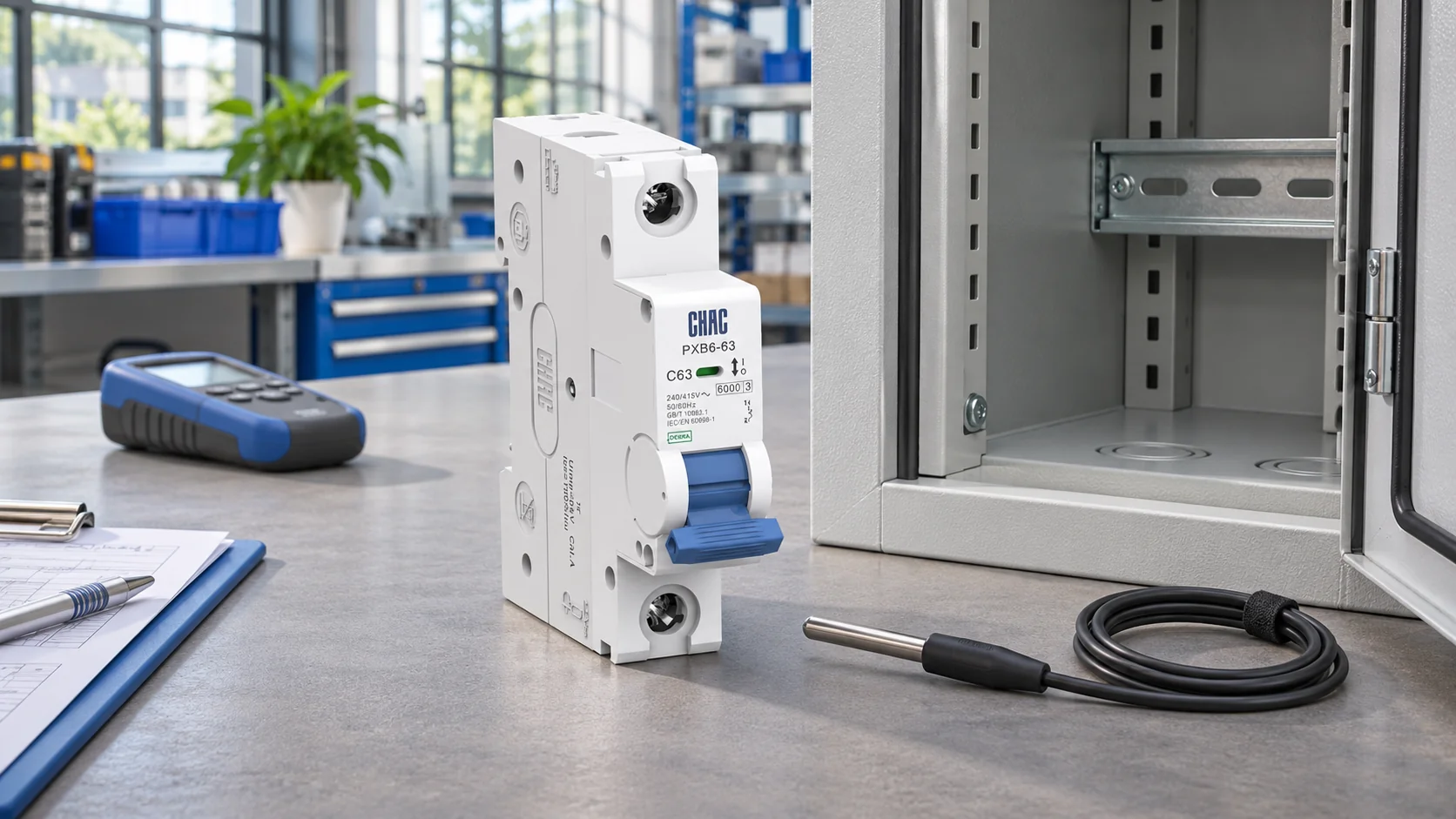
Check breaker derating alongside cable and assembly current limits
Temperature derating addresses one influence on usable current. Conductor grouping, cable installation method, terminal suitability and the assembly’s temperature-rise performance introduce other limits. A correction intended for a cable cannot be applied to an MCB, and an MCB correction cannot establish the capacity of the complete panel.
IEC 61439-1:2020 expressly addresses assemblies and introduces group rated current in connection with temperature-rise verification. Its scope explains why checking one component does not settle the assembly question. Apply the relevant assembly part together with the general rules; the appropriate verification depends on the design and intended use.
| Pytanie | To, co opisuje | Potrzebne dowody |
|---|---|---|
| What is the breaker rated current? | The selected device rating under its declared conditions | Exact model, poles, curve and rating |
| What current is permitted at this temperature? | The manufacturer’s temperature correction | Applicable table and its reference conditions |
| What can the cable carry? | Conductor capacity in its installation | Cable calculation including applicable corrections |
| What can the loaded assembly carry? | The enclosure and circuit arrangement together | Applicable assembly verification and loading assumptions |
Where a manufacturer explicitly defines a multiplicative factor, the arithmetic may be straightforward. For illustration only, a hypothetical factor of 0.90 applied to 32 A gives 28.8 A. This is not PXB6 correction data, a recommended load or evidence that several correction factors may be multiplied together. The manufacturer’s method determines whether and how those factors can be combined.
Investigate panel heating before increasing the breaker rating
Increasing a breaker from 32 A to 40 A changes the protection decision. It may leave the existing conductor insufficiently protected, even if it stops an inconvenient trip. Changing from curve B to C or D also changes the magnetic trip characteristic; it does not provide a general solution to heat-related overload behaviour. The B, C and D curve guide explains that separate selection issue.
Review the measured load profile and investigate abnormal heating or connection defects before treating every trip as a derating problem. A poorly made termination requires correction under the manufacturer’s installation instructions. More ventilation cannot make an unsuitable termination acceptable. Equally, a larger enclosure or revised spacing needs to be evaluated as an assembly change, including any effect on ingress protection and maintenance.
| Obserwowany stan | Useful review | Avoid assuming |
|---|---|---|
| Operation changes after other circuits are loaded | Actual simultaneous loading and local thermal conditions | Every circuit can carry its headline current simultaneously |
| One termination is abnormally hot | Conductor, terminal condition and approved connection procedure | A general derating factor repairs a connection fault |
| Behaviour changes with the cabinet door open | Normal closed-door service conditions | An open-door trial validates the finished panel |
| A higher-current replacement is proposed | Cable protection, fault duty and assembly verification | A larger rating is an equivalent replacement |
The purchasing cost includes engineering time as well as hardware. A low-cost replacement followed by another site visit can cost more than resolving the enclosure design before manufacture. Compare corrective options by their effect on protection, assembly requirements, downtime and future servicing; do not select the cheapest component change in isolation.
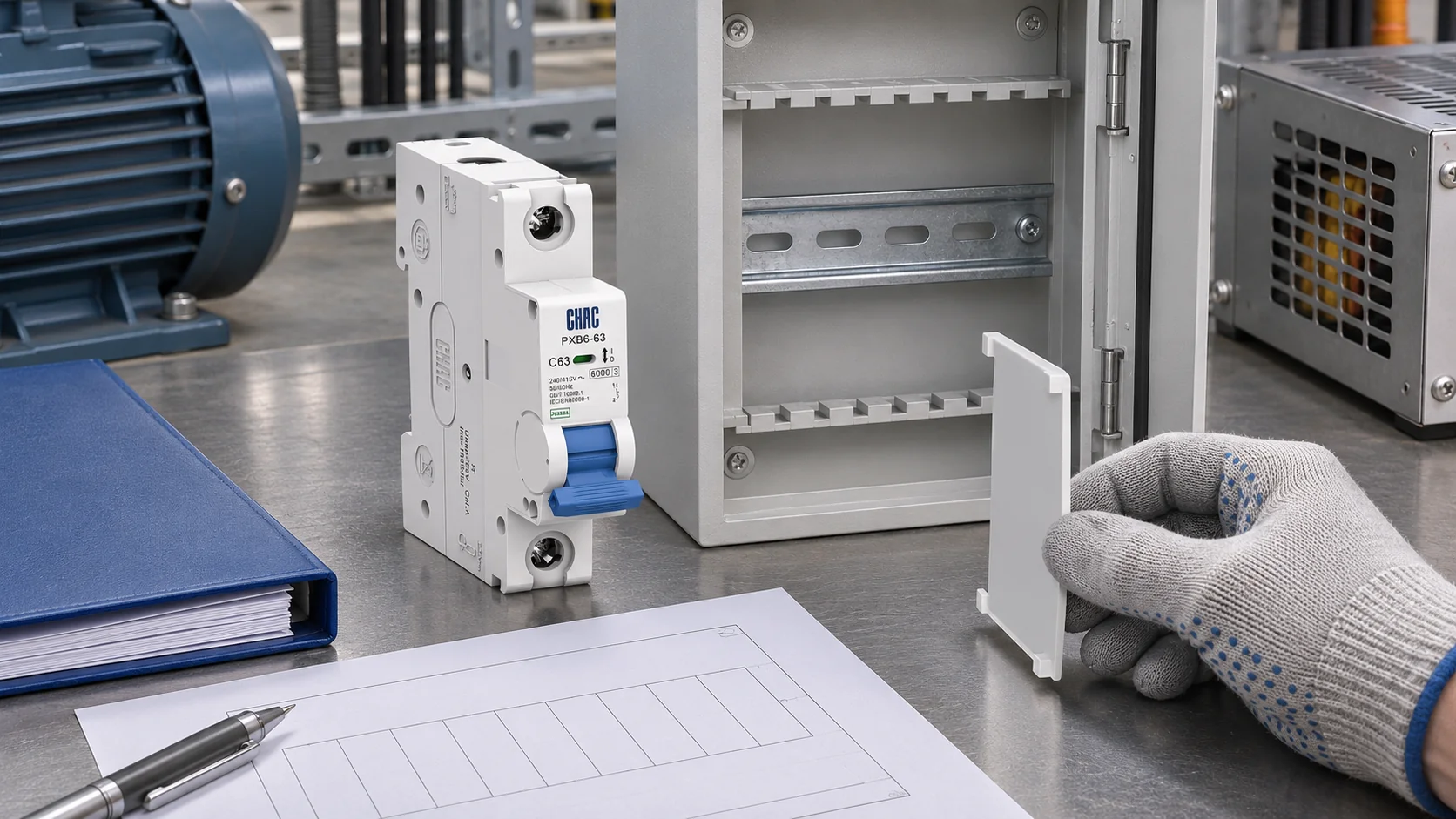
How to request temperature correction data for your PXB6 configuration
CHAC PXB6-63 product information lists current options from 6 A to 63 A, pole options from 1P to 4P, and B, C and D curves. Those choices identify different order configurations. The public 30°C tripping reference does not supply a complete current-versus-temperature table for every configuration.
Send the exact PXB6 designation, intended load, pole arrangement, local ambient-temperature estimate, enclosure arrangement and simultaneous-loading assumptions when requesting the applicable correction data. Ask whether the supplied method accounts for adjacent devices and whether additional assembly checks remain necessary. Keep the response and revision with the panel design.
IEC TR 61439-0:2022 provides guidance for specifying assembly functions and characteristics, including current-rating considerations. Use that specification discussion to agree the intended loading and service conditions with the assembly manufacturer. It is a technical report, not a product certificate or a source of a universal PXB6 correction factor.
IEC 60898-1 is the product-standard reference on the published PXB6 page. IEC 61439 addresses the assembly, while the applicable installation rules govern circuit and conductor protection. These are different scopes. A catalogue standard reference does not establish conformity of a modified panel or prove that an order carries every possible approval.
Common questions about PXB6 derating in hot panels
What does circuit breaker derating mean in a hot electrical panel?
It means limiting usable current according to the manufacturer’s data for the actual thermal conditions. It does not change the number printed on the breaker or automatically change its trip setting. The permitted circuit load must also satisfy conductor and assembly requirements.
Which ambient temperature should be used when reading a breaker’s derating table?
Use the ambient temperature and measurement conditions defined by that manufacturer’s table, normally relating to the environment around the device. Do not substitute room temperature or a measured terminal surface temperature without checking the instructions. Record the enclosure’s representative loaded condition.
How do adjacent devices and enclosure ventilation affect usable breaker current?
They can change the local thermal environment and the assembly’s temperature rise. The size of the effect depends on the actual arrangement, loading and approved correction method. Do not borrow a grouping factor from another product family.
Is temperature derating the same as changing the trip setting?
No. Derating concerns permitted use under particular conditions, while a trip setting determines a protection threshold where adjustment is available. A fixed-rating MCB does not acquire an adjustable overload setting because a correction table is used.
Where can I obtain the temperature correction data for the exact PXB6 rating?
Request it from CHAC with the complete model, current, curve, poles and panel conditions. Ask for the applicable document revision and any limits on using it. The published reference-temperature tripping table alone is insufficient to calculate every high-temperature operating case.
Can one temperature derating factor be applied to every MCB model?
No. Different products can have different reference conditions and thermal behaviour. Apply a factor only to the models and arrangements covered by its source, including any stated restrictions.
What assembly conditions should be checked before increasing a breaker rating?
Check the design load, cable capacity, terminations, simultaneous loading, enclosure ventilation, fault duty and coordination. Review the applicable assembly verification and local installation requirements. Resolve the cause of the original trip before approving a larger protective device.
Przypisy
- IEC 61439-1:2020: assembly service conditions and verification, including group rated current.
- IEC 60947-2:2024: circuit-breaker scope for instructed or skilled users; a separate product-standard context.
- IEC TR 61439-0:2022: guidance for specifying assemblies.
The published PXB6-63 technical data linked above supplies the model range and the 30°C test reference. No PXB6-specific high-temperature correction factor is asserted in this article.
Specify the load and the conditions around the device together. For a PXB6 review, send CHAC your configuration and panel conditions so the appropriate technical information can be confirmed before ordering.