Рассмотрим следующую гипотетическую ситуацию при пусконаладочных работах: инженер по распределительным щитам в Дубае включает недавно смонтированный распределительный шкаф, и цепь, которая успешно функционировала во время проверки при открытой двери, впоследствии начинает срабатывать защитное отключение. Замена автоматического выключателя на аналогичный по номинальному току не объясняет произошедшее. Важнее задаться вопросом: что именно изменилось в окружающих условиях — температура в шкафу, соседние нагрузки, состояние кабелей или сама контактная группа? Прохладное помещение и нагретый отсек выключателя — это совершенно разные эксплуатационные условия.
Резюме: Снижение номинального тока автоматического выключателя означает использование значения, допустимого производителем, с учётом фактических условий монтажа. Опубликованная таблица срабатывания для PXB6-63 использует эталонную температуру 30°C. Этот эталон не является ни универсальной максимальной температурой окружающей среды, ни поправочным коэффициентом. Перед увеличением номинала выключателя необходимо уточнить данные о температуре, соответствующие его номиналу, оценить загруженность корпуса и повторно проверить защиту кабелей.
Какую температуру следует использовать для снижения номинального тока автоматического выключателя?
Соответствующий Температурный номинал автоматического выключателя Его необходимо интерпретировать с учётом указанных условий измерения. Настенный термометр измеряет температуру в помещении; он не определяет температуру воздуха, окружающего устройство внутри загруженного шкафа, особенно вблизи другого источника тепла. Аналогично, термограмма клеммы отображает поверхностную температуру, которую нельзя просто внести в таблицу поправок на температуру окружающей среды.
Опубликованные характеристики срабатывания PXB6-63 указывают 30°C в качестве эталонной температуры калибровки. В таблице также различаются условия холодного пуска и испытание, проводимое после предыдущей стадии нагружения. Эти детали имеют значение при интерпретации работы. Кратное значение тока и временной предел относятся к конкретной последовательности испытаний, а не описывают каждое полевое состояние.
Фиксируйте место измерения температуры, какие цепи находятся под нагрузкой, закрыта ли дверь и находятся ли вентиляторы и фильтры в штатном рабочем состоянии. Для определения соответствующего метода и места измерений используйте инструкции производителя. Квалифицированный персонал должен планировать все измерения вблизи электрооборудования; вскрытие токоведущего шкафа с целью получения удобного показания не является допустимым методом пусконаладочных работ.
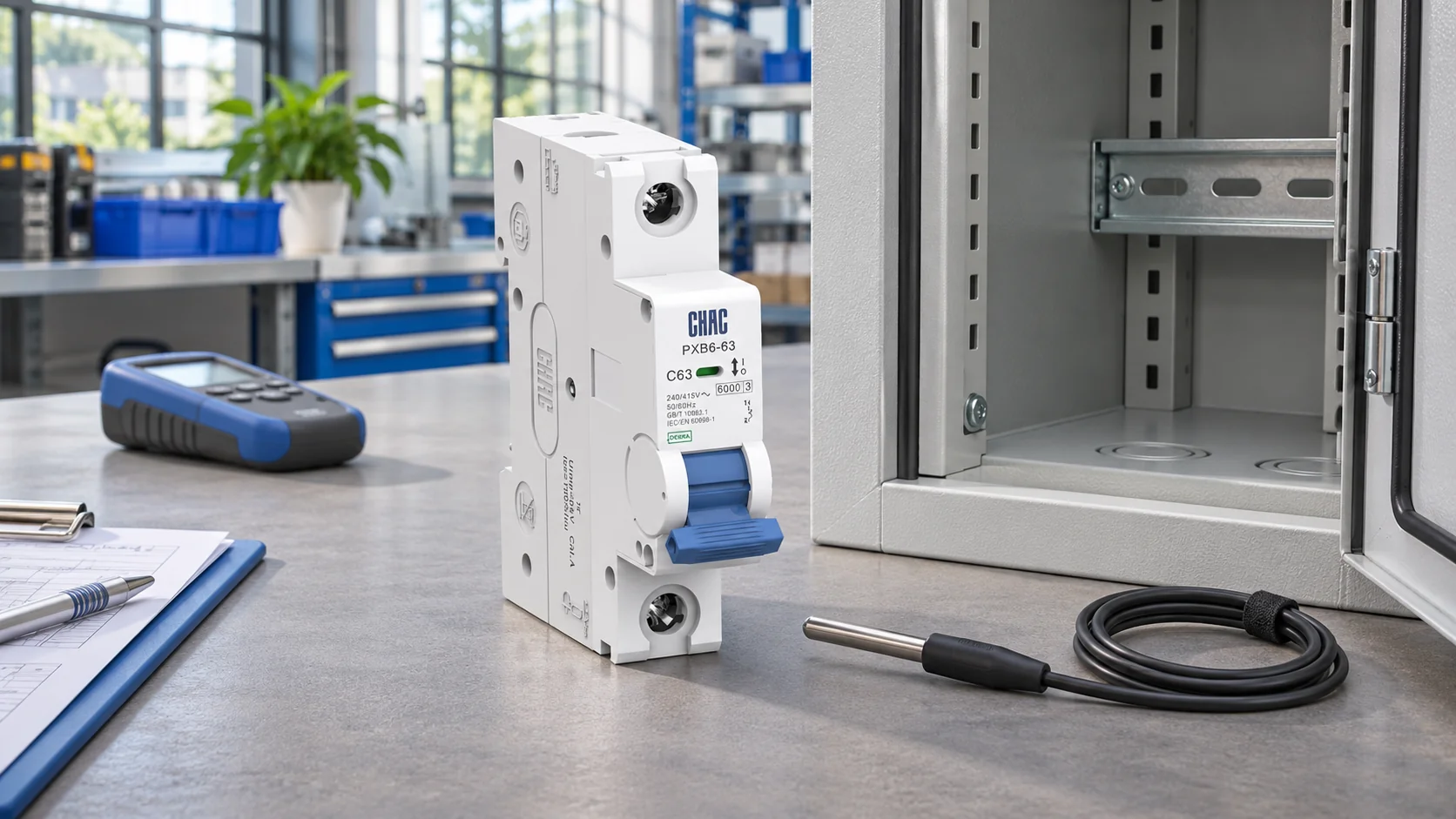
Проверьте понижение номинального тока автоматического выключателя с учётом предельных значений тока кабелей и сборок.
Температурное снижение характеристик Рассматривается один из факторов, влияющих на допустимый ток. Группировка проводников, способ прокладки кабелей, соответствие номиналу контактов и температурный режим сборки вводят дополнительные ограничения. Коррекция, предназначенная для кабеля, не может быть применена к автоматическому выключателю, а коррекция для автоматического выключателя не позволяет определить пропускную способность всего распределительного щита.
МЭК 61439-1:2020 специально касается сборок и вводит понятие группового номинального тока в связи с проверкой температурного повышения. Область применения поясняет, почему проверка одного компонента не решает вопрос о сборке. Применяйте соответствующую часть, касающуюся сборок, вместе с общими правилами; подходящая проверка зависит от конструкции и предполагаемого использования.
| Вопрос | Что оно описывает | Необходимы доказательства |
|---|---|---|
| Каков номинальный ток автомата защиты? | Номинальные характеристики выбранного устройства в заявленных условиях эксплуатации | Точная модель, полюсы, кривая и номинальные характеристики |
| Какой ток допустим при этой температуре? | Температурная поправка производителя | Применимая таблица и её исходные условия |
| What can the cable carry? | Conductor capacity in its installation | Cable calculation including applicable corrections |
| What can the loaded assembly carry? | The enclosure and circuit arrangement together | Applicable assembly verification and loading assumptions |
Where a manufacturer explicitly defines a multiplicative factor, the arithmetic may be straightforward. For illustration only, a hypothetical factor of 0.90 applied to 32 A gives 28.8 A. This is not PXB6 correction data, a recommended load or evidence that several correction factors may be multiplied together. The manufacturer’s method determines whether and how those factors can be combined.
Investigate panel heating before increasing the breaker rating
Increasing a breaker from 32 A to 40 A changes the protection decision. It may leave the existing conductor insufficiently protected, even if it stops an inconvenient trip. Changing from curve B to C or D also changes the magnetic trip characteristic; it does not provide a general solution to heat-related overload behaviour. The B, C and D curve guide explains that separate selection issue.
Review the measured load profile and investigate abnormal heating or connection defects before treating every trip as a derating problem. A poorly made termination requires correction under the manufacturer’s installation instructions. More ventilation cannot make an unsuitable termination acceptable. Equally, a larger enclosure or revised spacing needs to be evaluated as an assembly change, including any effect on ingress protection and maintenance.
| Observed condition | Useful review | Avoid assuming |
|---|---|---|
| Operation changes after other circuits are loaded | Actual simultaneous loading and local thermal conditions | Every circuit can carry its headline current simultaneously |
| One termination is abnormally hot | Conductor, terminal condition and approved connection procedure | A general derating factor repairs a connection fault |
| Behaviour changes with the cabinet door open | Normal closed-door service conditions | An open-door trial validates the finished panel |
| A higher-current replacement is proposed | Cable protection, fault duty and assembly verification | A larger rating is an equivalent replacement |
The purchasing cost includes engineering time as well as hardware. A low-cost replacement followed by another site visit can cost more than resolving the enclosure design before manufacture. Compare corrective options by their effect on protection, assembly requirements, downtime and future servicing; do not select the cheapest component change in isolation.
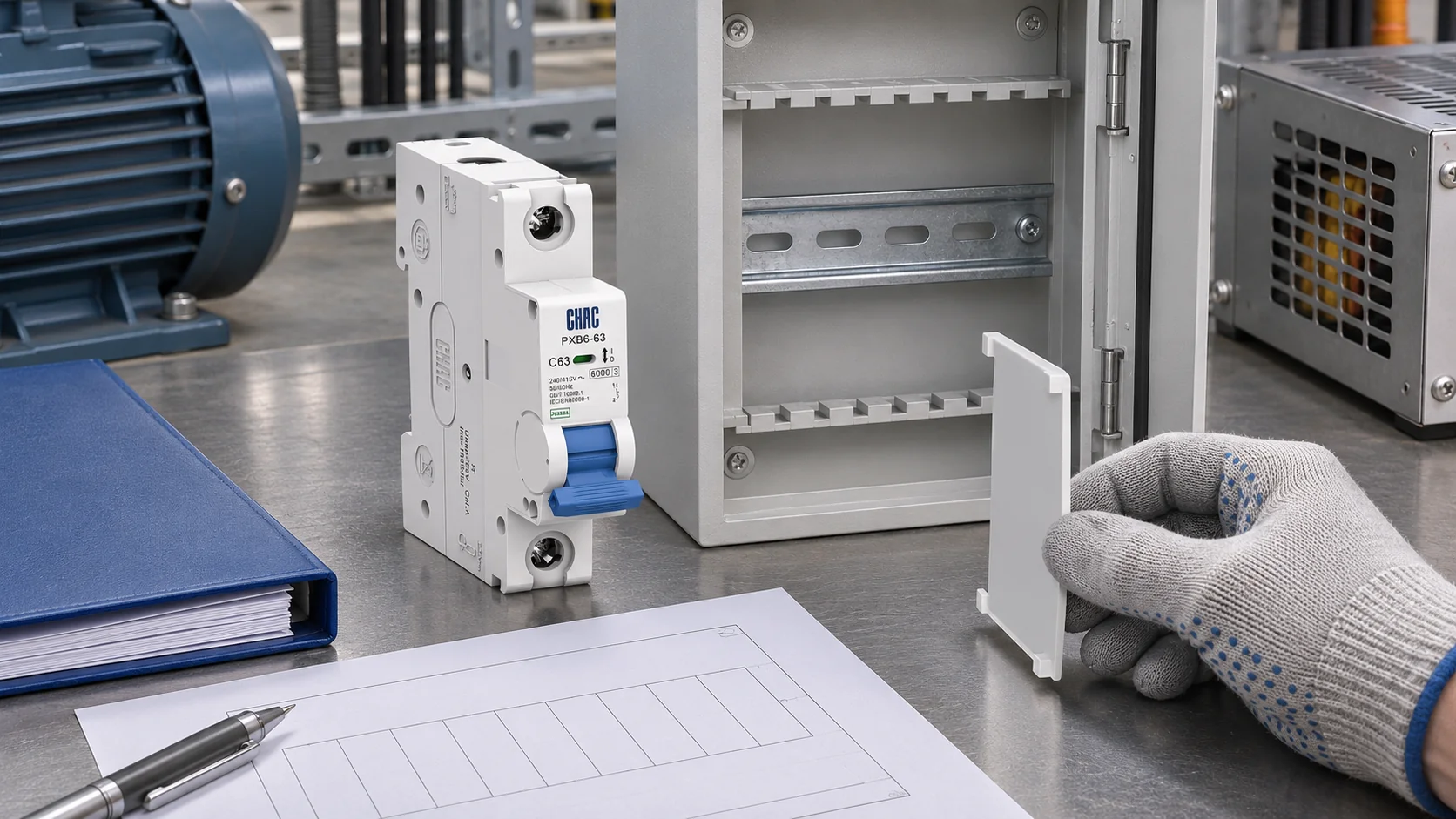
How to request temperature correction data for your PXB6 configuration
CHAC PXB6-63 product information lists current options from 6 A to 63 A, pole options from 1P to 4P, and B, C and D curves. Those choices identify different order configurations. The public 30°C tripping reference does not supply a complete current-versus-temperature table for every configuration.
Send the exact PXB6 designation, intended load, pole arrangement, local ambient-temperature estimate, enclosure arrangement and simultaneous-loading assumptions when requesting the applicable correction data. Ask whether the supplied method accounts for adjacent devices and whether additional assembly checks remain necessary. Keep the response and revision with the panel design.
IEC TR 61439-0:2022 provides guidance for specifying assembly functions and characteristics, including current-rating considerations. Use that specification discussion to agree the intended loading and service conditions with the assembly manufacturer. It is a technical report, not a product certificate or a source of a universal PXB6 correction factor.
IEC 60898-1 is the product-standard reference on the published PXB6 page. IEC 61439 addresses the assembly, while the applicable installation rules govern circuit and conductor protection. These are different scopes. A catalogue standard reference does not establish conformity of a modified panel or prove that an order carries every possible approval.
Common questions about PXB6 derating in hot panels
What does circuit breaker derating mean in a hot electrical panel?
It means limiting usable current according to the manufacturer’s data for the actual thermal conditions. It does not change the number printed on the breaker or automatically change its trip setting. The permitted circuit load must also satisfy conductor and assembly requirements.
Which ambient temperature should be used when reading a breaker’s derating table?
Use the ambient temperature and measurement conditions defined by that manufacturer’s table, normally relating to the environment around the device. Do not substitute room temperature or a measured terminal surface temperature without checking the instructions. Record the enclosure’s representative loaded condition.
How do adjacent devices and enclosure ventilation affect usable breaker current?
They can change the local thermal environment and the assembly’s temperature rise. The size of the effect depends on the actual arrangement, loading and approved correction method. Do not borrow a grouping factor from another product family.
Is temperature derating the same as changing the trip setting?
No. Derating concerns permitted use under particular conditions, while a trip setting determines a protection threshold where adjustment is available. A fixed-rating MCB does not acquire an adjustable overload setting because a correction table is used.
Where can I obtain the temperature correction data for the exact PXB6 rating?
Request it from CHAC with the complete model, current, curve, poles and panel conditions. Ask for the applicable document revision and any limits on using it. The published reference-temperature tripping table alone is insufficient to calculate every high-temperature operating case.
Can one temperature derating factor be applied to every MCB model?
No. Different products can have different reference conditions and thermal behaviour. Apply a factor only to the models and arrangements covered by its source, including any stated restrictions.
What assembly conditions should be checked before increasing a breaker rating?
Check the design load, cable capacity, terminations, simultaneous loading, enclosure ventilation, fault duty and coordination. Review the applicable assembly verification and local installation requirements. Resolve the cause of the original trip before approving a larger protective device.
Ссылки
- IEC 61439-1:2020: assembly service conditions and verification, including group rated current.
- IEC 60947-2:2024: circuit-breaker scope for instructed or skilled users; a separate product-standard context.
- IEC TR 61439-0:2022: guidance for specifying assemblies.
The published PXB6-63 technical data linked above supplies the model range and the 30°C test reference. No PXB6-specific high-temperature correction factor is asserted in this article.
Specify the load and the conditions around the device together. For a PXB6 review, send CHAC your configuration and panel conditions so the appropriate technical information can be confirmed before ordering.