A breaker quotation can match the requested current and still leave the essential purchasing question unresolved: under which standard, voltage and configuration are its protection ratings declared? For panel builders and distributors, an incomplete specification can make apparently comparable offers technically different.
IEC 60898-1 addresses circuit breakers for household and similar installations, associated with operation by ordinary persons; IEC 60947-2 addresses circuit breakers intended for installation and operation by instructed or skilled persons. Specify according to the project’s users, circuit conditions and applicable requirements—not simply whether the enclosure is labelled residential, commercial or industrial.
How do the standards change the purchasing comparison?
IEC 60898 and IEC 60947 are standard-series references; the relevant circuit-breaker parts should appear in the procurement specification. Neither a series reference nor the physical description “miniature” or “moulded case” establishes an exact unit’s compliance.
| Comparison point | IEC 60898-1 | IEC 60947-2 |
|---|---|---|
| Intended context | Household and similar installations; ordinary-person operation | Installation and operation by instructed or skilled persons |
| Breaking-capacity terminology | Icn: rated short-circuit capacity | Icu: ultimate; Ics: service short-circuit breaking capacity |
| Buyer’s evidence check | Exact variant, declared ratings and supporting conformity documents | Exact variant, voltage-specific Icu/Ics and supporting conformity documents |
The official IEC 60947-2 scope explicitly identifies instructed or skilled persons and covers AC and DC circuits within its stated voltage scope. That describes the standard, not the certification or AC/DC suitability of a particular breaker.
A commercial project may contain final circuits and a main distribution assembly with different access arrangements and protection needs. Its building category alone therefore cannot settle which standard each ordered device needs. Obtain the designer’s requirements for each circuit group.

Why are Icn, Icu and Ics not interchangeable?
These symbols identify different declared short-circuit performance measures and associated test requirements. Icn is not an alternative spelling of Icu. Ics addresses service short-circuit performance, while Icu addresses ultimate breaking capacity; equal numerical values do not erase the distinction.
Compare the applicable standard, rated operational voltage, pole arrangement and test conditions before comparing capacity figures. Also review reference ambient conditions, frequency and trip-characteristic information. Differences in reference conditions can affect how declared ratings apply inside the intended enclosure. Rated insulation voltage is not a substitute for rated operational voltage.
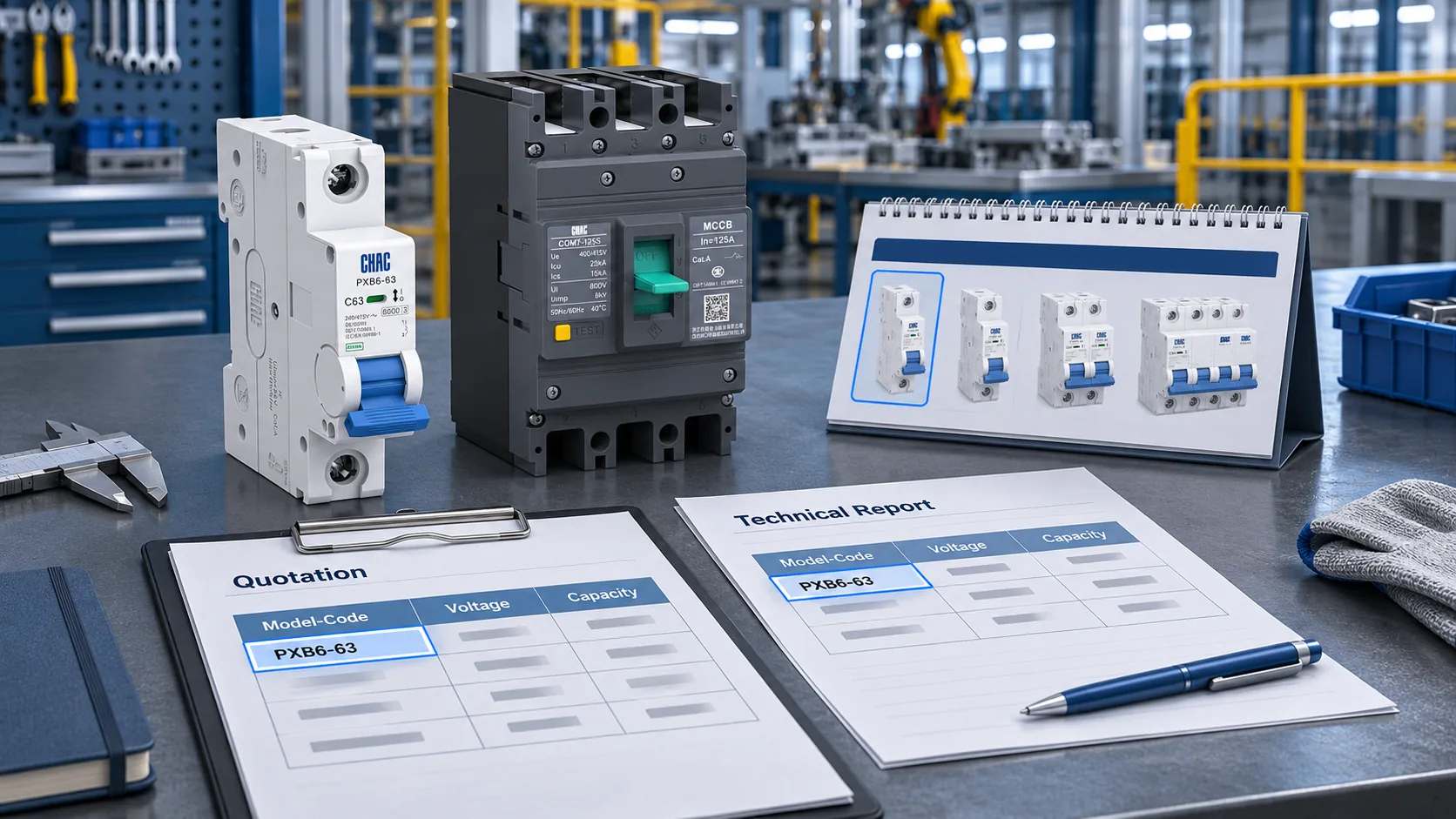
The CHAC PXB6-63 listing illustrates why document reconciliation matters: it references IEC 60898-1 while publishing “6kA Icu = Ics.” Buyers should request the exact variant’s marking and supporting report to establish the applicable rating basis; they should not silently relabel that figure as Icn.
The CHAC CQM7 catalogue separately lists frame-dependent Icu/Ics values at AC 400/415V for published three-pole variants. Its series maximum is not every variant’s rating. Neither catalogue comparison establishes that a particular model meets a project duty without configuration-level review.
What should the enquiry and purchase order actually specify?
Make the enquiry auditable: separate project inputs from the evidence requested for the offered breaker. Ask engineering to resolve missing circuit information before procurement treats competing quotations as equivalent.
| Project input | Required supplier response |
|---|---|
| Users, access and installation conditions | Proposed product standard and edition, with exact-model evidence |
| AC/DC system, operational voltage and poles | Matching declared electrical configuration and ratings |
| Prospective fault current and service requirements | Applicable Icn or Icu/Ics at the specified voltage |
| Load, conductor and enclosure conditions | Trip data, reference conditions and applicable derating information |
| Destination market and assembly interface | Required conformity documents, dimensions and connection data |
Require agreement between the quotation, ordering code, product marking, datasheet and report coverage. A family brochure may describe options beyond those tested or supplied in the offered configuration. Confirm any accessory or mounting interface separately; shared branding does not establish compatibility. Keep technical consultation distinct from documented acceptance of the final order.
Frequently asked questions
How do IEC 60898-1 and IEC 60947-2 differ in intended application?
IEC 60898-1 concerns household and similar installations with ordinary-person operation. IEC 60947-2 concerns breakers intended for installation and operation by instructed or skilled persons; the distinction is not simply domestic versus factory buildings.
Which standard should be specified for the users and installation conditions of the project?
Have the project designer identify intended users, access arrangements, circuit characteristics and applicable installation requirements. Specify the relevant part and edition, then verify the offered configuration rather than selecting solely by current rating or enclosure type.
Can one circuit breaker carry ratings under both standards?
Yes, where compliance and declared ratings under both are substantiated for that exact variant. Request separate rating information and supporting coverage; evidence under one standard does not automatically establish compliance under the other.
Why should Icn and Icu and Ics not be treated as identical labels?
They represent different performance declarations and test requirements. Retain each original symbol and its voltage and standard context; do not convert a catalogue value into another rating merely because the numerical capacities match.
How do reference conditions affect the comparison of declared breaker ratings?
Ambient conditions, voltage, frequency and pole configuration help define the rating’s applicability. Compare equivalent conditions and obtain relevant derating information for the enclosure instead of assuming catalogue current or breaking-capacity figures apply unchanged.
What markings and supporting reports should be checked for the exact ordered model?
Reconcile model code, current, voltage, poles, trip designation, standard reference and applicable breaking-capacity markings with the datasheet and report scope. Check that any certificate actually covers the ordered variant and destination requirements.
Does compliance with an IEC product standard replace local installation and market-access requirements?
No. Product-standard compliance does not establish compliance of the completed installation or satisfy every market-access requirement. Confirm applicable national requirements, assembly obligations and acceptance documentation with appropriately qualified project and conformity personnel.
A defensible breaker order connects the intended users, circuit conditions and declared performance to one identifiable configuration. Send those inputs and your documentation requirements to CHAC for configuration review, with unresolved ratings or compatibility questions kept open until supporting evidence is agreed.