A quotation for a 100A MCCB can leave a panel buyer with a critical question: does the proposed frame match the approved electrical and mechanical configuration? For a replacement or new feeder, the current rating alone cannot resolve mounting, protection or fault-duty requirements.
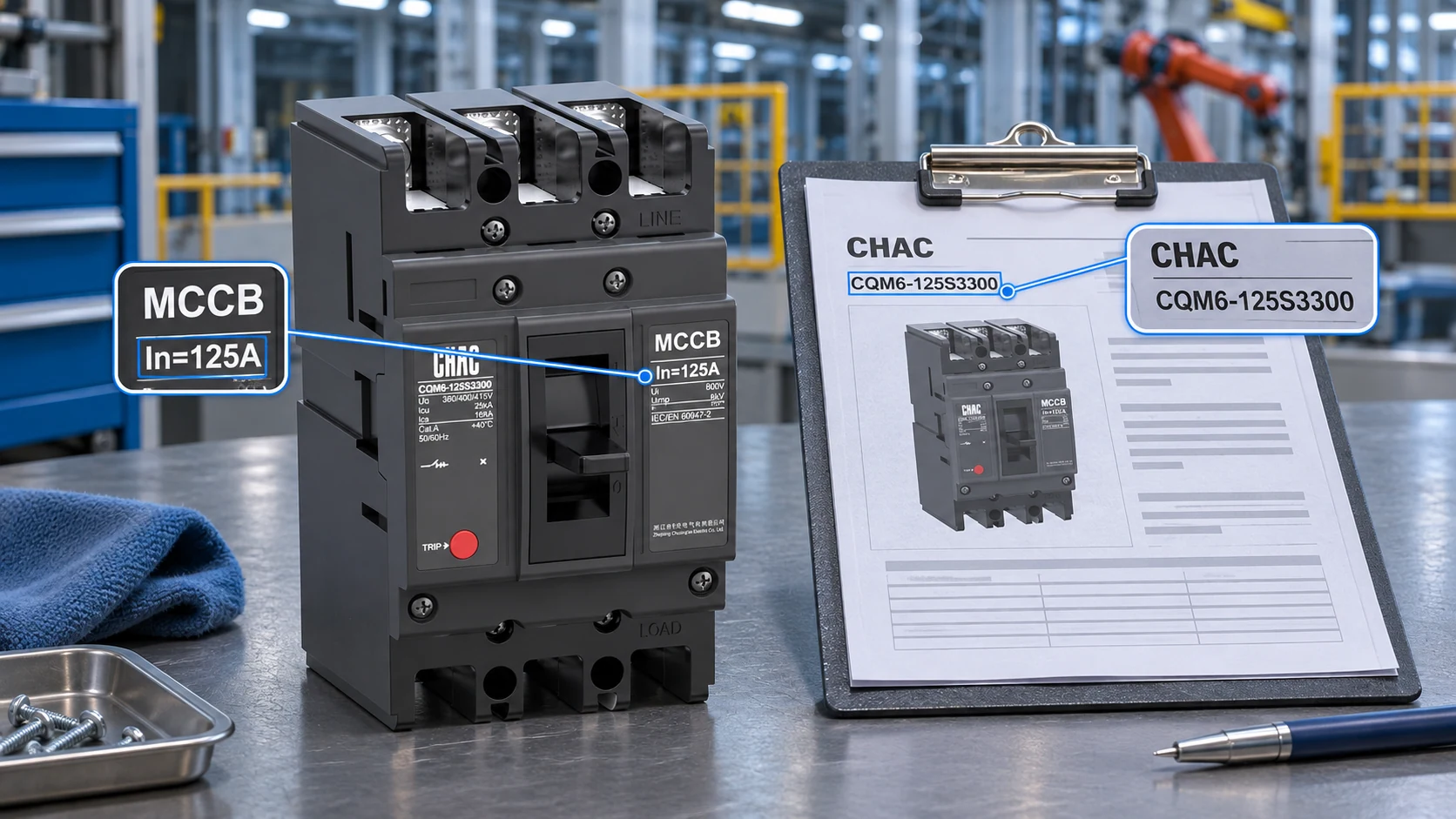
Compare CQM6-125 and CQM6-160 through exact variant documents, not their suffixes. CHAC’s published CQM6 information identifies CQM6-125, but does not establish a CQM6-160 variant or its 100A configuration. Request confirmation before treating that designation as an available alternative, then assess each documented option against the same circuit requirements. For example, a request for a three-pole 100 A MCCB identifies the current and pole count but still leaves the frame designation open.
What does a 100A rating establish about the frame?
The frame identifies a construction platform and its declared current capability; the fitted trip-unit rating and any adjustable overload setting are separate characteristics. A 100A marking therefore does not fully describe the breaker’s enclosure dimensions, terminals, protection response or interrupting performance. Frame designations should be interpreted using the manufacturer’s documentation rather than assumed from the number alone.
| Comparison point | CQM6-125 | CQM6-160 enquiry |
|---|---|---|
| Published identity | Identified in CHAC’s CQM6 information | Exact designation requires confirmation |
| Pole availability | Family page lists 2P, 3P and 4P for this frame | Obtain variant-specific pole data |
| 100A configuration | Request exact order code and trip data | Confirm availability before comparison |
| Physical interchangeability | Requires approved dimensional drawing | Requires independently confirmed drawing |
The CHAC CQM6 product page supplies family-level selection information, not proof that every current, pole count and accessory combination is available. For a 100A MCCB enquiry, ask the supplier to distinguish the frame, fitted release and settings explicitly.
Which electrical and mechanical differences decide suitability?
Breaking capacity must be evaluated separately from continuous current. Compare rated ultimate short-circuit breaking capacity, Icu, and rated service short-circuit breaking capacity, Ics, at the actual operating voltage against the project’s fault-duty requirements. A frame suffix or a family’s highest published breaking value cannot establish either candidate’s performance.
IEC 60947-2:2024 addresses circuit-breakers within its stated scope. A reference to this standard does not itself certify a particular ordered unit or establish project acceptance. Request evidence applicable to the exact configuration and the standard edition required by the project.
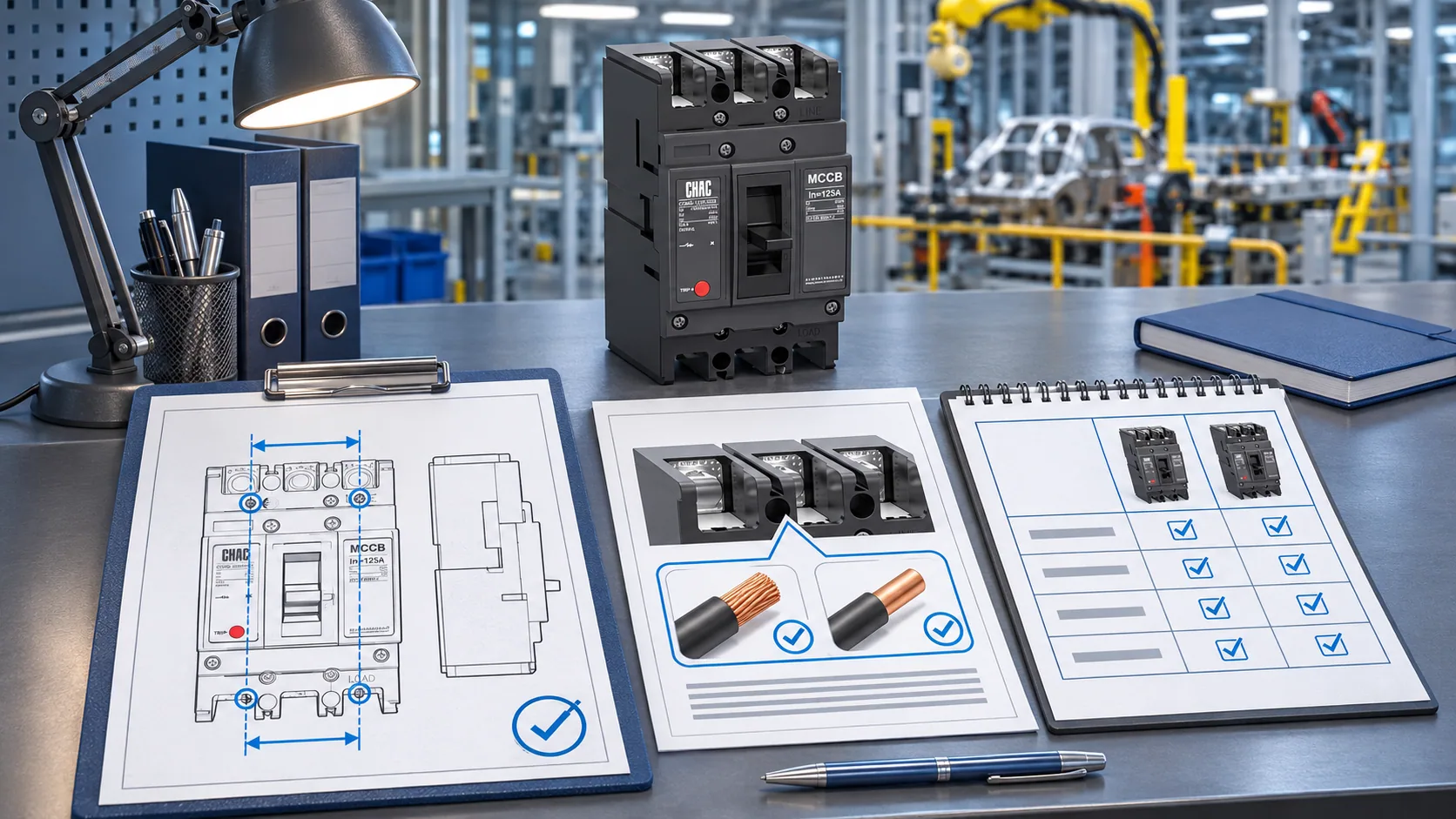
For a 100 amp 3 pole circuit breaker replacement, compare overall width, height and depth; mounting-hole locations; terminal positions; handle projection; and required clearances. Terminal conductor material, permitted conductor range, lug geometry and approved tightening information also matter. Similar external dimensions do not prove busbar alignment or cable suitability.
Accessory compatibility is another independent check. A shunt release, auxiliary contact or operating mechanism requires explicit approval for the receiving variant, including its electrical rating and mounting arrangement. CHAC’s MCCB buying guide likewise separates accessory architecture from the family name.
Finally, a mechanically fitting breaker still needs an assembly assessment. IEC 61439-1:2020 concerns low-voltage switchgear and controlgear assemblies and includes temperature-rise verification considerations. Device documentation does not replace the applicable assembly verification.
What should the buyer submit before approving either option?
Build one comparison record covering the circuit and both proposed configurations. For example, if a quotation substitutes CQM6-160 for a specified CQM6-125, hold the substitution for documentary review rather than assuming the proposed frame is larger, compatible or electrically preferable.
| Decision input | Evidence to obtain |
|---|---|
| Circuit requirements | Voltage, poles, load profile, conductor details and prospective fault current |
| Protection selection | Exact order code, trip rating, adjustment range if applicable, and time-current curves |
| Fault duty | Variant-specific Icu and Ics at the required voltage; coordination evidence where required |
| Panel interface | Dimensioned drawing, terminal specification, clearances and assembly assessment |
| Accessory package | Approved part numbers, control ratings and compatibility documentation |
| Release for purchase | Approved configuration schedule and applicable conformity evidence |
Separate unanswered questions from accepted facts in the purchase specification. Supplier consultation can establish what is offered; engineering approval must establish whether the documented configuration suits the circuit and assembly.
Frequently asked questions
Why can a 100A MCCB be offered in more than one frame size?
A product range may use different construction platforms with overlapping trip-current options. The shared 100A rating does not establish equal dimensions, fault performance or accessory architecture.
How should CQM6-125 and CQM6-160 be compared for a 100A circuit?
First confirm the CQM6-160 designation and availability. Then compare exact order codes, trip characteristics, voltage-specific breaking data and installation drawings against the same circuit specification.
Is a frame rating the same as the fitted trip-unit current rating?
No. The frame describes the platform’s declared capability; the fitted trip rating identifies the release’s current rating. Where adjustment is provided, its setting is another separate value.
Which dimensional and terminal differences matter when replacing a 100A MCCB?
Check the complete envelope, mounting centres, terminal alignment, handle position and clearances. Also verify conductor and lug compatibility; matching mounting holes alone cannot establish replacement suitability.
Should breaking capacity be checked separately from the 100A current rating?
Yes. Continuous-current and short-circuit duties are different. Obtain Icu and Ics for the exact variant at the circuit voltage and assess them against the installation’s fault-duty requirements.
Can accessories be transferred between two CQM6 frame sizes without verification?
No. Require documented compatibility for each accessory part number and receiving breaker, including control voltage, mechanical interface and operating arrangement. Family membership is insufficient.
What approved data should accompany a 100A MCCB frame-selection decision?
Retain the approved order code, ratings, protection curves, fault-duty assessment, drawings, terminal data, accessory schedule and relevant conformity evidence, together with applicable coordination and assembly approvals.
A sound 100A MCCB frame decision connects the quoted order code to verified circuit duty and panel interfaces. Use CHAC’s contact team to clarify the proposed designation and request variant-level documents before releasing either configuration for purchase.