An online listing can show the right brand, an apparently matching frame and convincing packaging while leaving the actual supply route unexplained. For panel builders, distributors and maintenance buyers, that uncertainty should be resolved before stock reaches assembly—not after an installation deadline makes substitution difficult.
To reduce the risk of buying counterfeit circuit breakers, verify the seller through an independently established brand contact, obtain exact variant documentation, and preserve the connection between the quotation, delivered labels and invoice. Authenticity and application suitability are separate checks: a genuine breaker can still be unsuitable for the intended panel or electrical duty. A lower price alone cannot distinguish fake circuit breakers from genuine surplus stock; provenance is the stronger test.
What separates a counterfeit breaker from a legitimate alternative?
A counterfeit misrepresents its identity or origin, such as by using another brand’s identity without authorization. A genuine alternative-brand product identifies its actual brand and supplier honestly. It still needs a separate technical review; being legitimate does not make it interchangeable with the specified breaker.
| Purchase situation | What it establishes | What remains to check |
|---|---|---|
| Verified genuine specified variant | Identity supported by a verified supply route | Condition, configuration and project suitability |
| Genuine alternative brand | A different, honestly identified product | Panel acceptance and complete electrical specification |
| Suspected counterfeit | Unresolved identity or origin | Brand verification before release |
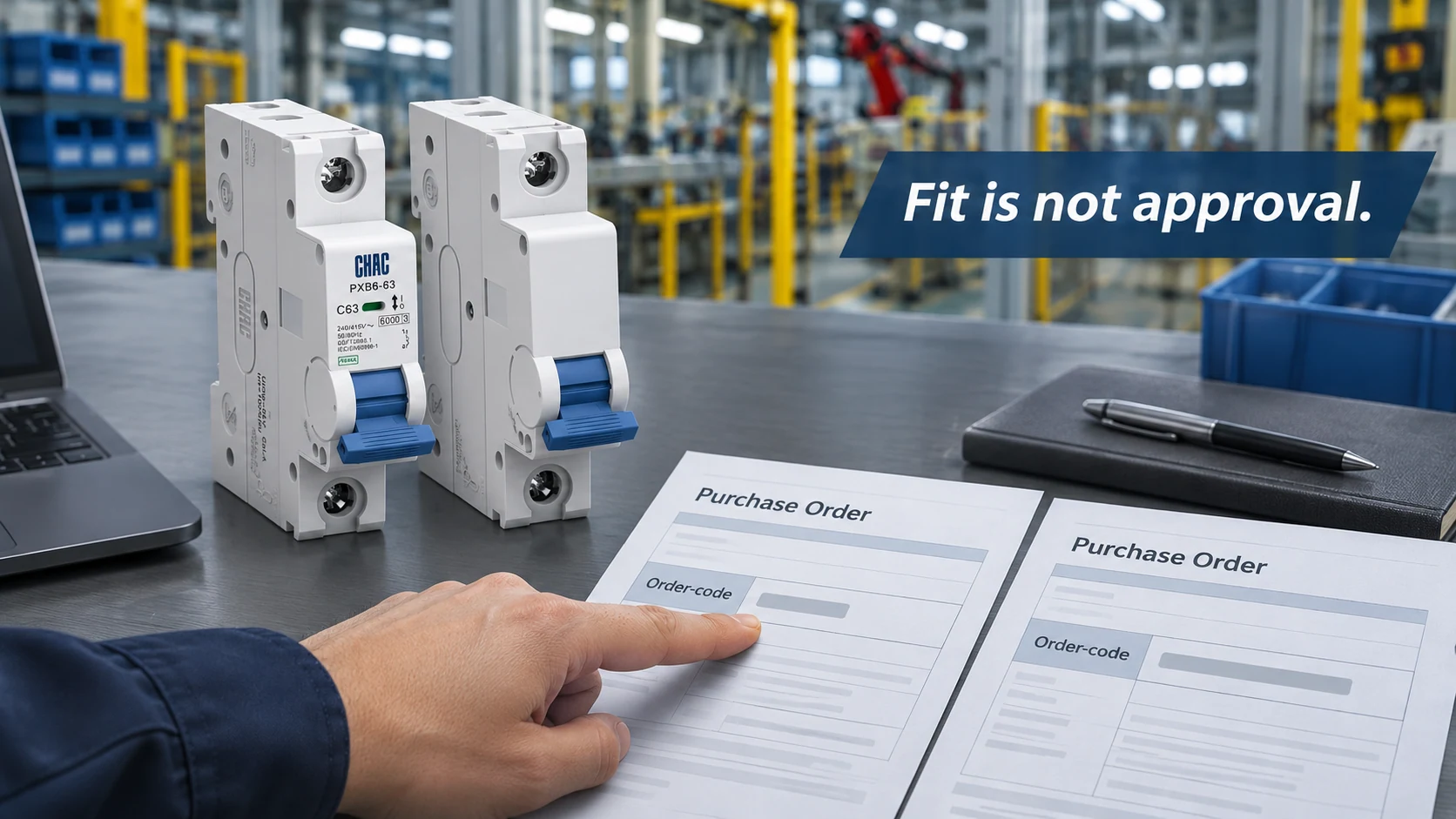
Physical fit proves little about protection performance or origin. Similar dimensions do not establish breaking capacity at the required voltage, trip characteristics, terminal suitability or acceptance in a particular assembly. CHAC’s MCCB buying guide distinguishes a matching frame designation from the complete approved configuration.
The guide also discusses IEC 60947-2 ratings. That standard designation concerns circuit-breaker requirements; seeing it in a listing does not establish certification of the delivered unit, authenticity or acceptance in every destination market. Request evidence tied to the exact variant rather than extending a family-level claim.
How can buyers verify an online seller and its product evidence?
Begin supplier verification before issuing the purchase order. Establish the seller’s legal identity and confirm which entity will invoice and dispatch the goods. If authorization is claimed, ask the brand through an independently established contact whether that entity is authorized for the relevant product and territory. A seller-provided letter is a claim to verify, not the final verification.
Ask for the complete order code, suffixes, configuration and supporting technical documents. Request photographs of the offered stock and its labels, not only catalog images. Compare the quoted identity with the documents and invoice description. A photograph can expose discrepancies, but cannot authenticate the stock ultimately delivered.
Certification marks on counterfeit electrical products may be copied. Where certification is claimed, request the certificate or listing identifier and check it through the identified issuing organization’s official verification channel. Confirm that its scope covers the relevant product variant and claimed standard. This establishes a documented claim’s scope; it does not independently prove that a particular delivered item is genuine.
For unfamiliar product categories, CHAC’s low-voltage product overview distinguishes MCBs, RCCBs, RCBOs, MCCBs and other devices. Category identification is a starting point for a specification discussion, not evidence that one device can replace another.
What evidence should control purchase approval and receiving release?
Make documentation requirements part of the purchase specification. Retain records that connect the approved variant to the received goods, and keep unresolved stock separate from released inventory.
| Decision | Required input | Buyer check |
|---|---|---|
| Approve supply route | Seller identity and brand confirmation where authorization is claimed | Match the confirmed entity to the invoice |
| Approve configuration | Full order code, ratings and variant documents | Review against panel and protection requirements |
| Release received stock | Device labels, packaging, batch identifiers and delivery record | Reconcile with the approved order |
| Resolve a discrepancy | Photographs and written supplier or brand findings | Keep stock on hold until resolved |
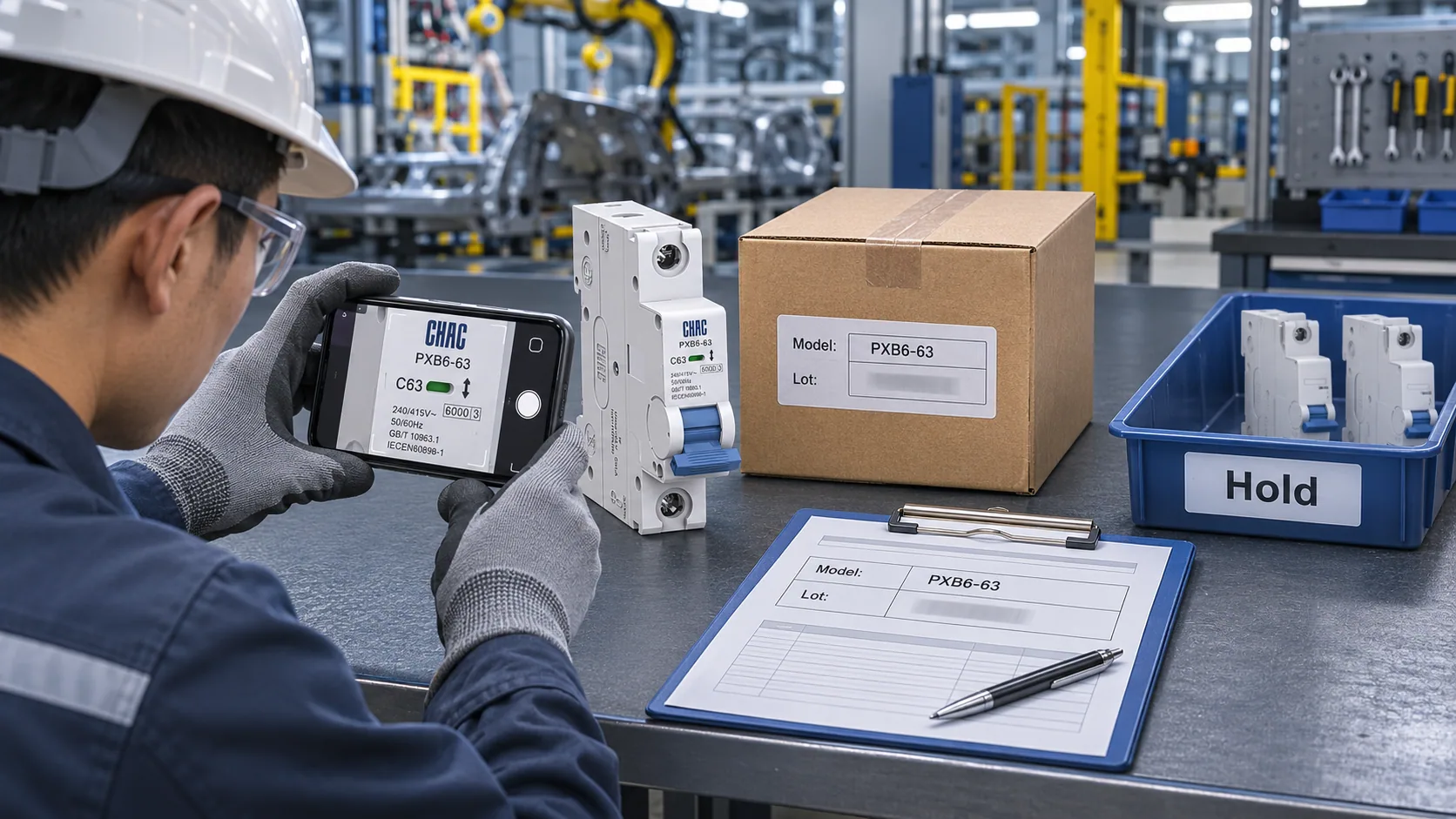
Record model and suffix, declared ratings, batch or lot code, serial number where present, invoice number, seller, delivery reference and receipt date. Preserve photographs showing the markings alongside the corresponding packaging. Not every product has a unique serial number; record what exists without treating its absence alone as proof of counterfeiting.
Inconsistent labels or packaging are warning signs, not a diagnosis. Preserve the goods and records, seek written clarification and do not install suspect stock or use energization as an authenticity test.
Frequently asked questions
How does a counterfeit circuit breaker differ from a genuine alternative-brand product?
A counterfeit falsely represents identity or origin. A genuine alternative openly identifies its own brand, but still requires technical approval for the intended application.
Why is physical fit insufficient proof of breaker compatibility or authenticity?
Dimensions cannot verify origin, fault-interruption performance, trip behavior or panel acceptance. These require exact-variant evidence and an application review.
How can an authorized supply route be verified before an online purchase?
Independently contact the brand and confirm the seller’s legal entity, relevant product scope and territory. Match that confirmation to the entity issuing the invoice.
Which model and batch and invoice details should be retained for traceability?
Keep the full order code and suffixes, ratings, lot or batch identifiers, serial number if present, invoice and delivery references, seller identity and receipt date.
Can a certification logo or product photo alone prove a breaker is genuine?
No. Both can be copied. Check any certification claim’s identifier and scope with its issuer, while separately verifying the supply route and delivered identity.
What should a buyer do when labels or packaging appear inconsistent?
Hold the stock, photograph the discrepancies and retain packaging and purchase records. Request written clarification from the supplier and brand before deciding whether to release or return it.
Should a suspected counterfeit breaker be installed while its identity is being checked?
No. Keep it outside released installation stock. Arrange qualified review and obtain a verified, application-suitable replacement if the project cannot wait.
Online breaker purchasing needs two documented approvals: confidence in identity and confidence in application suitability. For CHAC sourcing enquiries, use the published CHAC contact channel to discuss exact product codes and documentation requirements; consultation does not itself establish a variant’s certification or panel compatibility.