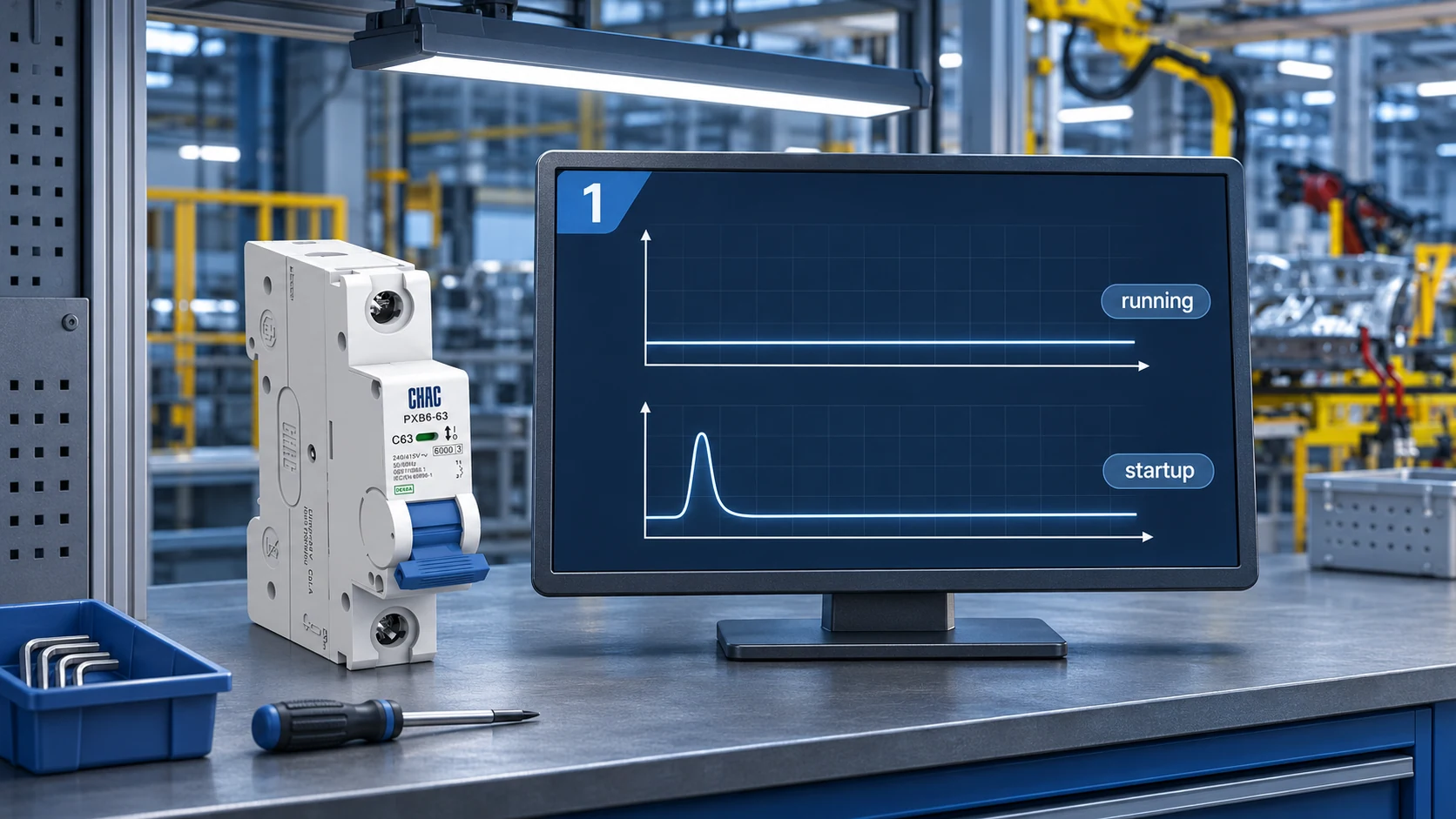
A lighting schedule can show modest running current while leaving the panel buyer without the information needed to assess startup tripping. For a commercial lighting circuit, the missing detail is often the LED drivers’ short charging pulse—especially when a control system energizes a whole group together.
LED inrush current should be evaluated as a current-versus-time waveform, not just a peak or a wattage total. PXB6-63 can be shortlisted using its published options, but selecting an ordered variant requires driver startup data, device-specific impulse-response evidence and a circuit protection review.
Why does LED startup need a different comparison from running load?
Input capacitors in LED drivers can draw a brief charging current at energization. That transient differs from sustained overload: low running current does not establish startup compatibility with an MCB. Equally, startup tripping should not automatically be dismissed as harmless inrush; a competent assessment must distinguish load behavior from faults.
| Comparison | Running load | Startup transient |
|---|---|---|
| Useful evidence | Declared input current and operating conditions | Peak, pulse duration and waveform |
| Protection question | Are conductor loading and thermal protection coordinated? | Will acceptable startup avoid unwanted operation? |
| Grouping effect | Combined operating demand | Overlap between driver charging pulses |
Request LED driver inrush current data at stated supply voltage and startup conditions, including cold start and restart behavior where relevant. Ask how pulse duration is defined and whether a supplier’s maximum-driver count refers to an identified breaker. A count without those conditions is not a transferable circuit limit.
What does PXB6-63 product data establish—and what remains unproven?
The CHAC PXB6-63 product page publishes a 6A–63A range, B/C/D options, 1P/2P/3P/4P configurations and 6kA Icu = Ics. These are shortlist inputs, not evidence that a particular variant will tolerate a particular lighting bank. The listed 500V value is rated insulation voltage, Ui; it must not be substituted for a confirmed operational-voltage rating.
Compare the complete startup waveform with the exact device’s available time-current and short-pulse response information, including tolerances and stated conditions. A peak-only comparison with a curve letter can miss pulse-duration effects. Where published curves do not resolve the short pulse, request supporting compatibility evidence rather than assuming immunity.
The CHAC trip-curve selection guide explains why greater startup tolerance must be balanced against fault clearing. Neither a different curve nor a higher current rating is an automatic solution. Confirm ordered-variant documentation and certification scope; a referenced standard alone does not certify the selected unit.
Which project inputs should accompany an LED circuit breaker enquiry?
Send a circuit-specific evidence pack rather than asking only which LED circuit breaker suits the total lighting wattage.
| Decision input | Buyer check |
|---|---|
| Driver startup evidence | Waveform, duration definition, supply conditions and restart behavior |
| Lighting control groups | Driver quantities and which groups energize together |
| Circuit and supply | Cable details, impedance, fault levels and conductor loading |
| Ordered breaker | Current, curve, poles, operational voltage and response evidence |
| Protection review | Fault-clearing performance, breaking capacity and coordination |
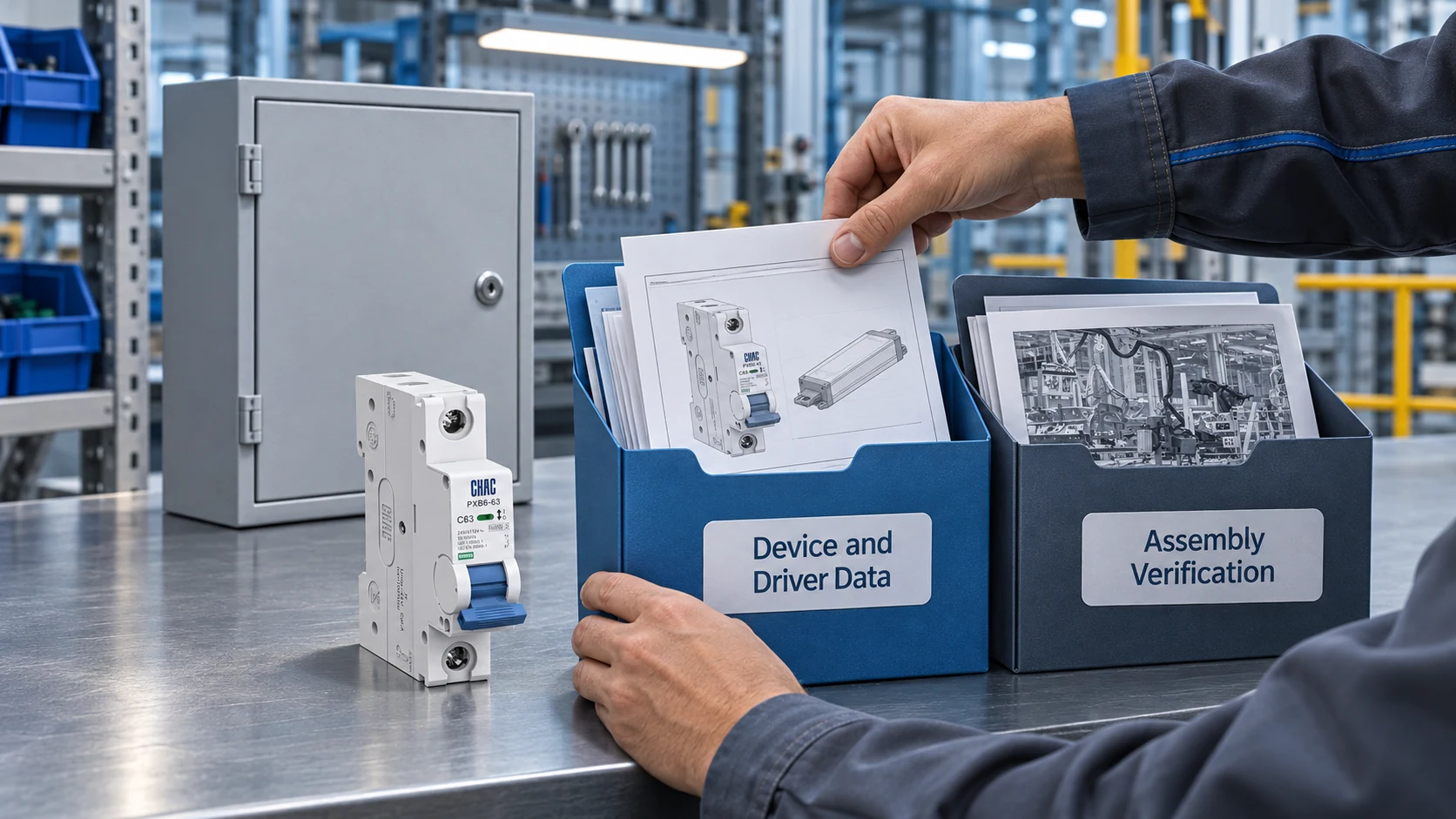
Cable and network impedance affect both startup current and available fault current. An upstream driver waveform therefore needs its supply conditions identified before it represents the installed circuit. Panel integration also remains a separate responsibility: IEC 61439-1:2020 addresses low-voltage assembly requirements, including temperature-rise verification. That assembly-standard scope does not establish PXB6-63 lighting compatibility or certify a particular panel.
Frequently asked questions
Why can LED lights trip an MCB when their running current is low?
Driver input capacitors can demand a short charging pulse much larger than operating current. LED lights tripping breaker protection at startup therefore requires a transient assessment, while genuine faults must still be ruled out.
Which inrush peak and pulse-duration data should be requested from an LED driver supplier?
Request peak current, the waveform and duration definition, supply voltage, source impedance or test conditions, and cold-start and restart behavior. Ask whether values are typical or declared limits.
How does switching several LED drivers together affect nuisance-tripping risk?
Their pulses can overlap, increasing the combined transient. The total is not necessarily a simple multiple of one driver's peak because supply impedance and pulse timing influence the result. Use group-specific evidence.
How should an MCB's impulse response be compared with the driver startup waveform?
Compare current and duration against exact-device response information and tolerances under matching conditions. Do not infer short-pulse immunity from the magnetic operating band alone; seek clarification where the published data are insufficient.
Why do cable length and network impedance matter in an LED lighting circuit?
They influence the current available during charging and during a fault. Impedance that limits startup current can also reduce fault current, so it cannot be treated solely as a nuisance-tripping benefit.
Can changing to a different trip curve require a new fault-protection check?
Yes. A different instantaneous response can change fault-clearing performance. Reassess available fault current, required disconnection performance, conductor protection and coordination before accepting the change.
When should staged switching or an inrush limiter be considered instead of increasing the breaker rating?
Consider them when grouped startup is the identified problem and increasing the rating would compromise conductor protection or coordination. Confirm control requirements and any limiter's load compatibility, thermal behavior and restart limitations through documented design review.
A defensible PXB6-63 enquiry pairs lighting startup evidence with conductor and fault-protection information. Use CHAC project consultation to request ordered-variant documentation and clarify unresolved response data; consultation supports selection but does not itself establish circuit suitability.