A generator-backed distribution board can expose a protection gap: a breaker selected for load current and utility fault duty may respond differently when the generator supplies the same circuit. Buyers need to establish whether the available fault current will operate the protection before conductor or equipment limits are exceeded.
The direct answer is: CQM6 cannot be confirmed suitable for low generator fault current from its ampere rating or breaking capacity alone. Assess the exact variant’s time-current characteristics against the generator’s fault-current decrement, excitation response and circuit impedance. A generator circuit breaker needs both sufficient interrupting capability and a verified response to the minimum credible fault. For generator breaker sizing, ask for the fault-current data for generator operation as well as the normal load current.
Why does low generator fault current change the breaker assessment?
A synchronous generator’s initial short-circuit contribution can decay as its electromagnetic response changes. Excitation support then influences the current available during the protection operating interval. Cable impedance and fault location can further reduce current at a downstream breaker.
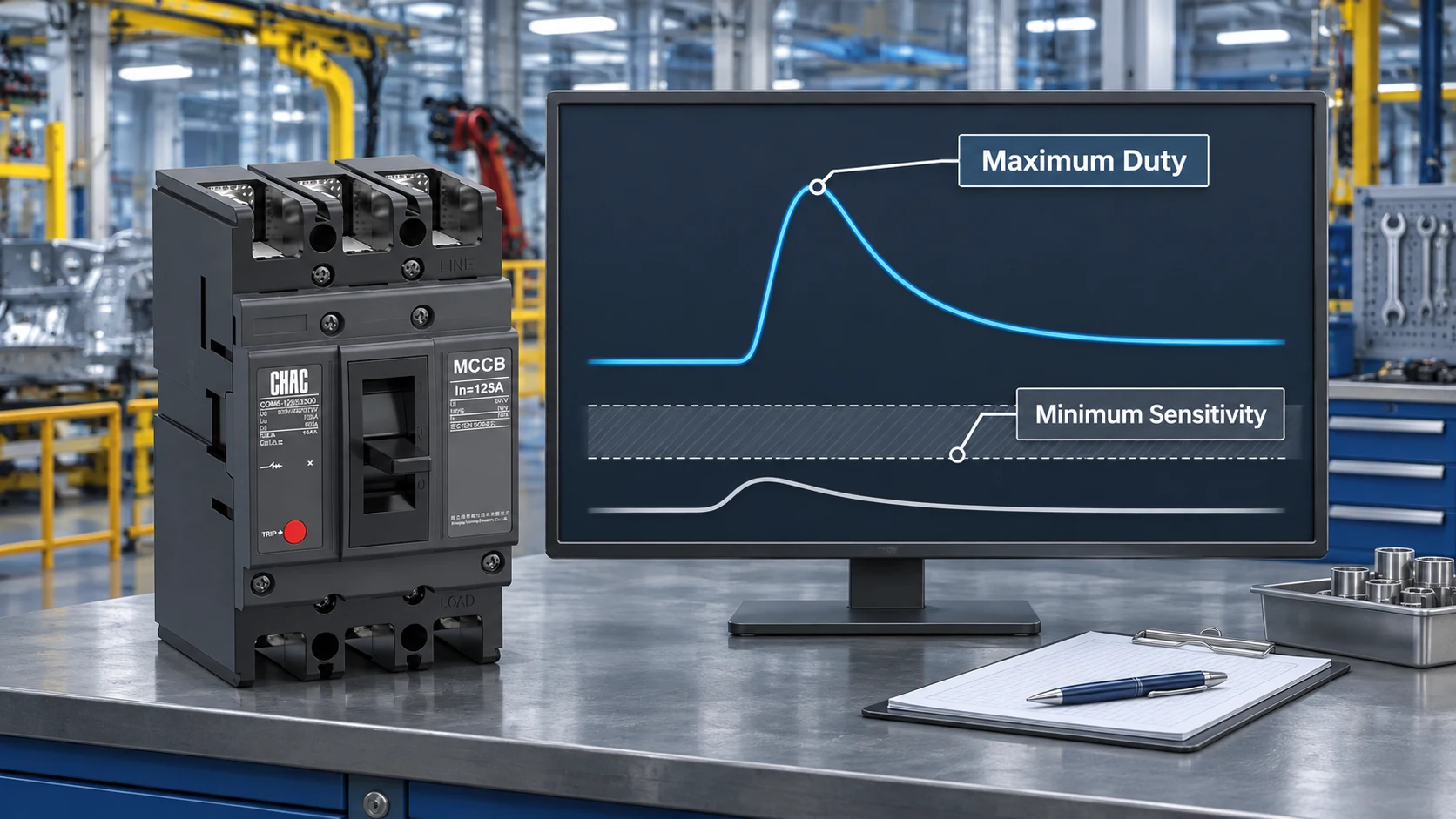
Consequently, maximum fault duty and minimum fault sensitivity are separate checks. A high breaking-capacity figure does not establish that a magnetic release will pick up on a remote generator-fed fault.
| Selection question | Relevant evidence | What it does not establish |
|---|---|---|
| Can the breaker interrupt the available fault? | Exact voltage-specific Icu and Ics data, compared with prospective fault duty | Operation at low fault current |
| Will protection operate soon enough? | Trip tolerance bands and generator current over time at the fault location | Adequate breaking capacity |
| Will normal demand be carried? | Load profile, starting demand and installation conditions | Fault clearance or selectivity |
The CHAC CQM6 product page publishes overload and short-circuit protection across a 16–1600A range, with frame-dependent configurations. These are shortlist data, not proof of generator protection for a particular order. Obtain the exact frame, release and voltage-specific documentation.
Which generator and trip-curve evidence must be compared?
Request generator-manufacturer decrement data covering the relevant fault types, initial loading and excitation arrangement. Establish whether curves represent generator terminals or include circuit impedance, and obtain the sustained contribution and any excitation limiting or shutdown behavior. A single initial fault-current value cannot describe the full clearing interval.
For CQM6, request the proposed variant’s time-current curve, tolerance bands, magnetic pickup characteristics and applicable thermal conditions. Do not assume that adjustability or a protection feature is available without variant-level confirmation. Compare the changing fault current with the release response; a decaying current should not simply be treated as constant throughout a static curve reading.
Excitation matters because supported field current may maintain fault contribution, while voltage-dependent excitation or limiting can reduce it. Neither arrangement guarantees downstream breaker operation. The review must connect generator behavior, circuit impedance, breaker response and conductor withstand.
IEC 60909-0:2016 describes calculation of balanced and unbalanced short-circuit currents in three-phase AC systems. Its calculation scope does not establish a particular generator-breaker pairing. Likewise, IEC 60947-2:2024 addresses circuit-breakers within its stated scope; citing it is not evidence that an ordered CQM6 variant is certified or suitable for this duty.
What should buyers submit before specifying CQM6?
Use a documented protection review rather than a generator full-load-current match. Check both utility and generator operation: the former may govern maximum interrupting duty, while the latter may expose insufficient pickup or slower clearance. Neither outcome should be assumed without calculation.
| Required input | Decision it supports |
|---|---|
| Source arrangements, earthing and permitted operating modes | Relevant fault paths and protection responsibilities |
| Generator decrement curves and excitation limits | Available fault current throughout the clearing interval |
| Cable lengths, impedances and withstand data | Remote-fault sensitivity and permissible clearing time |
| Exact upstream and downstream breaker curves | Coordination in each supply mode |
| Load profile and starting demand | Normal-operation tolerance without weakening fault protection |
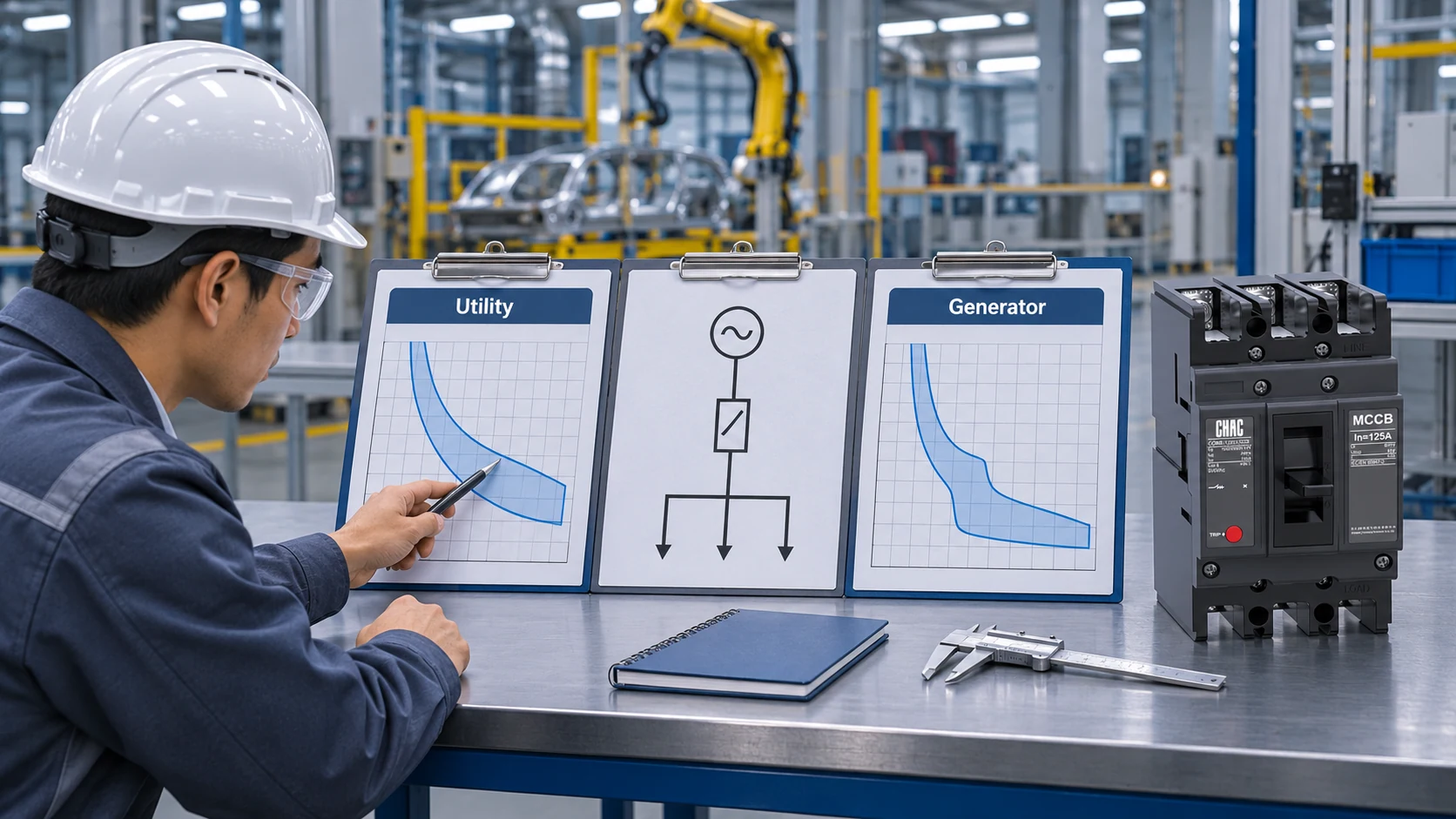
For example, a downstream device may coordinate acceptably on utility power yet fail to reach its instantaneous operating region on generator power. The review must then establish whether its remaining response protects the circuit and whether the upstream device intervenes first. Curve separation alone may not establish selectivity where manufacturer coordination data are required.
Use the CHAC MCCB range to frame a consultation about protection functions and available documentation, not as evidence that an alternative release solves the duty.
Frequently asked questions
What is the role of a low-voltage generator's main circuit breaker?
It provides the overcurrent protection specified by its release and interrupts faults within its verified ratings. It does not automatically provide every generator protection function, such as voltage or frequency supervision.
Why can a generator deliver less sustained fault current than a utility supply?
Generator contribution changes as its electromagnetic response decays and excitation controls act. The sustained current can therefore be much lower than the initial contribution; utility behavior also depends on network impedance.
Which generator fault-current decrement data are needed to assess CQM6?
Obtain current-versus-time data for relevant fault types, operating conditions and excitation arrangements, including sustained contribution, limiting behavior and the impedance basis. Compare these with the exact proposed CQM6 trip characteristics.
How can the excitation system influence downstream breaker operation during a fault?
Excitation support can maintain fault current, whereas reduced field support or excitation limiting can lower it before a downstream release operates. Assess the documented response rather than inferring performance from the excitation-system label.
How should breaker coordination be checked in both utility and generator modes?
Evaluate each permitted source configuration using its fault levels, device tolerances and upstream/downstream characteristics. Check clearing time and conductor protection alongside selectivity, using applicable manufacturer coordination data.
Does sizing a generator breaker from full-load current alone prove fault protection?
No. Full-load current informs continuous-current selection, but does not establish minimum-fault pickup, clearing time, breaking capacity, starting tolerance or coordination.
What should be investigated before resetting a generator breaker that repeatedly trips?
Qualified personnel should investigate trip indications, fault and overload evidence, starting demand, conductor condition, connections, ambient conditions and generator controls. Repeated resetting or increasing ratings can conceal an unresolved hazard.
Low-current fault clearance is a system finding, not a CQM6 family-level claim. Submit the proposed variant, generator decrement data, circuit details and coordination requirements through CHAC’s technical consultation contact to identify documentation needs before project-specific engineering approval.