A circuit breaker quotation may include a substance declaration that names a product family but not the ordered variant. Before approving that document, match it to the breaker configuration, supplied accessories and revision in your purchasing specification.
RoHS vs REACH is not a choice between equivalent certificates. RoHS restricts specified substances in electrical and electronic equipment within its scope; REACH addresses chemicals through broader requirements, including restrictions and substance communication. Buyers should assess each separately and request evidence tied to the actual supply.
What does RoHS vs REACH mean for circuit breaker procurement?
The European Commission’s RoHS overview explains restrictions on hazardous substances in electrical and electronic equipment. Its REACH overview describes the broader chemicals framework. These sources explain regulatory scope; neither certifies a particular CHAC product.
| Buyer check | RoHS | REACH |
|---|---|---|
| Main concern | Restricted substances in equipment within scope | Applicable chemical restrictions and communication duties |
| Assessment focus | Individual homogeneous materials | Relevant substances, mixtures and articles under the applicable requirement |
| Useful submission | Model-linked declaration, supporting evidence and exemption details | Scoped substance information, including dated SVHC assessment |
| Common gap | A whole-product result masking a material concern | An SVHC statement presented as proof of every REACH obligation |
A REACH SVHC declaration addresses substances of very high concern against an identified Candidate List. It is not interchangeable with a RoHS declaration or, by itself, a complete REACH assessment. For both, establish applicability to the product and transaction rather than accepting a logo or an unexplained “compliant” label.
Why must material evidence match the supplied breaker configuration?
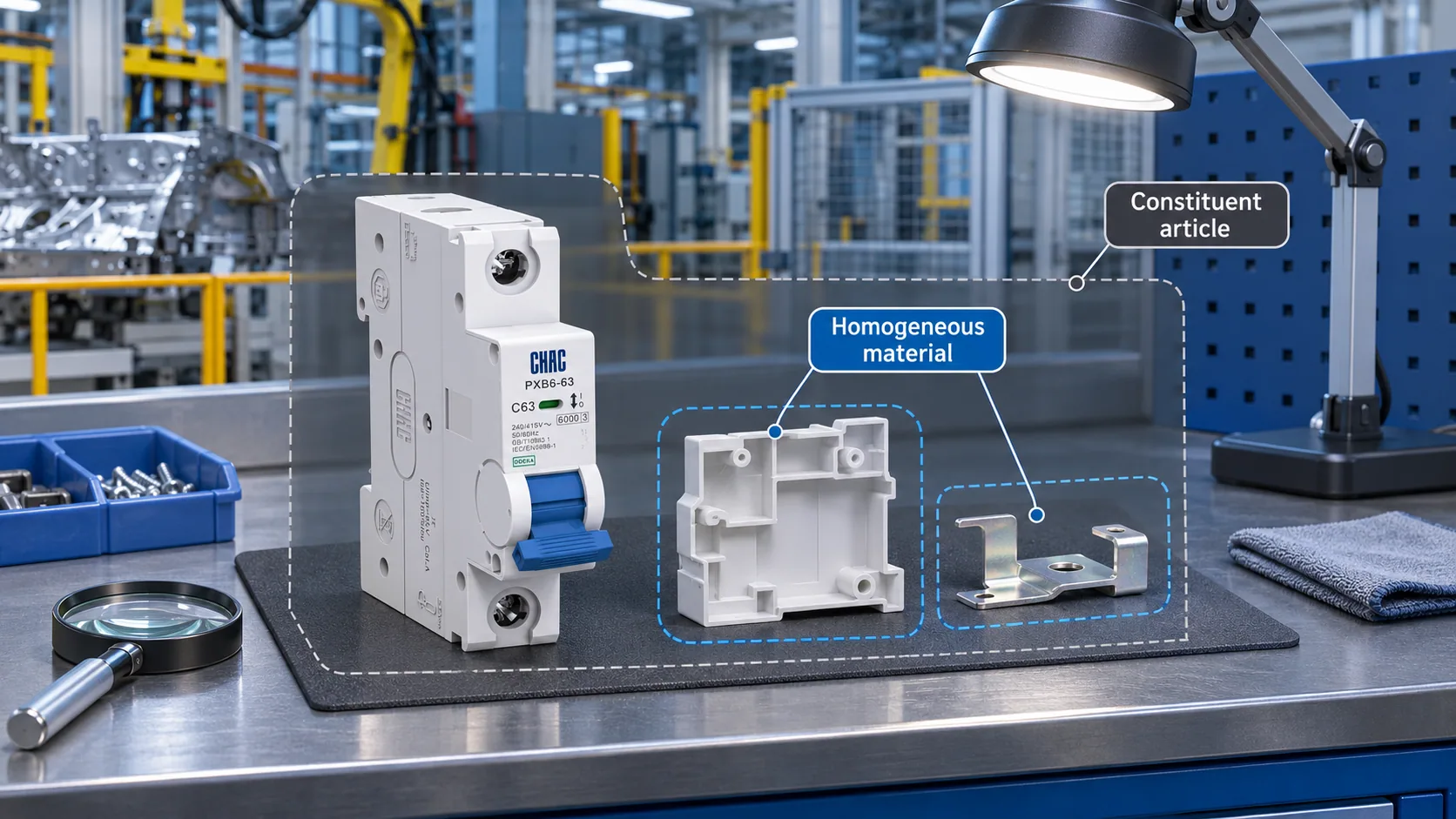
A breaker can combine molded insulation, metal parts, coatings and electronic assemblies. For RoHS, a homogeneous material is assessed separately rather than averaging restricted-substance content across the complete breaker. For REACH article communication, constituent articles can remain relevant within a complex product; whole-breaker dilution is not an appropriate substitute for identifying the relevant article.
For example, a plated component and a molded housing call for different material evidence. A report on housing resin does not establish the status of plating, solder or an accessory. This is an evidence-mapping principle, not a claim about substances present in any named breaker.
Request an explicit link between the declaration and the ordered model, suffixes, relevant revision and supplied options. A family declaration can be useful if its coverage and exclusions are explained. The CHAC MCCB buying guide similarly emphasizes approving the complete configuration rather than relying on a family name; electrical configuration approval and substance assessment nevertheless remain separate checks.
Supporting evidence may combine controlled material declarations, supplier records and targeted laboratory reports. Check what each document actually covers. A report title alone does not establish coverage of every material, production revision or supplied accessory.
Which inputs should buyers resolve before accepting substance declarations?
Build a document register against the purchase specification. A recent signature is useful only when the underlying assessment is identifiable. For RoHS compliance, record any exemption relied upon; for REACH, distinguish Candidate List communication from other applicable restrictions.
| Input to request | Decision it supports |
|---|---|
| Ordered model, revision and option list | Whether the documents cover the delivered configuration |
| Declaration issue date and Candidate List reference | Whether SVHC coverage matches the review baseline |
| Material or article coverage and exclusions | Whether evidence gaps need clarification |
| RoHS exemption entry, application and validity basis | Whether reliance is relevant to this product |
| Change-notification arrangements | When reassessment and replacement documents are needed |
An exemption needs more than an entry number: request the affected material or component, the covered application and evidence supporting its use. Resolve unclear applicability with qualified compliance support. Keep substance acceptance separate from electrical ratings, installation suitability and destination-market certification.

Frequently asked questions
How do RoHS and REACH differ for electrical products sold in the EU?
RoHS focuses on restricted substances in electrical and electronic equipment within scope. REACH has a broader chemicals remit, with requirements that depend on substances, articles and the supply-chain role. Buyers need separate applicability checks.
Does a RoHS declaration automatically establish REACH compliance?
No. It does not establish Candidate List coverage or satisfaction of applicable REACH restrictions. Request a separately scoped REACH statement and clarify whether it addresses SVHC communication, restrictions or both.
Why do homogeneous-material and article-level assessments need to be distinguished?
They use different assessment units. RoHS examines individual homogeneous materials, while REACH article communication can require attention to constituent articles within an assembly. Averaging everything over the complete breaker can obscure relevant substance information.
Which product models and revisions should a supplier's substance declaration identify?
It should identify the purchased model and relevant suffixes, design or material revision, and supplied options. If several variants share a declaration, request an explicit coverage list and the basis for treating their material compositions together.
How should the date and scope of an SVHC declaration be checked?
Compare its issue date with the Candidate List version actually assessed. Confirm covered articles, models and exclusions. A newly signed document may still rely on an older assessment, so ask how subsequent list additions were reviewed.
What evidence is needed when a supplier relies on a RoHS exemption?
Request the exemption entry, affected substance and material, covered application, supporting technical rationale and applicable validity information. The supplier should explain why that exemption covers the supplied configuration rather than merely listing exemptions used elsewhere.
When should buyers request updated compliance evidence after a material or regulatory change?
Request review when composition, plating, resin, electronics, supplied options or relevant upstream sourcing changes, or when a regulatory update affects the assessment. Establish change notification in purchasing controls and seek refreshed evidence before accepting affected supply.
For a circuit breaker RFQ, send the configuration list alongside your substance-document requirements. Use CHAC’s contact channel to discuss model-specific documentation and unresolved coverage questions; consultation is not itself evidence that a variant satisfies RoHS or REACH requirements.