A switchboard enquiry that specifies only “four poles” leaves important questions unanswered: does the neutral need disconnection, does it need protection, and what contact sequence is required? Those distinctions matter when purchasing breakers for three-phase loads, generator supplies or UPS distribution.
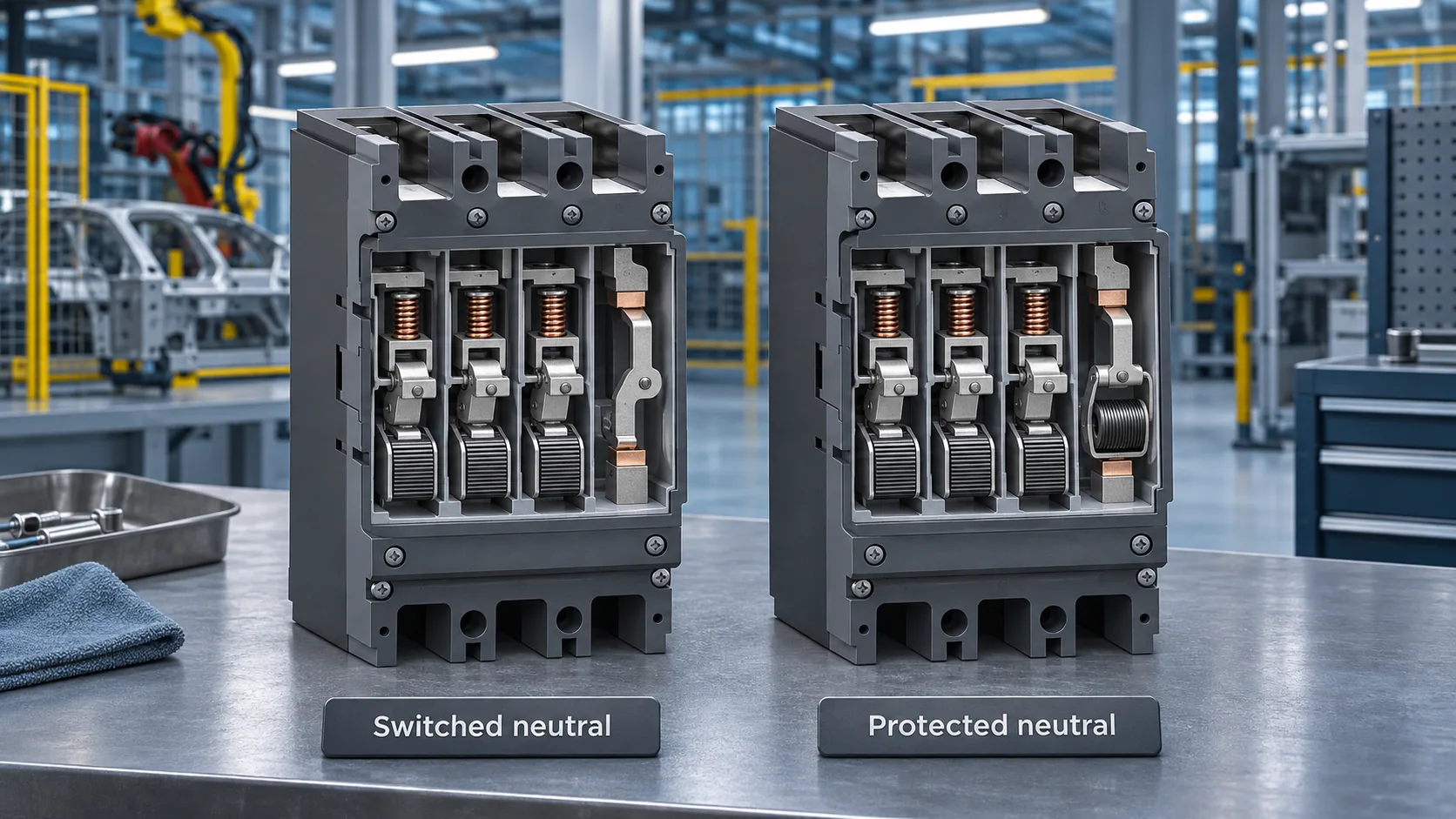
A 4 pole circuit breaker generally switches three phase conductors and a neutral. Whether the neutral must switch depends on the earthing arrangement, source configuration and applicable installation requirements—not simply the presence of a neutral conductor. Neutral switching, neutral overcurrent protection and isolation suitability require separate confirmation for the selected variant.
What does a fourth pole actually provide?
Pole count describes current paths, but does not establish which paths have overcurrent protection. Treat “4P” and “3P+N” as starting points for a specification, not complete functional descriptions.
| Arrangement | Typical distinction | Buyer check |
|---|---|---|
| Three phase poles | Neutral is outside the breaker’s switched paths. | Is an unswitched neutral consistent with the design? |
| 3P+N | Usually three protected phases plus a switched neutral. | Confirm neutral protection status, rating and sequence. |
| Four protected poles | Protection functions include the neutral path. | Confirm sensing, settings and common opening behaviour. |
A switched neutral circuit breaker does not automatically provide residual-current protection. Nor does a fourth pole prove suitability for isolation. Review those functions independently.
The CHAC MCB range identifies pole options as series-dependent; the CHAC MCCB range likewise calls for checking protection functions, voltage and frame. These are useful consultation routes, not evidence that every listed series offers the required neutral arrangement.
For example, the published ratings on the CQM7 product page are expressly for three-pole models. Those ratings must not be transferred to a presumed four-pole variant without supporting variant documentation.
When does the supply design require neutral disconnection?
The designer must establish which live conductors require disconnection for the intended function. Earthing arrangements, isolation boundaries and connections between sources determine whether leaving the neutral connected is acceptable. A protective conductor must not be treated as an ordinary switched neutral; a combined protective and neutral conductor requires particular care in the design review.
Generator and UPS systems need more than a pole-count check. Establish where neutral-to-earth connections exist, whether a common neutral is intentional, and how normal, alternative and bypass supplies interact. Switching a neutral cannot by itself resolve an incorrect bonding arrangement.
Contact sequence also matters. An unintended open neutral while phases remain connected can disturb phase-to-neutral voltages on unbalanced loads. Where the design requires neutral first-make/last-break behaviour, obtain explicit evidence for that behaviour. Do not assume mechanically linked poles guarantee it.
Assembly obligations remain separate from breaker selection. IEC 61439-1:2020 addresses low-voltage switchgear and controlgear assemblies and explains that incorporation of UPS equipment is subject to the IEC 61439 series. Its published scope is not certification of a particular breaker or proof of a neutral-switching sequence.
What information should accompany a four-pole breaker enquiry?
A useful enquiry converts the system design into verifiable device requirements. Request documentation for the exact ordering code before accepting a substitute described only as a 4p circuit breaker.
| Design input | Evidence to request |
|---|---|
| Earthing and source arrangement | Designer’s neutral-disconnection requirement and source schematic. |
| Neutral function | Variant declaration of switching, protection and neutral rating. |
| Required contact sequence | Manufacturer’s sequence statement for the ordered configuration. |
| Circuit and assembly constraints | Applicable voltage, breaking capacity, dimensions and terminal data. |
A search for a 4 pole circuit breaker wiring diagram should lead to the manufacturer’s variant-specific drawing—not a generic connection sketch. Check the designated neutral terminal, phase identification, terminal numbering and any supply/load orientation restrictions. The drawing should agree with the device markings and ordering documentation.
Also confirm conductor compatibility, enclosure space and any requested accessories against that same variant. If the supplier cannot document neutral functionality or sequence, keep those points unresolved rather than inferring them from a product photograph or family name.

Frequently asked questions
What does the fourth pole switch in a three-phase circuit breaker?
It generally switches the neutral alongside the three phases. Whether that neutral pole also has overcurrent protection depends on the exact device configuration.
When does a system design require the neutral to be disconnected?
When the applicable installation requirements and the designed isolation or source-separation function require it. A neutral conductor’s presence alone does not establish that requirement.
How does a 3P+N arrangement differ from four protected poles?
A 3P+N arrangement commonly protects the phases and switches an unprotected neutral. Four protected poles include neutral protection; verify its sensing, settings and opening behaviour.
Why must the earthing arrangement be checked before selecting neutral switching?
It establishes the neutral’s relationship to protective earth and the source. Interrupting a combined protective and neutral conductor is not equivalent to switching a separate neutral.
What neutral-switching requirements should be reviewed for generator or UPS supplies?
Review source bonding, shared-neutral intentions, transfer operation, bypass paths and required separation. Confirm how neutral continuity and protection are maintained in each intended operating mode.
Which terminal markings and wiring diagram should be checked on a 4-pole breaker?
Check the neutral designation, phase identification, terminal numbering and permitted supply/load orientation against the exact variant’s manufacturer drawing, not a generic four-pole illustration.
How should the required neutral contact sequence be confirmed for the chosen device?
Obtain a documented manufacturer statement tied to the ordering code. If first-make/last-break behaviour is required, demand explicit confirmation; pole count and handle linkage are insufficient evidence.
Specify the neutral’s required function before selecting the breaker: switching, protection and contact sequence are distinct requirements. Send the source arrangement, circuit ratings and required documentation to CHAC for configuration review, keeping suitability subject to variant-level evidence and the assembly design.