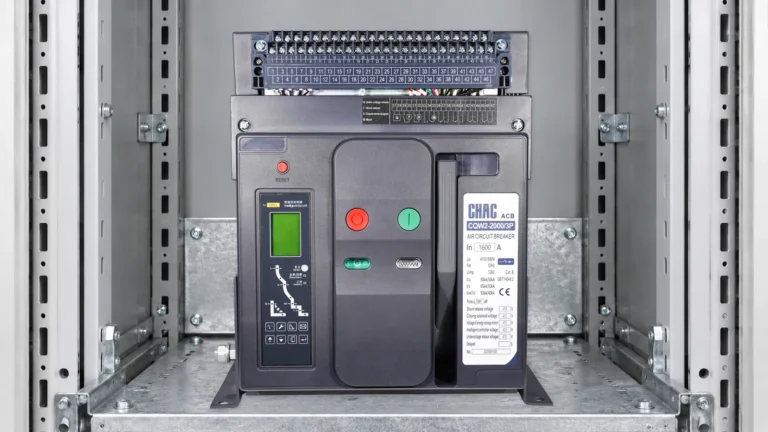
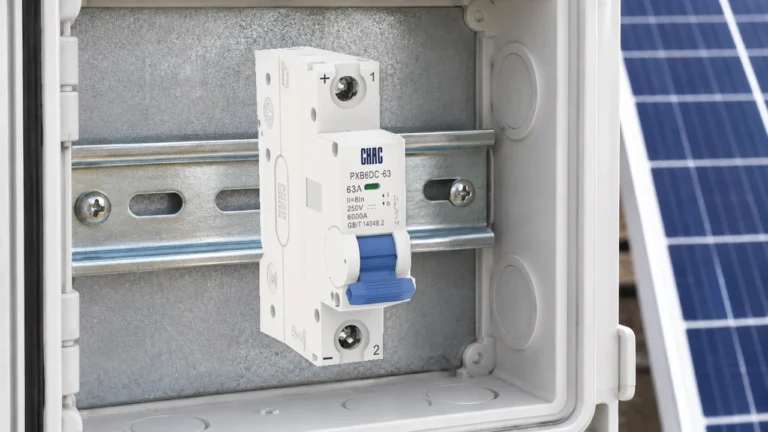
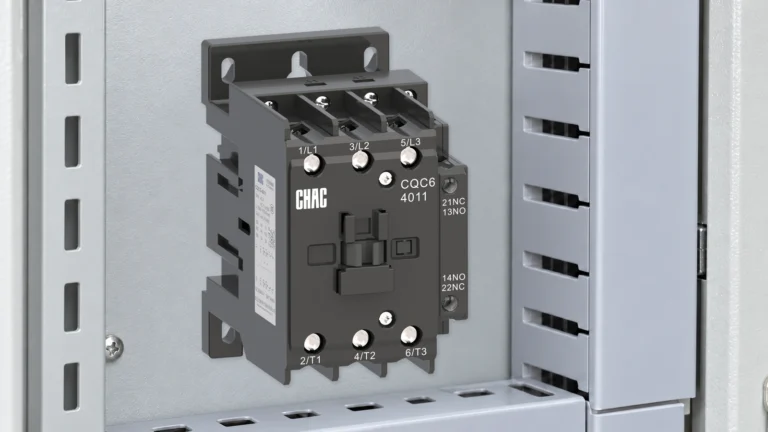
A breaker comparison can go wrong before the buyer reaches the catalogue: a current rating is treated as proof that the device can interrupt the available fault current, or an MCCB frame size is mistaken for its overload setting. Those are different checks. A breaker can fit the load yet fail the fault-duty requirement; it can also interrupt a fault without providing the selective operation a distribution system needs. Engineers, contractors and panel builders therefore need more than a residential-versus-industrial rule. This guide compares MCB and MCCB protection, explains the ratings that must be read together, and sets out the evidence needed before approving a device or replacement.
The short answer is that MCCB vs MCB selection depends on the circuit, not a universal 125 A dividing line. MCBs commonly serve compact branch circuits with fixed trip characteristics; MCCBs commonly serve feeders and equipment circuits where the specified trip unit may offer adjustment. Neither name guarantees the required breaking capacity, accessories or residual-current protection. IEC 60898-1 and IEC 60947-2 ratings must be interpreted according to the declared product standard and operating voltage. Start with load and conductor requirements, establish the prospective short-circuit current at the installation point, then verify the exact device’s trip characteristics, coordination data and installation suitability.
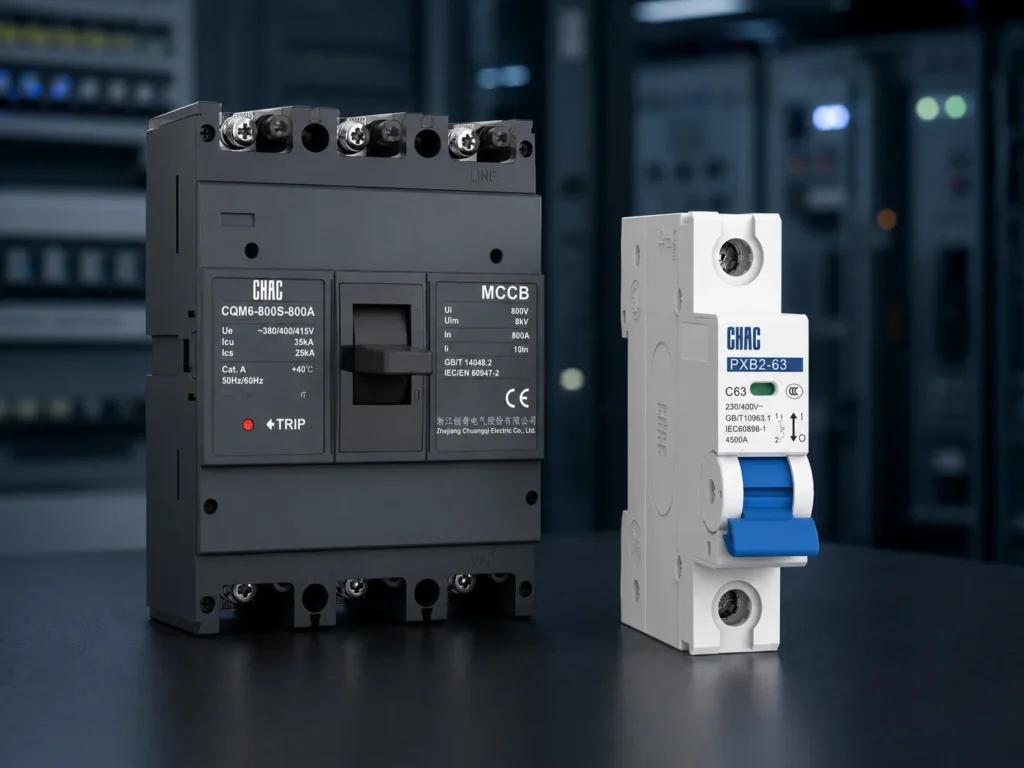
MCB and MCCB are construction categories, not complete protection specifications. Compare current, voltage, trip characteristics, short-circuit duty and the installation requirements together.
What are MCBs and MCCBs used for?
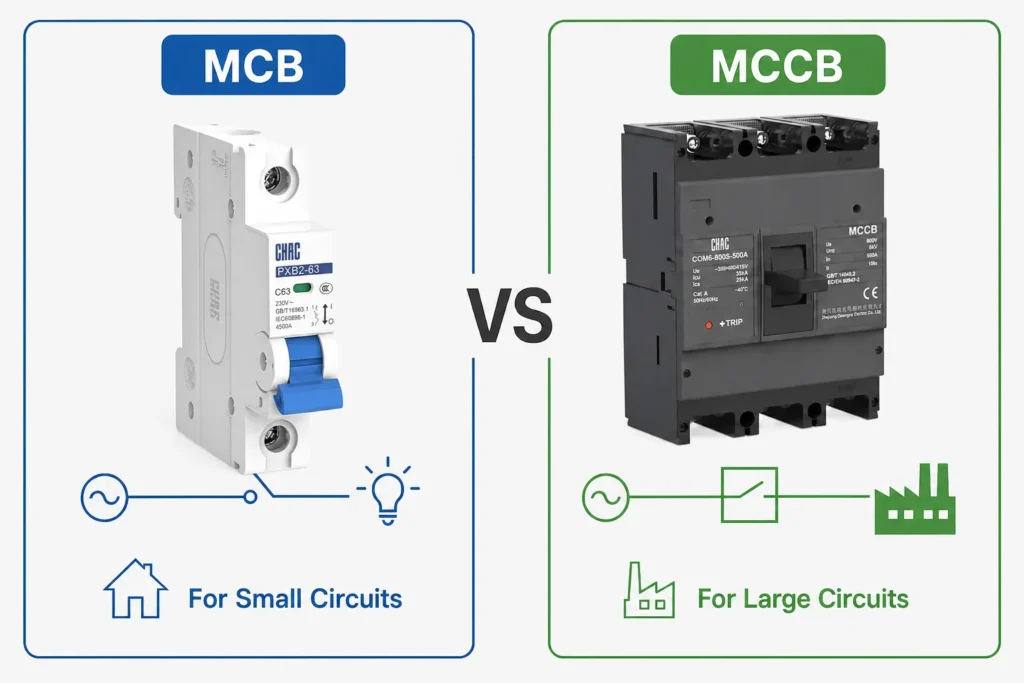
An MCB, or miniature circuit breaker, provides overcurrent protection in a compact format commonly used for lighting, socket circuits and other branch loads. An MCCB (Molded Case Circuit Breaker) also provides overcurrent protection, but its construction and available configurations often suit feeders, larger equipment circuits and distribution incomers. Applications overlap; neither label establishes the complete current range or fault rating of a particular product.
Both can use thermal-magnetic protection. Some MCCBs instead use electronic trip units, with functions and adjustment ranges that depend on the ordered configuration. A breaker protecting a motor feeder does not automatically replace the motor’s switching and overload-protection arrangement. Likewise, standard overcurrent protection should not be confused with residual-current protection.
Schneider Electric’s Electrical Installation Guide, “Fundamental characteristics of a circuit-breaker” identifies operational voltage, rated current, overload and short-circuit settings, and breaking capacity as separate characteristics. The page was last edited on 5 August 2026; its named Schneider examples are not specifications for other manufacturers’ products.
How do B, C and D MCB trip characteristics affect selection?
MCBs are commonly classified by their instantaneous trip characteristics. For the domestic-type IEC 60898 characteristics described in the Electrical Installation Guide’s protective-relay table, the B, C and D bands are commonly expressed as 3-5, 5-10 and 10-20 times rated current respectively. Confirm the exact product’s standard and published curve; industrial modular breaker characteristics are not automatically identical.
- Type B is a candidate for circuits with relatively low inrush, subject to fault-current and disconnection checks.
- Type C can accommodate a higher instantaneous-current threshold, but needs a compatible fault-loop condition.
- Type D can suit high-inrush loads where the circuit can still deliver the fault current needed for the required disconnection time.
A curve letter is not an application guarantee. Choosing D solely because the circuit supplies a motor can reduce sensitivity to lower fault currents. Evaluate starting current and duration, conductor protection and the installation’s disconnection requirements together. For the broader selection process, read Miniature Circuit Breaker Types & Specifications: Complete Guide to Selection, Working Principle and Applications – CHAC Electric.
What differences should an MCB and MCCB comparison table show?
The comparison below describes common configurations, not a ranking or product-specific promise. Its technical distinctions use the Electrical Installation Guide noted above and were reviewed on 7 October 2026. This article is published by a breaker supplier; no competitor model is being ranked.
| Selection factor | MCB | MCCB | What the buyer must verify |
|---|---|---|---|
| Common role | Compact branch and modular distribution circuits | Feeders, equipment branches and incomers | Required circuit function and permitted installation |
| Current rating | Model-specific; not defined by a universal MCB/MCCB boundary | Model-specific; frame and trip-unit ratings may differ | Load, conductor capacity and environmental derating |
| Trip characteristics | Often fixed, with a selected curve | Fixed or adjustable, depending on trip unit | Actual functions, thresholds and time-current curves |
| Short-circuit rating | Read the applicable Icn or industrial rating | Read declared Icu and Ics where applicable | Standard, voltage and fault duty, not only the kA number |
| Installation | Often modular rail mounting | Mounting and connection arrangement vary by model | Enclosure fit, terminals, clearances and conductor arrangement |
| Accessories | Available options vary | Available options vary; motor operation is not automatic | Compatible accessory reference and control supply |
| Procurement cost | Depends on rating and required configuration | Depends on frame, trip unit and accessories | Installed scope, coordination work, spares and maintenance |
Do not convert this table into “MCB below 125 A, MCCB above 125 A.” Current ranges overlap, and a modest-load circuit can still have demanding fault duty. Conversely, an MCCB is not automatically the better choice where a suitable compact breaker already meets the circuit requirements.
What does MCCB adjustable protection actually mean?
MCCB adjustable protection means that specified trip parameters can be set within the limits of the fitted trip unit. It does not mean that every MCCB has adjustable long-time, short-time, instantaneous and ground-fault protection. Fixed thermal-magnetic units exist; electronic units differ in which functions they provide. Obtain the trip-unit reference, setting range and operating instructions before designing around an adjustment.
How are frame size, rated current In and overload setting Ir different?
Frame size identifies the rating associated with the highest current-level trip unit that the frame can accommodate. In describes rated current under the manufacturer’s stated conditions and with the specified trip unit. Ir is the overload trip-current setting. A larger frame therefore does not mean that the connected circuit should be protected at the frame’s maximum rating.
The Electrical Installation Guide’s frame-size and overload-setting sections illustrate this with a Schneider NSX630N frame fitted with a 400 A trip unit set to 0.9, giving Ir = 360 A. That is the source’s named example, not a CHAC rating or a universal adjustment range. For fixed overcurrent protection, the guide identifies Ir = In.
Select the overload setting against both the design load and the conductor’s allowable current under the actual installation conditions. A dial should not be turned upward simply to stop repeated tripping. First determine whether the cause is sustained overload, starting inrush, incorrect settings or an electrical fault.
How should Icn, Icu and Ics be compared?
Circuit breaker breaking capacity concerns short-circuit interruption, not the current the breaker carries during normal operation. Icn is the rated short-circuit capacity associated with domestic-type breaker ratings. Under IEC 60947-2, Icu is rated ultimate short-circuit breaking capacity and Ics is rated service short-circuit breaking capacity. Their test duties differ, so an Icn marking must not be treated as interchangeable with Icu or Ics.
Read every fault rating alongside its declared standard, rated operational voltage and AC/DC application. A rating at one voltage does not establish the same capacity at another. When comparing competing devices, establish a common standard and voltage basis first; then consider both the ultimate duty and the service-duty requirement for the project. The Electrical Installation Guide’s short-circuit rating section explains these distinctions and notes that operating sequences and fault-loop power factor form part of the standardized testing conditions.
Breaking capacity is not a promise of damage-free operation under every conceivable fault. After a short-circuit trip, follow the exact device manufacturer’s inspection and return-to-service instructions. Do not reclose into an unresolved fault.
Can an MCB be used as the main incoming breaker?
An MCB can be considered for an incomer if the exact device satisfies the required current, voltage, fault-duty, isolation and installation conditions. There is no blanket prohibition based only on its name. An MCCB becomes a relevant candidate when the installation needs a configuration, fault rating or protection adjustment that the proposed MCB cannot provide.
Nor does installing an MCCB automatically guarantee selective tripping. An upstream device and downstream breakers must be evaluated as a system, using the manufacturer’s data for the actual devices and settings. Fixed-curve MCBs can participate in coordinated arrangements, but the limit of selectivity must be established rather than assumed.
What is the difference between fault duty, selectivity and backup protection?
| Question | Meaning | Evidence to request |
|---|---|---|
| Can the installation interrupt the available fault? | Fault duty compares prospective short-circuit current with the applicable interruption rating or a supported coordinated arrangement. | Fault study and device ratings at the actual system voltage |
| Will only the intended downstream device open? | Selectivity concerns which protective devices operate, and up to what fault-current limit. | Time-current curves and manufacturer selectivity data for the exact pair and settings |
| Can the upstream device support a downstream device’s fault duty? | Backup protection, also called cascading in some documentation, relies on a verified device combination; both devices may operate. | Manufacturer combination tables for the exact devices, voltage and stated conditions |
Backup protection does not prove selectivity. Do not infer a usable combination by adding two kA ratings or by assuming that any larger upstream breaker supports any smaller downstream one. The Selectivity, Cascading and Coordination Guide, document LVPED318033EN, linked from the Electrical Installation Guide, is a route to Schneider’s own coordination data, not evidence for an unlisted CHAC combination.
Which accessories and protection functions need separate specification?
Motor operation, shunt trips, undervoltage releases and indication contacts are configuration choices, not inherent MCCB features. Specify the intended command or indication, compatible accessory, control-supply rating and interlocking requirements. Remote opening and remote closing are different functions; neither should be inferred from an accessory’s presence without checking its documentation.
Earth-leakage protection also requires explicit verification. A plain MCB or MCCB with overcurrent protection does not automatically detect residual current. Some configurations provide ground-fault or earth-leakage functions, but these are not interchangeable promises of additional shock protection. Confirm the function, sensing arrangement, threshold, time delay and applicable standard against the project’s earthing system and protection objective.
What mistakes increase installed cost or create protection gaps?
- Ordering against frame size while leaving the trip-unit rating or Ir setting unspecified.
- Comparing kA markings without checking the standard and system voltage.
- Assuming that an MCCB guarantees selectivity or that backup protection keeps the upstream device closed.
- Changing a trip curve or setting to avoid nuisance trips without confirming conductor protection and fault disconnection.
- Assuming residual-current protection or motorized operation is included.
- Evaluating purchase price without terminals, enclosure changes, settings work, coordination evidence and maintenance access.
An oversized frame does not inherently create an efficiency loss. The practical concerns are protection suitability, enclosure space, connections, installation work and the cost of unnecessary functions. Future expansion still requires reassessment of conductors, load and fault duty; it is not permission to overrate today’s protection.
What should OEM and distributor buyers request from the manufacturer?
For MCCB vs MCB selection, provide the supply voltage and frequency or DC duty, load details, prospective fault current, conductor arrangement and intended protection function. Ask for the exact model and trip-unit combination rather than a generic family name.
- Confirm declared standards, current and voltage ratings, applicable fault ratings and environmental limits.
- Record the trip curve or adjustable settings, including who is responsible for commissioning and protecting those settings from unauthorized changes.
- Request coordination evidence for the specified upstream and downstream combination.
- Check mounting, terminals, accessory compatibility, installation instructions and maintenance requirements.
- Verify certificates or approvals against the exact product and destination market rather than accepting a company-wide logo as proof.
The MCB product route and the MCCB platform buying guide provide starting points for a model-specific discussion. Compare CHAC’s miniature circuit breakers and molded case circuit breakers only after the required circuit duty is documented.
Which CHAC product pages are relevant to the comparison?
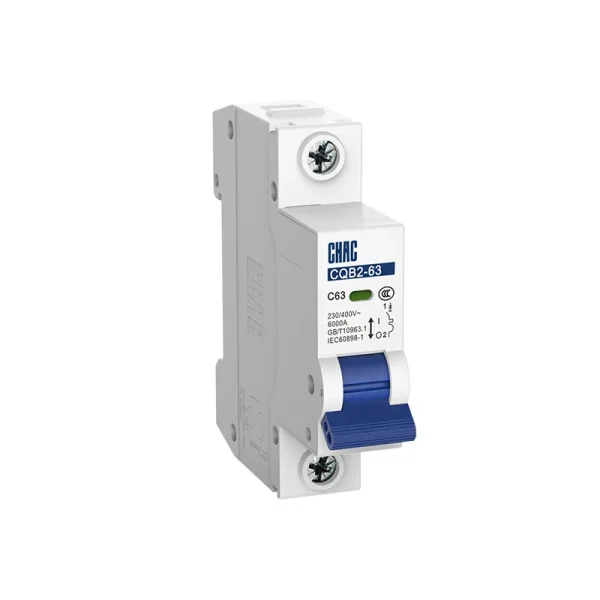
CQB2-63 Miniature Circuit Breaker For Power Systems | CHAC Electric
CQM6 Standard Molded Case Circuit Breaker (MCCB) OEM Manufacturer | CHAC Electric

What can production-line information establish?
Manufacturing information can help a buyer discuss process control, calibration, traceability and order consistency, but a factory photograph does not establish a breaker rating or certificate. Request product-specific test and inspection documentation for the ordered configuration. Do not substitute automation percentages or general manufacturing claims for electrical performance evidence.

Which standards and market requirements need checking?
Read the declared product standard on the exact device documentation. IEC 60898-1 and IEC 60947-2 describe different breaker rating and test frameworks; a construction label alone does not establish which applies. The retained IEC 60947-2 scope link is an edition-specific IEC catalogue entry, not proof that its edition is the one required by the project. Confirm the applicable edition and market acceptance separately.
For US applications, also distinguish branch-circuit protection from supplementary protection. UL Solutions’ Circuit Breaker and Supplementary Protector Services, reviewed on 7 October 2026, states that supplementary protectors are not intended to provide the branch-circuit overcurrent protection required by the NEC. The same guidance notes that a replacement-breaker investigation does not establish the end application or a series combination. This is a scope distinction, not a claim that any CHAC device has a UL approval.
CE marking, CB documentation and ISO management-system certification are not interchangeable product standards or universal installation approvals. The European Commission’s CE-marking guidance, reviewed on 7 October 2026, explains that CE is the manufacturer’s declaration of compliance with applicable requirements, not an EU or authority safety approval. Ask which evidence applies to the exact model and intended market. No certification is established here from a general brand statement.
Frequently Asked Questions
Can MCCB be used instead of MCB?
It can be considered if the exact MCCB meets the circuit’s protection, fault-duty, voltage, installation and approval requirements. It is not a drop-in replacement based only on ampere rating. Check conductor protection, terminals, enclosure fit and upstream/downstream coordination before changing the device.
What is MCCB used for?
MCCBs commonly protect feeders, equipment branches and distribution incomers in commercial and industrial installations. The application depends on the ordered trip unit and ratings. A motor feeder may still need a separate switching and motor-overload arrangement.
What does MCCB mean in electrical systems?
MCCB means molded case circuit breaker. It identifies a construction category for a protective device, not a guarantee of adjustable protection, motorized operation or earth-leakage detection.
How do I choose between MCB and MCCB?
Establish load and conductor requirements, then check system voltage, prospective fault current and the required protection functions. Compare exact device ratings and coordination data. There is no universal 125 A boundary that replaces these checks.
What is circuit breaker protection?
It is automatic interruption in response to the conditions detected by the breaker’s fitted protection functions, commonly overload and short circuit. Residual-current or ground-fault functions require a suitable configuration. A trip interrupts the circuit but does not repair the underlying fault.
Can an MCCB overload setting be increased when the load grows?
Only after a qualified assessment confirms that the conductors, terminals and installation can support the new setting and that the protection remains suitable. Check the actual trip unit’s adjustment range rather than the frame rating alone. Revisit fault-duty and coordination requirements as part of the change.
Does a high Icu rating guarantee service continuity after a fault?
No. Icu is an ultimate breaking-capacity rating, not a promise that a breaker can immediately be returned to normal service after any fault. Check Ics, the manufacturer’s post-fault instructions and the condition of the installation. Service continuity also depends on selectivity, not just the interruption rating.
Does backup protection mean only the downstream breaker will trip?
No. Backup protection concerns a verified combination’s fault duty; both devices may operate. Selectivity is a separate requirement and must be checked using the manufacturer’s data for the exact devices, voltage and settings.
References and further reading
- Schneider Electric Electrical Installation Guide: Fundamental characteristics of a circuit-breaker. Last edited 5 August 2026; reviewed 7 October 2026. Technical explanations and named examples, not CHAC specifications.
- UL Solutions: Circuit Breaker and Supplementary Protector Services. Publication date not displayed; reviewed 7 October 2026. Branch-versus-supplementary protection and replacement-investigation scope.
- European Commission: CE marking. Reviewed 7 October 2026. Manufacturer responsibilities and the limits of what the mark establishes.
- CHINT MCCB selection guidance. Retained manufacturer further-reading link; use the selected device’s own documentation for acceptance.
What should decide the final breaker choice?
The useful distinction is not that one breaker is for homes and the other for factories. It is whether the proposed configuration meets the circuit’s load, conductor, voltage and fault-duty requirements while delivering the intended protection behavior. Start with those installation conditions, select the current rating and trip characteristic or settings, then verify coordination and the physical installation. Do not let a frame-size label replace an overload-setting check, or a large kA value replace a standard-and-voltage comparison. Where a backup arrangement is proposed, require its documented combination limits and check selectivity separately. CHAC’s linked product pages provide a starting point for a configuration enquiry; send the project duty and request the exact model documentation before committing to an order.