A circuit breaker quotation can look complete while leaving a critical question unanswered: who controls the product design, production records and response to a quality problem? Before comparing prices, an importer or panel builder needs to identify both the seller and the production source for each quoted model.
The practical answer to manufacturer vs trading company is not that one supplier type is always better. A manufacturer produces goods; a trading company sources and resells them. Either can be suitable when the exact breaker configuration, supporting evidence, total supply cost and accountability are clear.
What changes when buying from a manufacturer rather than a trading company?
A direct manufacturing relationship can shorten communication with production and engineering. A trading company can coordinate purchases across sources. Neither business label establishes that a particular breaker satisfies an electrical duty or destination-market requirement.
| Buying issue | Direct manufacturer | Trading company |
|---|---|---|
| Production visibility | Can provide access to its own relevant processes; verify the quoted models. | Should identify the production source and explain access to its records. |
| Product breadth | Confirm which lines are made internally and which are sourced. | May combine several product lines, subject to source traceability. |
| Technical changes | Ask which engineering team approves changes. | Confirm how requests reach the responsible factory. |
| Order flexibility | Depends on the model, production plan and customization. | May consolidate orders, but minimum quantities remain quotation-specific. |
For example, a distributor buying breakers alongside other panel components may value consolidation. An OEM changing product markings may prioritize direct engineering access. Neither scenario removes the need for model-level approval.
CHAC explicitly identifies MCB, RCCB and RCBO manufacturing on its terminal electrical products customization page. Its broader product range describes additional categories; a catalog listing alone should not be treated as proof that every listed item is manufactured internally.
How do you verify the circuit breaker factory and its technical evidence?
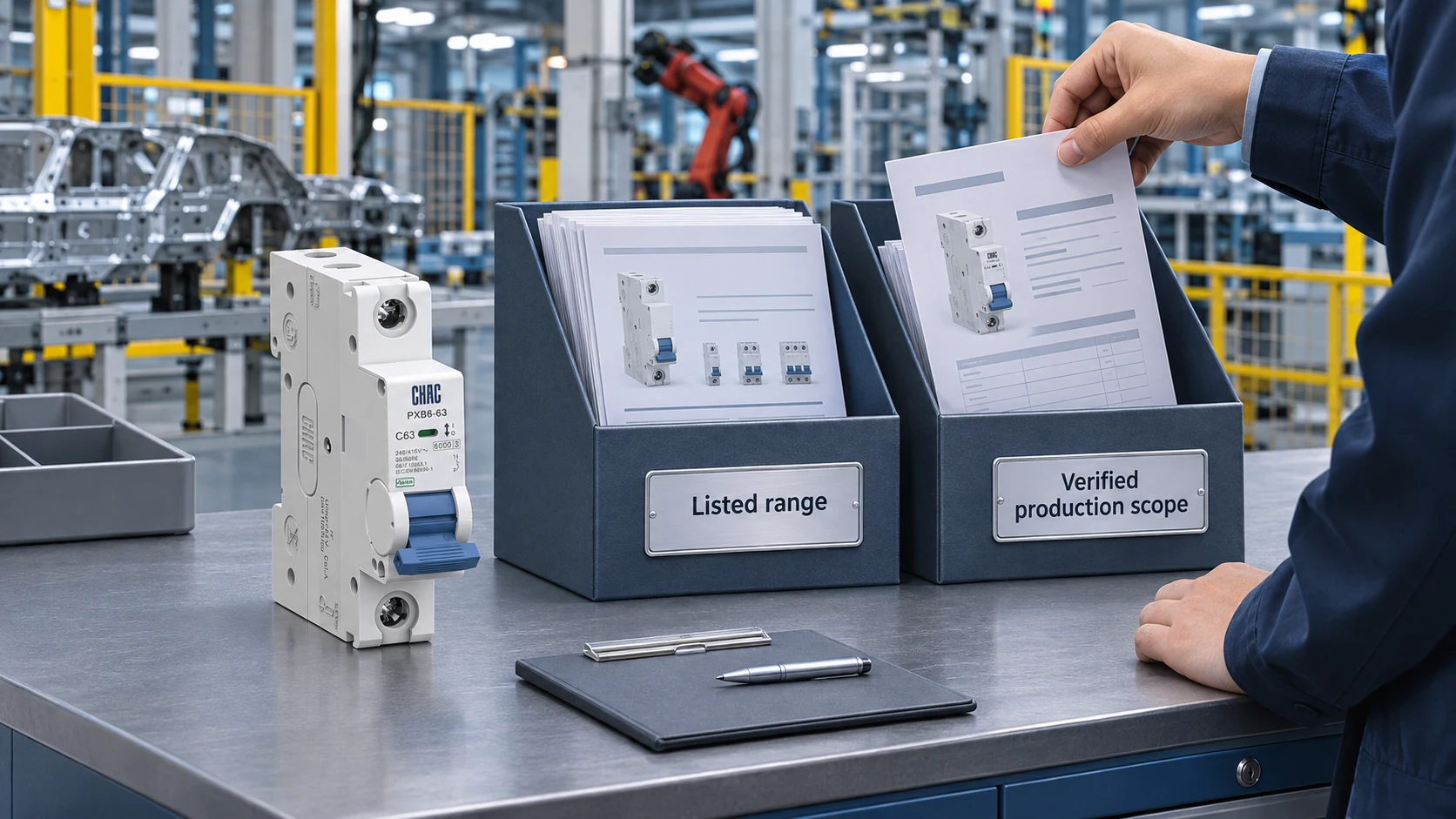
Supplier verification should connect the quoted model, production location, technical documents and delivered identification. Ask the seller to distinguish its legal entity from the manufacturing entity and identify any outsourced products or processes. A factory visit or remote review is useful only when it examines the relevant production activity rather than an unrelated assembly line.
Request controlled drawings, datasheets, identification details and applicable test or certification documents for the proposed variants. Check whether model codes, poles, ratings and other configuration details agree across them. Where certification is claimed, seek confirmation through the issuing body’s official verification channel; a logo or an unrelated report is insufficient.
Standards also need careful interpretation. IEC 60947-2 concerns circuit breakers within its scope; citing it does not establish a particular unit’s certification or acceptance in every market. CHAC’s MCCB buying guide emphasizes complete-configuration approval, including operating-voltage-dependent breaking capacity and trip-unit details. It is supplier guidance, not independent certification evidence.
Do not infer accessory compatibility or panel fit from a shared family name or frame designation. Obtain explicit evidence for the proposed combination. If evidence is incomplete, record the point as an engineering consultation item rather than an established capability.
Which inputs make supplier quotations and responsibilities comparable?
A useful trading company vs manufacturer comparison begins with the same RFQ for both. Separate mandatory technical requirements from commercial preferences, and require each supplier to identify exclusions instead of silently substituting a configuration.
| Buyer input | Required supplier response | Approval purpose |
|---|---|---|
| Application, destination and electrical requirements | Exact proposed model and supporting evidence | Evaluate suitability without relying on a family claim. |
| Panel constraints and requested accessories | Variant-specific drawings and compatibility confirmation | Resolve fit and configuration questions before approval. |
| Quantities, branding and packaging | Model-specific minimums, setup charges and lead-time basis | Compare realistic order conditions. |
| Inspection and traceability needs | Agreed records, acceptance criteria and batch identification | Define what accompanies release and delivery. |
| Quality and warranty expectations | Named contacts, claim evidence and remedy process | Make responsibility explicit before purchase. |
Compare total supply cost, including quoted freight, consolidation, documentation, inspection and inventory implications—not merely unit price. Agree who supplies drawings, authorizes revisions, investigates nonconformities and communicates with the production source. Testing should use agreed criteria and qualified facilities where appropriate, not improvised buyer tests.
Frequently asked questions
What is the practical difference between a circuit breaker manufacturer and a trading company?
A manufacturer produces breakers; a trading company buys and resells them. The purchasing distinction is access to production controls and technical decisions, not an automatic difference in quality.
How can a buyer verify which breaker models a supplier actually manufactures?
Request a model-to-production-site list, then cross-check relevant production activity, traceability records and technical-document identities. Ask explicitly which products or processes are outsourced.
Can a trading company offer lower order quantities or consolidate several product lines?
It may offer either through stockholding or coordinated sourcing. Confirm minimums for each model, branding requirement and shipment; consolidation does not guarantee lower minimums.
Is buying directly from a factory always cheaper after all supply costs are included?
No. Compare equivalent configurations and include logistics, inspection, documentation, inventory and coordination costs. A lower unit quotation can produce a higher overall purchasing cost.
Who should provide technical drawings and resolve product-quality questions?
The seller should supply controlled documents and coordinate resolution. Identify the engineering authority behind those documents and the production team responsible for investigation, especially when an intermediary is involved.
Which supplier documents should be checked before approving a circuit breaker order?
Check entity details, the exact specification, drawings, applicable reports or certificates, marking information and agreed inspection records. Confirm that their scope covers the ordered variants rather than merely a related product family.
How should responsibility for testing and warranty claims be agreed with the supplier?
Document acceptance criteria, test-record responsibilities, claim contacts, required evidence, investigation arrangements and agreed remedies. Confirm the applicable warranty terms in the quotation or purchase agreement rather than assuming standard coverage.
Choose the supplier relationship that makes the ordered configuration and accountability clearest. For a CHAC enquiry, send the proposed models, destination, quantities and unresolved technical requirements through CHAC’s contact page; request model-specific confirmation before treating customization, documentation or manufacturing scope as settled.
Sources and further reading
- Low-Voltage Electrical Products | CHAC Electric
- Molded Case Circuit Breaker Buying Guide for OEM Buyers
- MCB, RCCB & RCBO Manufacturer for OEM Supply | CHAC
- Contact Us
- Incoterms® 2020 – ICC – International Chamber of Commerce
- United Nations Convention on Contracts for the International Sale of Goods (Vienna, 1980) (CISG) | United Nations Commission on International Trade Law