A control-panel breaker can carry the transformer’s normal operating current yet trip when the transformer is energized. For panel builders and purchasing teams, that makes a current-rating-only quotation incomplete: the transformer data, circuit protection requirements and exact breaker characteristic must be reviewed together.
Transformer breaker sizing starts with rated VA and primary voltage, but finishes with an inrush-versus-trip-curve comparison, conductor protection, fault-clearing checks and applicable installation requirements. The PXB6 options in the miniature circuit breaker catalogue provide a shortlist—not proof that a particular variant will protect a particular control transformer.
Which transformer currents must the protection design distinguish?
For a single-phase transformer, rated primary current is VA divided by rated primary voltage. As a clearly hypothetical example, a 240 VA transformer with a 240 V primary has a rated primary current of 1 A. This identifies a reference current, not an automatic breaker rating.
| Quantity | What it describes | Selection consequence |
|---|---|---|
| Rated primary current | Input current reference at rated conditions | Supports overload and conductor checks |
| Magnetizing inrush | Transient current during energization | Requires magnitude-and-duration comparison |
| Secondary load current | Current supplied to control loads | Requires secondary circuit assessment |
Control transformer sizing also requires the intended load duty, including simultaneous load pickup. Do not confuse that load-side demand with transformer magnetizing inrush. Primary-side and secondary-side protection serve different circuit locations; neither should be assumed to establish complete protection for the other side.
How should transformer inrush be compared with PXB6 characteristics?
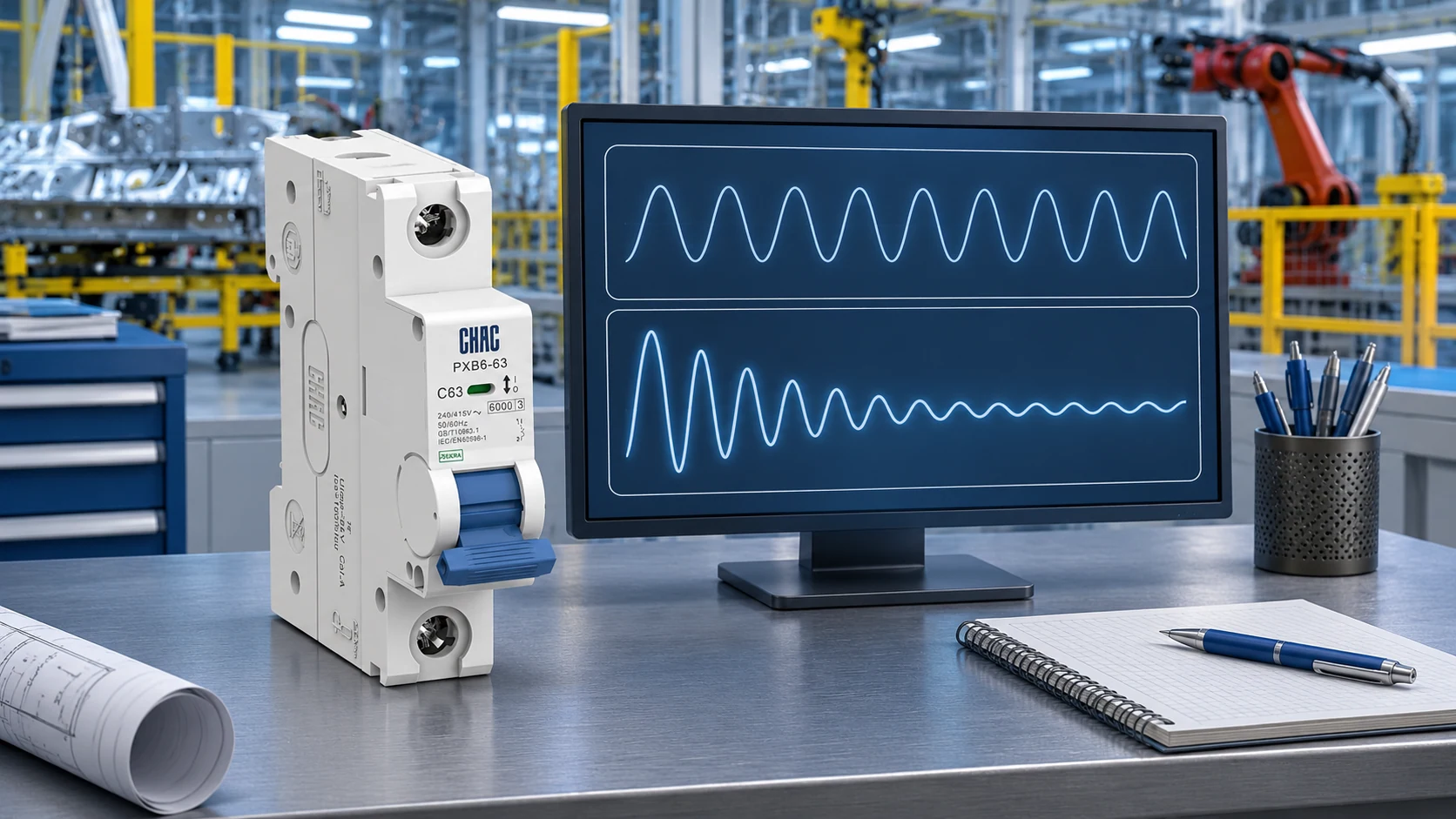
The CHAC PXB6-63 product data lists 6A–63A ratings, B/C/D options and published 6kA Icu = Ics breaking data. These family-level values do not establish transformer suitability. Request the ordered variant’s time-current curve, operating-voltage rating and applicable breaking-capacity documentation. The listed 500V insulation voltage is not a substitute for an operating-voltage rating.
Compare transformer inrush current and duration with the breaker’s tolerance band, using compatible measurement definitions. Peak current, RMS current and a multiple of rated current are not interchangeable without their stated basis. Include the transformer supplier’s energization conditions and repeated-start information where available.
The CHAC B/C/D curve guide explains why a less sensitive instantaneous response is not a universal cure: fault clearing and conductor protection still need verification. PXB6 documentation references IEC 60898-1; that standard reference does not establish certification of every configuration or suitability for this duty.
What evidence should accompany a breaker purchase request?
Ask for a documented selection review rather than a breaker chosen from VA alone. The purchasing file should identify missing inputs explicitly, so a consultation is not mistaken for an approved circuit design.
| Input to request | Decision it supports |
|---|---|
| Transformer VA, primary connection and voltage, secondary ratings | Establish relevant current references |
| Transformer protection table and inrush envelope | Check permitted protection and startup tolerance |
| Exact breaker curve, voltage and breaking data | Assess the proposed variant |
| Conductor details, fault levels and installation conditions | Verify cable protection and fault clearing |
| Destination requirements and assembly documentation | Confirm the applicable verification basis |
For an assembled control panel, component selection is only part of the assessment. The official IEC 61439-1 publication addresses low-voltage assembly requirements, including incorporation and temperature-rise considerations. It is not evidence that a particular panel or PXB6 unit is certified. Obtain configuration-specific documents before procurement release.

Frequently asked questions
Which transformer VA rating and primary voltage are needed for breaker sizing?
Use the transformer’s rated VA and the voltage for its intended primary connection. For a single-phase unit, VA divided by primary volts gives rated primary amperes. Also obtain secondary ratings and actual load duty; nominal current alone does not determine protection.
How does primary-side protection differ from secondary-side protection?
Primary protection responds to current entering the transformer and must accommodate acceptable energization behavior. Secondary protection addresses the outgoing circuit at its own voltage and current. Primary protection should not automatically be treated as sufficient secondary conductor protection.
Why can transformer magnetizing inrush trip a correctly loaded breaker?
Energizing the magnetic core can produce a brief current substantially different from normal load current. Its magnitude and duration depend on energization conditions and transformer characteristics. That transient can enter the breaker’s operating region even when steady load is acceptable.
Which transformer inrush data should be compared with the PXB6 trip curve?
Obtain the current-time envelope, current definition, energization conditions and repetition assumptions. Compare these with the exact proposed PXB6 rating’s curve and tolerance band, not just its B, C or D label. Resolve peak-versus-RMS differences before drawing conclusions.
Can one fixed percentage of full-load current be used for every transformer installation?
No. Transformer protection instructions, inrush behavior, conductor limits, fault conditions and applicable installation requirements can differ. A percentage may belong to a particular selection method, but it cannot replace the complete circuit assessment.
How should secondary conductor protection be checked separately from transformer protection?
Identify secondary conductor ampacity under actual installation conditions, protective-device location, available fault current and required clearing performance. Assess each outgoing circuit and any applicable exceptions through the project’s qualified designer rather than inferring protection from the primary breaker rating.
Which manufacturer protection tables and local rules should support the final breaker choice?
Use the transformer supplier’s protection tables for the exact transformer, the breaker supplier’s variant-specific curves and ratings, and any relevant coordination data. The responsible designer should identify destination installation rules and assembly requirements; generic product listings do not replace those documents.
For a PXB6 enquiry, send transformer ratings, supplier inrush data, conductor information and fault-level requirements through CHAC’s contact team. Request confirmation of available variant documentation and unresolved selection inputs; a quotation alone does not establish control transformer protection suitability.