An 800A MCCB enquiry can look complete until the panel builder checks terminal alignment, door clearance and the actual trip rating. For a replacement or new assembly, purchasing needs an identifiable breaker configuration—not simply a series name and an ampere value.
The CQM6 and CQM7 molded case breaker families should be compared by exact frame, installed rated current, operating voltage, Icu/Ics, protection characteristics and mechanical interface. Published data identifies CQM7-800 current and breaking-capacity options; CQM6’s broader series range does not establish equivalent ratings or dimensions for a proposed 800A configuration. Neither series name alone establishes suitability for your panel. When checking an MCCB’s current rating, distinguish the rating of the installed trip unit from the frame designation.
What does the published CQM6 versus CQM7 comparison establish?
The CQM6 product information covers a wider current range, while the CQM7 product information provides a specific CQM7-800 selection row. Keep series-level facts separate from orderable variant evidence.
| Comparison point | CQM6 published information | CQM7 published information |
|---|---|---|
| Current coverage | Series range: 16–1600A; confirm proposed configuration | CQM7-800: 500, 630, 700 and 800A |
| Operational voltage | AC 400/415V listed; other configurations require exact identification | AC 400/415V |
| Breaking duty | Obtain Icu/Ics for the exact frame, class and voltage | CQM7-800 at AC 400/415V: S 35/25kA; M 50/35kA, Icu/Ics |
| Poles and protection | Poles depend on frame; thermal-magnetic protection listed | Published ratings cover 3-pole models; confirm selected protection configuration |
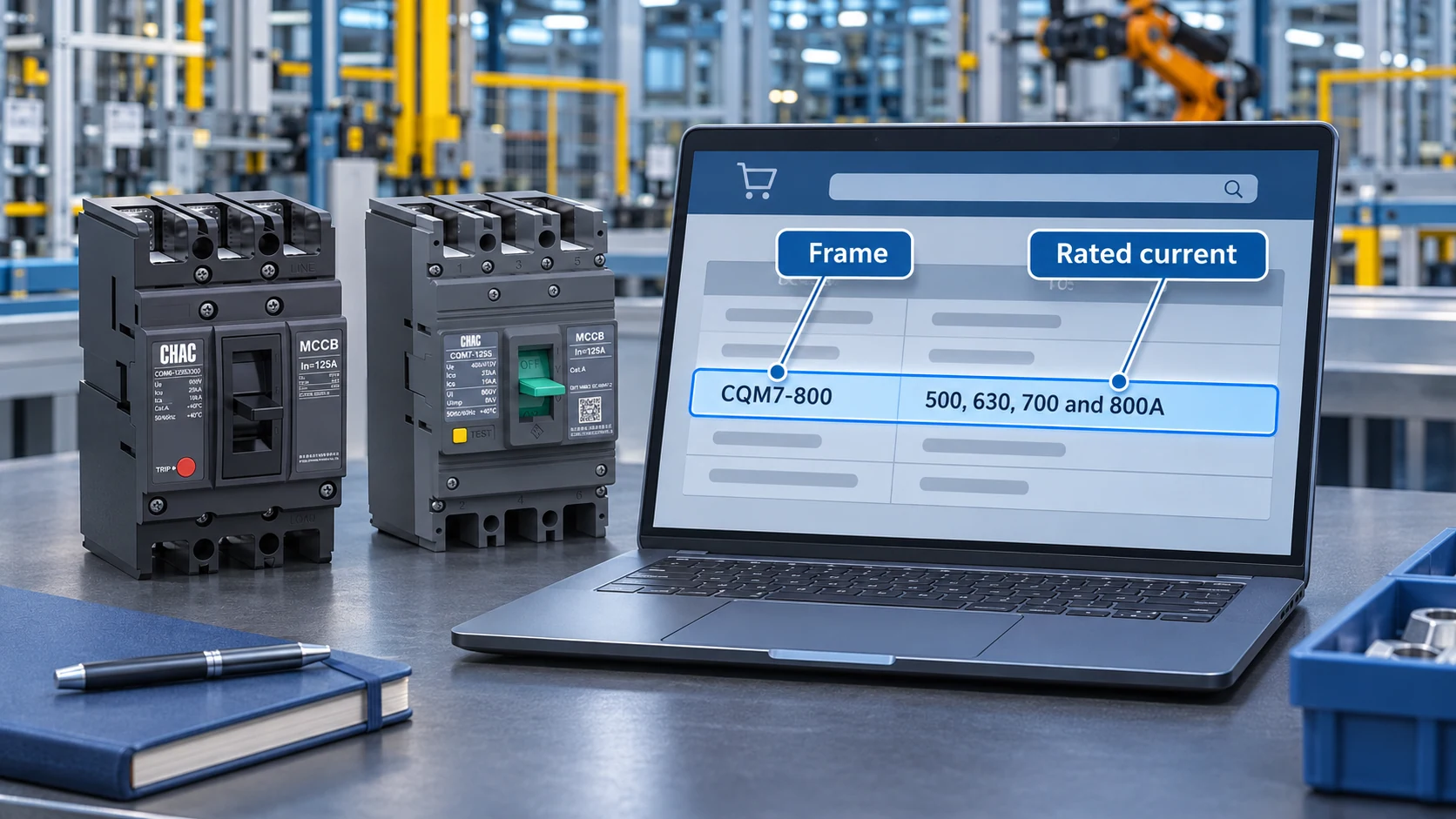
An mccb frame size identifies a frame category, not necessarily the installed current rating. CQM7-800’s listed current options demonstrate that distinction. Obtain the complete ordering code and nameplate details before comparing quotations.
How should breaking capacity and trip behaviour be compared?
Compare Icu and Ics at the panel’s actual operating voltage. Icu identifies ultimate short-circuit breaking capacity; Ics identifies service short-circuit breaking capacity under the applicable test sequence. They answer different questions, so a headline maximum is not a complete duty specification.
For example, the published CQM7-800 S and M options have different Icu/Ics pairs at AC 400/415V. Neither pair establishes suitability without the installation’s prospective fault current and required service performance. Do not transfer a CQM6 rating published for another frame or voltage to an 800A proposal.
For coordination, request time-current curves, tolerances and the available overload and magnetic settings. Do not infer adjustability from the series name. A magnetic-only option does not provide overload protection by itself.
IEC 60947-2:2024 addresses circuit-breakers within its stated voltage and application scope. A standards reference on a product page is not evidence that a particular ordered unit holds certification.
Which panel inputs and drawings should be approved before ordering?
Checking mccb dimensions means checking the complete installation envelope, not just body width. Terminal hardware, conductor approach, operating mechanisms and required clearances can prevent a nominally comparable breaker from fitting.
| Buyer input | Evidence required before approval |
|---|---|
| Existing panel interface | Variant-specific outline, mounting centres, fixing details and door cutout |
| Conductors and busbars | Terminal pitch, connection height, lug details and permitted conductor arrangement |
| Controls and accessories | Compatible part numbers, mechanism dimensions and control-voltage requirements |
| Installation environment | Ambient and altitude limits, derating information and applicable enclosure requirements |
| Assembly loading | Thermal assessment and relevant assembly verification |
Rotary handles and motor operators need explicit compatibility confirmation for the proposed frame and mounting arrangement. Similar appearance is insufficient. The IEC 61439-1:2020 information highlights assembly temperature-rise verification; a breaker’s standalone current rating does not establish the loaded panel’s thermal performance.
Submit these inputs for technical review rather than treating consultation as proof of fit or approval.

Frequently asked questions
Which CQM6 and CQM7 specifications should be compared for an 800A panel?
Compare the exact ordering codes, poles, installed current, operational voltage, Icu/Ics, trip curves, adjustment options, dimensions and accessories. Request variant-specific CQM6 data rather than comparing its series maximum against CQM7-800.
Does an 800A frame guarantee an 800A installed trip rating?
No. CQM7-800 lists 500, 630, 700 and 800A options. Verify the supplied unit’s nameplate, trip configuration and settings; also distinguish its rating from the current the assembled panel can carry.
How should Icu and Ics be compared at the panel's operating voltage?
Use both values at the same operational voltage and for the exact breaking-capacity designation. Compare them with the calculated fault level and required service performance, not with a series-wide maximum.
Which mounting and terminal dimensions can prevent an 800A MCCB from fitting?
Mounting centres, overall depth, terminal pitch, connection height, lug envelope and door-mechanism projection can all conflict. Required clearances and conductor bending space also matter beyond the breaker body.
What differences in trip adjustment matter for protection coordination?
Available overload pickup, short-circuit pickup and any documented delay adjustments affect coordination. Compare curves and tolerances with adjacent protection; do not assume either proposed variant offers adjustable functions.
Are rotary handles and motor operators interchangeable between the proposed frames?
Interchangeability is not established. Obtain approved accessory part numbers and compatibility drawings covering the breaker frame, coupling, shaft or linkage, door arrangement and relevant electrical requirements.
What verified drawings and environmental ratings are needed before approving an 800A replacement?
Obtain controlled outline, mounting, terminal and accessory drawings for the exact variant. Confirm ambient temperature, altitude limits, derating and applicable enclosure conditions, alongside the replacement’s effect on assembly thermal verification.
Approve an 800A comparison only when electrical duty, protection behaviour and the physical interface are documented together. Send the proposed ordering codes, panel drawings and fault-duty requirements to CHAC for configuration review, with unresolved compatibility points clearly identified before procurement.