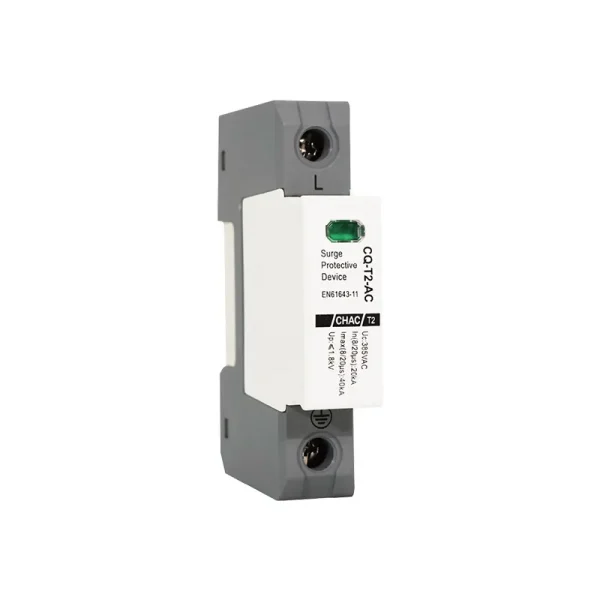
Surge Protective Device (SPD) Type Guide
Compare a starting surge protective device type for AC or PV/DC circuits using supply exposure, lightning protection and installation point. Includes Type 1, 2 and 3 checks.
Identify a starting SPD family. Confirm voltage, discharge ratings, earthing, and coordination separately.
Result
Starting SPD family
Type 2Product-family starting point onlyPV/DC → DC-rated; exposed main board → T1+2; equipment → coordinated T3Simplified starting-family rule. Verify Uc, Up, discharge duties, earthing, fault level and upstream coordination. This is not a risk assessment or proof of compliance.
Why this result?
Formula and method
Compare a starting surge protective device type for AC or PV/DC circuits using supply exposure, lightning protection and installation point. Includes Type 1, 2 and 3 checks.
How to use this calculator
- Identify whether the circuit is AC or PV/DC.
- Confirm external lightning protection and incoming-supply exposure.
- Select the installation point, then verify all electrical ratings against project conditions.
Calculation limits
This simplified rule does not select a CHAC model or verify compliance. DC and PV products require voltage, polarity, fault and coordination checks.
Surge protection device types: Type 1, Type 2 and Type 3
SPD types describe tested surge duties, not simply a good–better–best ranking. Type 1 addresses lightning-current duty, Type 2 limits induced or switching surges in distribution systems, and Type 3 provides coordinated protection close to sensitive equipment.
Input notes
| Input | What to check |
|---|---|
| AC or PV/DC | A DC or PV circuit needs an SPD designed and rated for that system. An AC voltage rating cannot simply be transferred to DC. |
| Lightning exposure | External lightning protection and an exposed supply are screening inputs. They do not replace a site lightning-risk assessment. |
| Installation point | Main-board, sub-board and equipment locations have different coordination needs. Type 3 is a supplement to suitable upstream protection. |
Worked example · initial form values
Initial screen for a main distribution board
AC supply · no external lightning protection indicated · underground incoming supply · main board
System check → AC
Entered exposure and location → starting family Type 2
Type 2
This is the guide’s starting family for the entered conditions. Changing to an exposed main-board supply or indicating external lightning protection gives Type 1+2 as a screening result, not a completed design.
Ratings to confirm on the product data sheet
- Match maximum continuous operating voltage Uc to the system and check voltage protection level Up against equipment withstand and installation conditions. Review the applicable Iimp, In or Imax discharge-duty ratings.
- Confirm the earthing arrangement, connection configuration, backup protection, fault rating and coordination with other SPDs. Lead length and routing affect installed protection.
Frequently asked questions
Which SPD details still need checking?
Verify continuous operating voltage, voltage protection level, discharge duties, earthing system, prospective fault current and coordination. The family result does not confirm a product model.
What do 10/350 µs and 8/20 µs mean?
They identify standardized impulse-current wave shapes used for different SPD duties. Type 1 uses a 10/350 µs lightning-current test; Type 2 uses an 8/20 µs test. A kA number is meaningful only with its stated duty.
Can a Type 3 device replace a Type 2 SPD?
No. Type 3 devices have limited discharge capacity and are used close to equipment as a coordinated supplement to upstream protection.
Does an underground supply remove the need for surge protection?
No. Underground supply alone does not resolve switching surges, other incoming services, equipment sensitivity or site risk. This guide uses it as one screening input only.
Need help choosing a CHAC product?
Send the system voltage, load current, and installation conditions with your inquiry.
Application example · Illustrative inputs
Reviewing surge protection at an exposed incoming supply
For a commercial building with an overhead AC supply and external lightning protection, select AC power, overhead supply and the main distribution board in the guide. The starting result is Type 1+2, which directs the product review toward a family such as CHAC ExS-T1T2-AC. The next decisions are the earthing arrangement, continuous operating voltage, protection level, discharge duties and backup protection. This starting-family result does not replace the lightning-protection design, and an AC product must not be carried over to the DC side of a solar installation.
Product data: ExS-T1T2-AC Series Single-Pole Pluggable Surge Protector
Related CHAC products
Browse AC and DC surge protection data. Match the device type and voltage to the installation.