Consideriamo questo ipotetico problema di messa in servizio: un ingegnere addetto ai quadri a Dubai chiude un nuovo quadro di distribuzione appena caricato, e un circuito che funzionava durante un controllo a porte aperte inizia a scattare più tardi nel corso del turno. Sostituire l’interruttore con uno dello stesso valore nominale non spiega la differenza riscontrata. La domanda utile da porsi è: cosa è cambiato nell’ambiente circostante? La temperatura dell’armadio, i carichi vicini, le condizioni dei cavi o lo stato della connessione stessa. Un locale climatizzato e un vano interruttore surriscaldato non rappresentano lo stesso ambiente di funzionamento.
Riepilogo: Il derating dell’interruttore automatico significa utilizzare la corrente consentita dal produttore in base alle condizioni reali di installazione. La tabella di intervento pubblicata per il PXB6-63 utilizza una temperatura di riferimento di 30°C. Tale riferimento non rappresenta né una temperatura ambiente massima universale né un fattore di correzione. Acquisire i dati di temperatura relativi alla portata esatta, valutare l’armadio caricato e ricontrollare la protezione dei cavi prima di aumentare la taglia dell’interruttore.
Quale temperatura si deve utilizzare per il derating dell’interruttore automatico?
Il pertinente valutazione della temperatura dell'interruttore automatico Deve essere letto tenendo conto delle condizioni di riferimento indicate. Un termometro a parete misura la temperatura ambiente; non determina la temperatura dell’aria che circonda un dispositivo all’interno di un armadio sottocarico, soprattutto in prossimità di un’altra fonte di calore. Analogamente, un’immagine termica di un terminale mostra una temperatura superficiale, che non può essere semplicemente inserita in una tabella di correzione della temperatura ambiente.
Le caratteristiche di intervento pubblicate da PXB6-63 identificano 30°C come temperatura di riferimento per la taratura. La tabella distingue inoltre una condizione di avviamento a freddo da un test eseguito dopo una fase di carico precedente. Tali dettagli sono importanti nell’interpretazione del funzionamento. Un multiplo di corrente e un limite di tempo appartengono a una sequenza di prova specifica, piuttosto che descrivere ogni condizione di campo.
Registri la temperatura rilevata, i circuiti sottoposti a carico, lo stato di chiusura della porta e le condizioni operative normali dei ventilatori e dei filtri. Utilizzi le istruzioni del fabbricante per definire il metodo e la posizione di misurazione appropriati. Il personale qualificato deve pianificare qualsiasi operazione di misurazione in prossimità di apparecchiature elettriche; aprire un quadro sotto tensione per effettuare una lettura comoda non costituisce una modalità di collaudo.
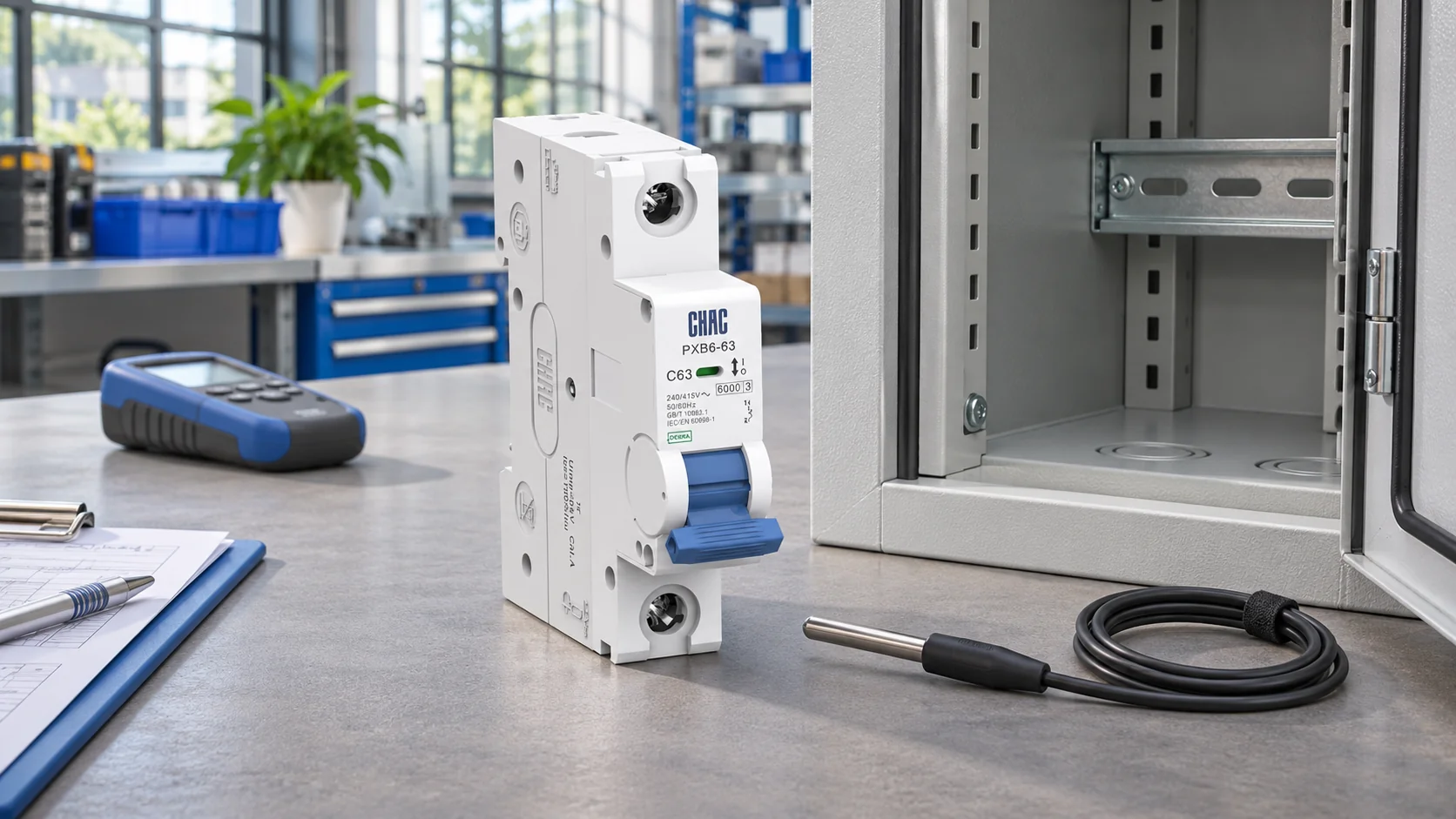
Verificare il ridimensionamento del valore nominale dell’interruttore insieme ai limiti di corrente dei cavi e degli assiemi.
Derating della temperatura Si prende in considerazione un fattore che influisce sulla corrente utilizzabile. Il raggruppamento dei conduttori, il metodo di installazione del cavo, l’idoneità dei morsetti e il comportamento termico dell’assemblaggio introducono ulteriori limitazioni. Una correzione applicata a un cavo non può essere estesa a un interruttore magnetotermico, e una correzione relativa a un interruttore magnetotermico non consente di determinare la capacità dell’intero quadro.
La IEC 61439-1:2020 tratta espressamente gli assiemi e introduce la corrente nominale di gruppo in relazione alla verifica dell'innalzamento della temperatura. Il suo ambito di applicazione spiega perché il controllo di un singolo componente non risolve la questione dell'assieme. Applicare la parte pertinente relativa all'assieme insieme alle norme generali; la verifica appropriata dipende dalla progettazione e dall'uso previsto.
| Domanda | Cos'è che descrive | Prova necessaria |
|---|---|---|
| Qual è la corrente nominale dell'interruttore? | La potenza nominale del dispositivo selezionato nelle condizioni dichiarate | Modello esatto, pali, curva e valutazione |
| Qual è la corrente ammessa a questa temperatura? | La correzione della temperatura del produttore | Tabella applicabile e relative condizioni di riferimento |
| What can the cable carry? | Conductor capacity in its installation | Cable calculation including applicable corrections |
| What can the loaded assembly carry? | The enclosure and circuit arrangement together | Applicable assembly verification and loading assumptions |
Where a manufacturer explicitly defines a multiplicative factor, the arithmetic may be straightforward. For illustration only, a hypothetical factor of 0.90 applied to 32 A gives 28.8 A. This is not PXB6 correction data, a recommended load or evidence that several correction factors may be multiplied together. The manufacturer’s method determines whether and how those factors can be combined.
Investigate panel heating before increasing the breaker rating
Increasing a breaker from 32 A to 40 A changes the protection decision. It may leave the existing conductor insufficiently protected, even if it stops an inconvenient trip. Changing from curve B to C or D also changes the magnetic trip characteristic; it does not provide a general solution to heat-related overload behaviour. The B, C and D curve guide explains that separate selection issue.
Review the measured load profile and investigate abnormal heating or connection defects before treating every trip as a derating problem. A poorly made termination requires correction under the manufacturer’s installation instructions. More ventilation cannot make an unsuitable termination acceptable. Equally, a larger enclosure or revised spacing needs to be evaluated as an assembly change, including any effect on ingress protection and maintenance.
| Observed condition | Useful review | Avoid assuming |
|---|---|---|
| Operation changes after other circuits are loaded | Actual simultaneous loading and local thermal conditions | Every circuit can carry its headline current simultaneously |
| One termination is abnormally hot | Conductor, terminal condition and approved connection procedure | A general derating factor repairs a connection fault |
| Behaviour changes with the cabinet door open | Normal closed-door service conditions | An open-door trial validates the finished panel |
| A higher-current replacement is proposed | Cable protection, fault duty and assembly verification | A larger rating is an equivalent replacement |
The purchasing cost includes engineering time as well as hardware. A low-cost replacement followed by another site visit can cost more than resolving the enclosure design before manufacture. Compare corrective options by their effect on protection, assembly requirements, downtime and future servicing; do not select the cheapest component change in isolation.
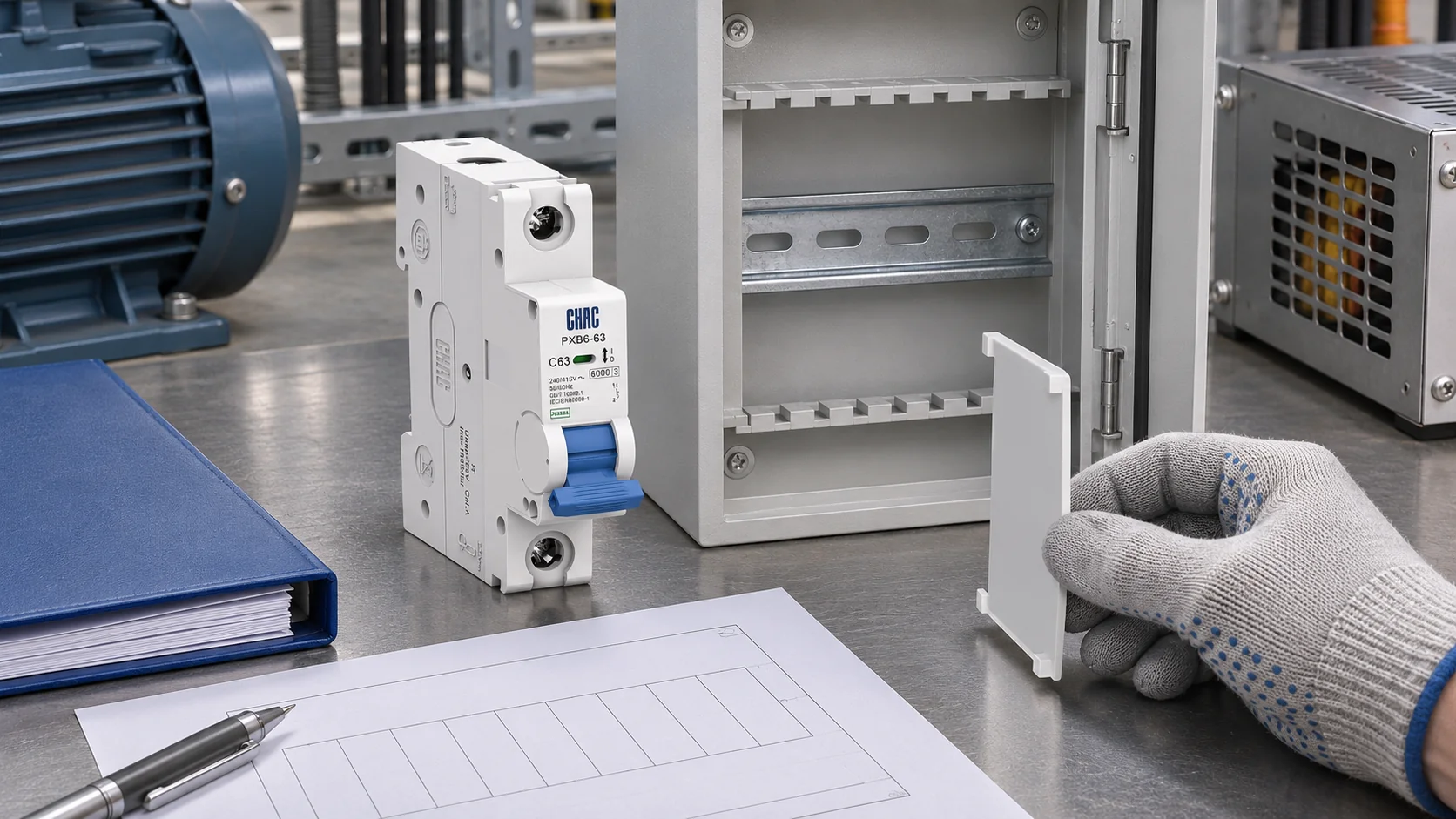
How to request temperature correction data for your PXB6 configuration
di CHAC PXB6-63 product information lists current options from 6 A to 63 A, pole options from 1P to 4P, and B, C and D curves. Those choices identify different order configurations. The public 30°C tripping reference does not supply a complete current-versus-temperature table for every configuration.
Send the exact PXB6 designation, intended load, pole arrangement, local ambient-temperature estimate, enclosure arrangement and simultaneous-loading assumptions when requesting the applicable correction data. Ask whether the supplied method accounts for adjacent devices and whether additional assembly checks remain necessary. Keep the response and revision with the panel design.
IEC TR 61439-0:2022 provides guidance for specifying assembly functions and characteristics, including current-rating considerations. Use that specification discussion to agree the intended loading and service conditions with the assembly manufacturer. It is a technical report, not a product certificate or a source of a universal PXB6 correction factor.
IEC 60898-1 is the product-standard reference on the published PXB6 page. IEC 61439 addresses the assembly, while the applicable installation rules govern circuit and conductor protection. These are different scopes. A catalogue standard reference does not establish conformity of a modified panel or prove that an order carries every possible approval.
Common questions about PXB6 derating in hot panels
What does circuit breaker derating mean in a hot electrical panel?
It means limiting usable current according to the manufacturer’s data for the actual thermal conditions. It does not change the number printed on the breaker or automatically change its trip setting. The permitted circuit load must also satisfy conductor and assembly requirements.
Which ambient temperature should be used when reading a breaker’s derating table?
Use the ambient temperature and measurement conditions defined by that manufacturer’s table, normally relating to the environment around the device. Do not substitute room temperature or a measured terminal surface temperature without checking the instructions. Record the enclosure’s representative loaded condition.
How do adjacent devices and enclosure ventilation affect usable breaker current?
They can change the local thermal environment and the assembly’s temperature rise. The size of the effect depends on the actual arrangement, loading and approved correction method. Do not borrow a grouping factor from another product family.
Is temperature derating the same as changing the trip setting?
No. Derating concerns permitted use under particular conditions, while a trip setting determines a protection threshold where adjustment is available. A fixed-rating MCB does not acquire an adjustable overload setting because a correction table is used.
Where can I obtain the temperature correction data for the exact PXB6 rating?
Request it from CHAC with the complete model, current, curve, poles and panel conditions. Ask for the applicable document revision and any limits on using it. The published reference-temperature tripping table alone is insufficient to calculate every high-temperature operating case.
Can one temperature derating factor be applied to every MCB model?
No. Different products can have different reference conditions and thermal behaviour. Apply a factor only to the models and arrangements covered by its source, including any stated restrictions.
What assembly conditions should be checked before increasing a breaker rating?
Check the design load, cable capacity, terminations, simultaneous loading, enclosure ventilation, fault duty and coordination. Review the applicable assembly verification and local installation requirements. Resolve the cause of the original trip before approving a larger protective device.
Referenze
- IEC 61439-1:2020: assembly service conditions and verification, including group rated current.
- IEC 60947-2:2024: circuit-breaker scope for instructed or skilled users; a separate product-standard context.
- IEC TR 61439-0:2022: guidance for specifying assemblies.
The published PXB6-63 technical data linked above supplies the model range and the 30°C test reference. No PXB6-specific high-temperature correction factor is asserted in this article.
Specify the load and the conditions around the device together. For a PXB6 review, send CHAC your configuration and panel conditions so the appropriate technical information can be confirmed before ordering.