A panel quotation may list current rating, trip curve and breaking capacity yet leave a critical question unanswered: how much fault stress reaches the downstream circuit before interruption? For panel builders and electrical buyers, this matters when comparing conductor protection, equipment withstand and upstream/downstream coordination.
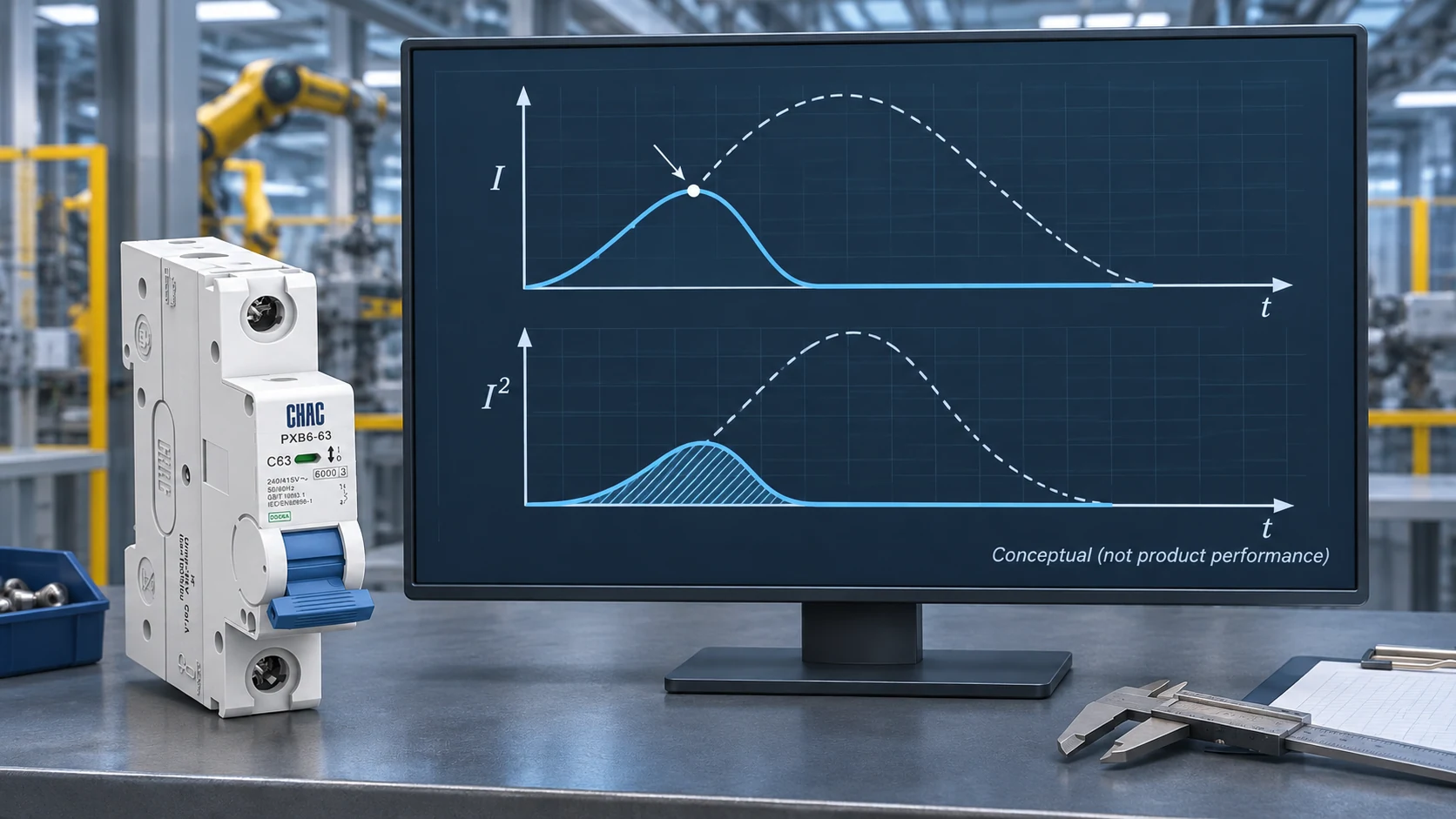
A current limiting circuit breaker limits the current that flows during a short circuit within its documented current-limiting operating range. It reduces the fault-current peak and associated I²t compared with the prospective fault without that limiting action. It does not regulate normal load current, and its limiting performance must be verified for the exact device and application conditions.
What does a current limiting circuit breaker limit during a fault?
Prospective fault current describes the fault available from the supply and circuit impedance before considering the breaker’s limiting action. A current limiting breaker interrupts sufficiently rapidly to restrict the developing fault waveform. The result is lower peak let through current and reduced current-squared time integral within the documented operating range.
| Quantity | What it describes | Buyer significance |
|---|---|---|
| Prospective fault current | Available fault current at the installation point | Input for breaking-capacity and limitation checks; AC values are commonly stated as RMS |
| Peak let-through current | Highest instantaneous current passed during interruption | Relevant to electrodynamic stress and peak withstand |
| I²t let-through | Integral of current squared over the interruption interval | Relevant to thermal stress and compatible withstand limits |
| Breaking capacity | Declared fault-interruption capability under specified conditions | Not a substitute for peak or I²t limitation data |
Peak current and RMS current are different quantities: do not compare their numerical values as though they were interchangeable. Likewise, I²t is not simply elapsed clearing time or energy measured in joules; its unit is A²s. Thermal assessment must use the appropriate equipment or conductor criteria.
A fast trip description alone does not establish the limiting performance. Nor does a B, C or D curve letter: those letters address instantaneous trip response, not a complete let-through characteristic. The CHAC trip-curve guide explains that distinction for MCB selection.
Which evidence establishes current-limiting performance?
Request documentation traceable to the exact catalogue reference, rated current, voltage, pole configuration and trip-unit settings where applicable. The evidence should identify the applicable product standard, declared current-limiting performance and the conditions covered by the published curves or tables. Do not transfer a claim from one variant to another merely because they share a series name.
The official IEC 60947-2:2024 scope covers circuit-breakers intended for installation and operation by instructed or skilled persons within its stated voltage scope. Citing that standard does not establish that a particular unit is certified, or prove its limitation values. Obtain device-specific declarations and supporting test or certification evidence as required by the project.
For assessment, request both peak let-through and I²t curves against prospective fault current, together with time-current characteristics. Check voltage, AC or DC applicability, curve limits, settings and any stated test conditions. A curve for a different voltage or configuration cannot automatically support the proposed duty.
The CHAC MCB range and CHAC MCCB range provide starting points for comparing product categories and discussing requirements. These category pages do not establish current-limiting performance for any named variant.
What inputs are needed before accepting a downstream protection arrangement?
Begin with the installation duty, then evaluate the proposed combination. Lower let-through stress can help protect downstream components, but it does not independently authorize a device with inadequate standalone breaking capacity.
| Required input | Decision it supports |
|---|---|
| System voltage, AC/DC and prospective fault current | Whether published ratings and curves cover the duty |
| Exact upstream breaker and settings | Which limitation characteristics apply |
| Downstream device and conductor withstand data | Whether peak and thermal stresses are acceptable |
| Verified backup or cascading combination data | Whether a specified conditional protection arrangement is supported |
| Selectivity evidence and assembly requirements | Whether service-continuity and assembly objectives are addressed |
Backup protection and selectivity answer different questions. A verified combination may support fault interruption without ensuring that only the downstream device trips. Request separate selectivity evidence where continuity matters.
Component selection also does not replace assembly verification. The official IEC 61439-1:2020 information addresses low-voltage assembly requirements; it is not certification of a proposed panel. Keep component limitation checks and assembly verification linked, but distinct.

Frequently asked questions
What does a current-limiting circuit breaker actually limit during a fault?
It restricts the fault-current waveform, reducing its peak and I²t within the breaker's documented current-limiting range.
How is peak let-through current different from prospective fault current?
Peak let-through is the highest instantaneous current actually passed. Prospective fault current describes the available fault without the limiting action and is commonly expressed as RMS for AC systems.
What does the I-squared-t let-through value describe?
It describes the integral of current squared over the interruption interval, in A²s. It supports thermal-stress assessment against applicable withstand criteria.
How can a buyer verify that a breaker is rated as current limiting?
Match the exact variant to its declared performance, limitation curves and supporting documentation. Confirm voltage, configuration, settings and applicable standard rather than relying on a catalogue headline.
Does a current-limiting breaker reduce normal load current?
No. It is not a load-current regulator. Overload operation follows its protective characteristic rather than continuously trimming current to the nameplate rating.
Which manufacturer curves are needed to assess downstream protection?
Obtain peak let-through, I²t let-through and time-current curves. Also request combination-specific backup and selectivity tables where those functions are required.
Can current limitation alone justify a lower-rated downstream device without a verified coordination arrangement?
No. Reduced stress alone does not establish an acceptable backup arrangement. The exact combination and application conditions need verified supporting evidence.
For procurement, make let-through documentation a quotation requirement alongside breaking capacity and trip characteristics. Contact CHAC with the fault level, system voltage and proposed device combination to discuss documentation availability; consultation is not confirmation that a particular variant meets the duty.