A three-phase miniature circuit breaker is normally a linked multipole protective device used for the three phase conductors of a circuit. It provides the overcurrent functions declared for the exact model. It does not automatically provide leakage protection, phase-sequence monitoring or dedicated motor phase-loss protection. Begin with the supply arrangement and load duty, then check current, voltage, curve, fault capacity and the required neutral treatment.
Know what the common-trip mechanism does
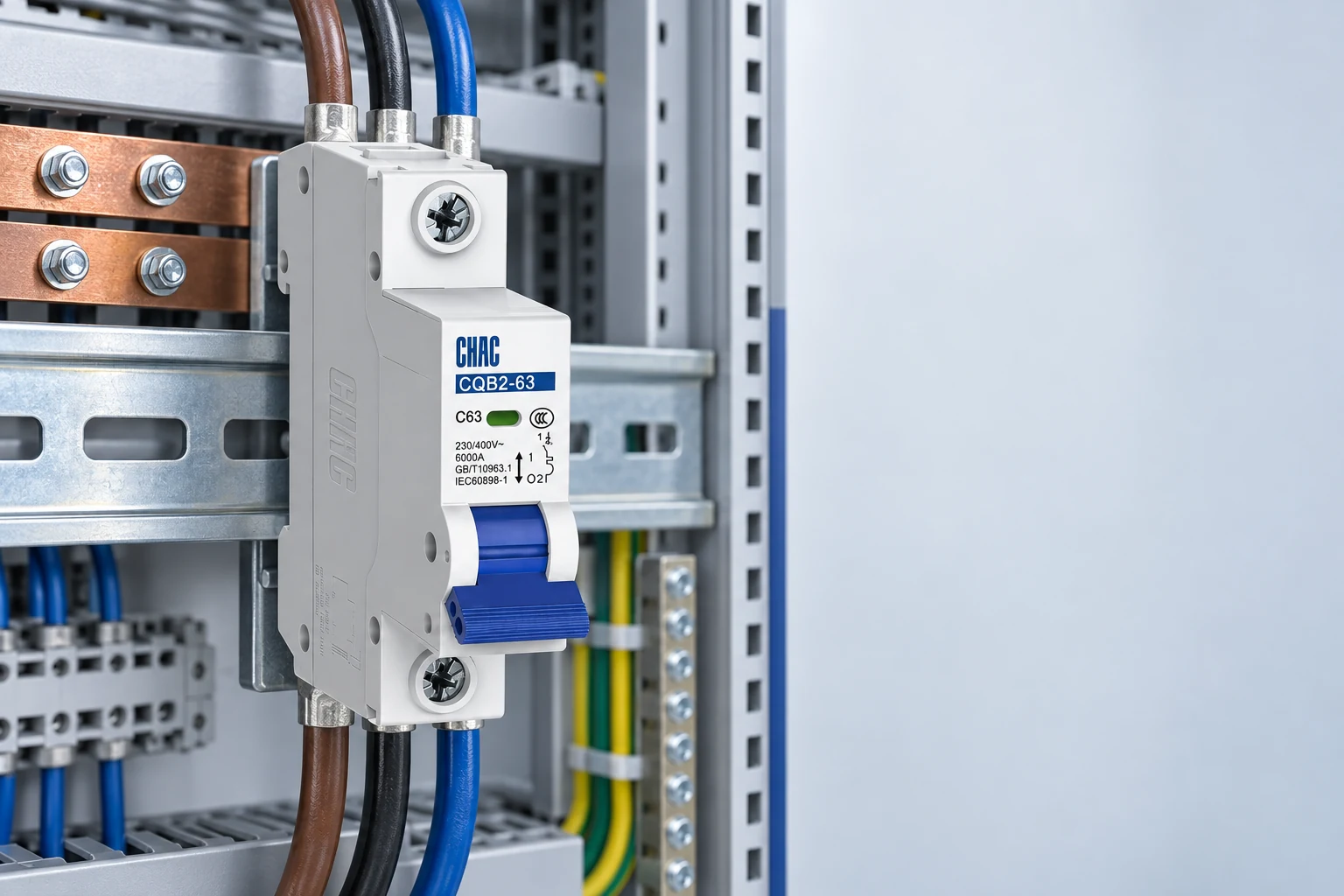
With an appropriate common-trip three-pole breaker, operation of the protective mechanism opens the linked phase paths. This differs from placing three independent single-pole devices together. Use the manufacturer’s declared construction when specifying common trip and isolation; a visual handle link alone may not establish the required function.
Common trip is not the same as sensing every abnormal condition. A phase lost elsewhere in the supply does not necessarily produce the current signature needed to operate a distribution MCB. A motor can therefore require additional protection even though all three phases pass through the same breaker.
Choose three poles or four from the neutral requirement
A three-phase circuit may be a three-wire load or may include a neutral for connected loads. A standard three-pole breaker switches the three phases and leaves the neutral arrangement to the design. Where neutral disconnection is required, specify an appropriate configuration and check its protected-pole and switching details.
Do not decide this from wire count alone. The earthing system, load characteristics and adopted wiring rules determine how the neutral is treated. A combined protective and neutral conductor must not be mistaken for an ordinary neutral that can be switched. Record the assumption explicitly on the one-line diagram.
Calculate the duty in each phase
The three-phase breaker rating applies per pole under its stated conditions. It is not the sum of three pole ratings. Check the most heavily loaded phase and the relevant conductor ampacity. Mixed single-phase loads can make a distribution circuit unbalanced even when its total power appears reasonable.
Use equipment input-current data or an appropriate three-phase calculation with the actual voltage and load assumptions. Starting currents and electronic loads deserve separate review. If the question is specifically a 100 A feeder, see the three-pole 100 A MCB selection guide.

Provide motor protection beyond the distribution breaker
Motor phase-loss protection needs an explicitly documented sensing and trip function. A suitable overload relay, motor-protection device or phase-monitoring arrangement may be required, depending on the motor and design. Schneider Electric’s Micrologic FAQ shows that phase-loss capability varies even among sophisticated trip systems; it cannot be assumed from the number of poles.
For product-scope information, review CHAC’s three-pole MCB options and CQV2 motor protection circuit breaker. Check the exact functions and coordination evidence. Neither a motor-related product name nor this article establishes the functions of every offered variant.
Commission the complete circuit and retain the results
Qualified personnel should follow the approved isolation procedure and equipment instructions. Check conductor identification, terminations, protective-conductor continuity and the installation tests required by the adopted rules. Confirm phase sequence where it affects the connected equipment. Do not improvise a short circuit to test a breaker.
Keep the final device reference, settings where applicable, torque requirements, test records and phase/neutral diagram with the board. If a motor repeatedly trips, record the operating conditions and measured currents before changing the curve or increasing the ampere rating. The fault investigation should distinguish overload, starting duty, supply problems and damaged equipment.
Which function belongs to which part of the protection scheme?
| Required function | What to verify | Do not assume |
|---|---|---|
| Overload and short circuit | Declared MCB curve and fault rating | Suitability from pole count alone |
| Phase loss or reversal | Explicit monitoring and trip function | Every three-pole MCB detects it |
| Residual current | Suitable RCD or RCBO function | An MCB includes leakage protection |
| Neutral isolation | Required switching arrangement | Three phase poles switch the neutral |
Frequently asked questions
What does a three-phase MCB protect?
It protects the three phase conductors from overcurrent and short circuit within its rated voltage and breaking capacity. Motor overload protection may still need a separate relay.
How is a three-phase MCB wired?
A qualified installer should follow the exact terminal diagram, conductor identification, line/load instructions and tightening requirements. Phase sequence and the required neutral arrangement must be verified for the connected equipment. This is not established by connecting three wires to any three terminals.
Can I use a three-pole MCB on a circuit with neutral?
Yes, when only the phases require protection and the neutral remains continuous as permitted. If neutral isolation is required, use the specified four-pole arrangement.
What curve is common for three-phase motors?
Curve choice depends on starting current and coordination; a dedicated motor protection scheme may be better than selecting a curve by habit.
How does a phase-loss relay work?
A suitable relay monitors the supply or current conditions defined by its design and changes its output when a specified fault condition is detected. That output must be connected to an appropriate stopping or tripping arrangement. Check its detection limits, delay, reset behavior and wiring instructions.
Can a three-phase breaker be used for single-phase?
Only where the exact product instructions and the circuit design permit that use. Do not parallel poles to increase current or invent a series arrangement. Confirm voltage, protected poles, common trip, unused poles and local requirements before selecting the configuration.
References
- Schneider Electric: phase-loss capability depends on the specific trip system
- Schneider Electric Electrical Installation Guide: overcurrent selection
For a model-specific review, contact CHAC Electric with the circuit diagram, supply voltage, load details and destination-market requirements.