Cable Short-Circuit Calculator
Estimate cable short-circuit withstand area with S = I√t/k using fault current, clearing time and a verified conductor k value. Compare with an installed conductor.
Check conductor thermal withstand using the short-duration adiabatic method.
Result
Minimum area estimate
13.75mm²Preliminary calculationSmin = I × √t / kShort-duration adiabatic estimate only. k must match conductor material, insulation and initial/final temperatures. Does not verify ampacity, breaker let-through or mechanical forces.
Why this result?
Formula and method
Estimate cable short-circuit withstand area with S = I√t/k using fault current, clearing time and a verified conductor k value. Compare with an installed conductor.
How to use this calculator
- Enter the prospective fault current and clearing duration.
- Enter a verified k value for the conductor and insulation conditions.
- Compare the required area with the installed conductor.
Calculation limits
I is in amperes in the equation; the input converts kA to A. The illustrated k value is not universal. Current-limiting protection may require manufacturer let-through energy data.
Cable short circuit calculation using the adiabatic equation
The adiabatic method treats short-duration fault heating as remaining in the conductor. The relation I²t ≤ k²S² can be rearranged to estimate a minimum area. The factor k depends on conductor material, insulation and the permitted initial and final temperatures.
Input notes
| Input | What to check |
|---|---|
| Fault current | Enter kA; the equation converts it to amperes. This tool does not calculate prospective fault current from network impedance. |
| Clearing duration | Use the relevant total protective-device clearing time, not an assumed delay alone. The form accepts 0.001 to 5 seconds; the method’s applicability still needs checking. |
| k and installed area | Use verified conductor data for k and enter metal cross-section in mm². An illustrative default is not valid for every cable. |
Worked example · initial form values
5 kA fault cleared in 0.10 seconds
Fault current 5 kA · clearing time 0.10 s · k = 115 A·√s/mm² · installed area 16 mm²
Smin = 5,000 × √0.10 / 115 = 13.75 mm²
For 16 mm²: tmax = (115 × 16 / 5,000)² = 0.135 s
13.75 mm²
16 mm² exceeds the calculated thermal minimum for these entered conditions. That comparison does not establish ampacity, fault disconnection compliance or overall cable suitability.
Choosing k and using manufacturer let-through data
- The referenced guide lists k = 115 for copper/PVC up to 300 mm² with 70°C initial and 160°C final temperatures. It lists k = 143 for copper/XLPE with 90°C initial and 250°C final temperatures. Confirm the applicable cable conditions.
- For current-limiting devices or very short clearing times, use manufacturer let-through I²t data and compare it with k²S². Multiplying prospective current squared by a guessed time can misrepresent the actual stress.
Frequently asked questions
Can I use the default k for every conductor?
No. Confirm k for the actual conductor material, insulation and permitted initial and final temperatures. Current-limiting devices may require manufacturer let-through energy data.
Can I use k = 115 for aluminium or XLPE cable?
No. k depends on material, insulation and temperature limits. Select it from the applicable cable data or design standard rather than retaining the default.
Does the tool calculate fault current or breaker clearing time?
No. You must obtain these separately from the network study and the protective device’s characteristics or manufacturer data.
Is passing this thermal check enough to select the cable?
No. Ampacity, voltage drop, minimum fault current, disconnection requirements, mechanical withstand and installation conditions still need verification.
Need help choosing a CHAC product?
Send the system voltage, load current, and installation conditions with your inquiry.
Application example · Illustrative inputs
Checking conductor thermal withstand against an assumed fault
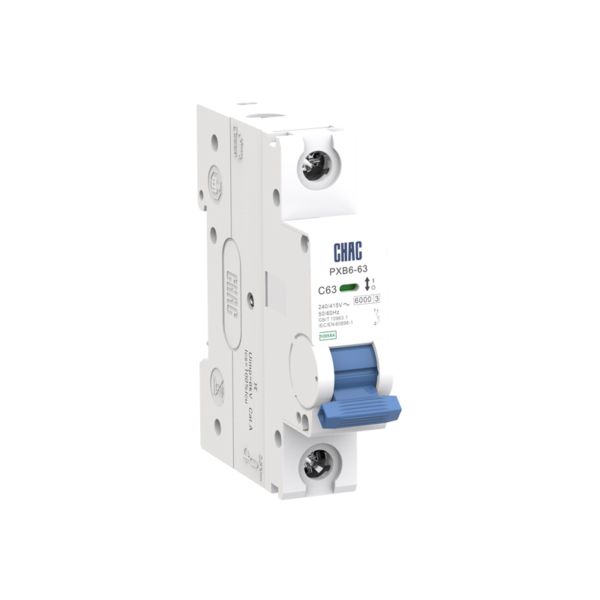
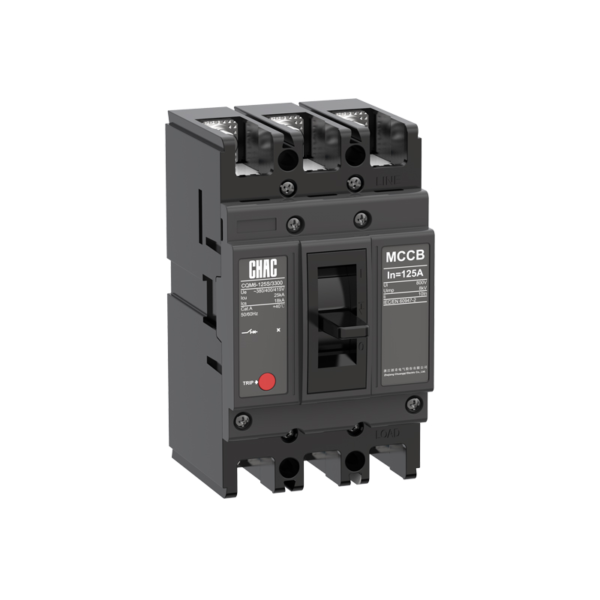
For a feeder study, enter a prospective fault current of 6 kA, a clearing time of 0.15 s and k = 115, provided that k matches the conductor, insulation and temperature conditions being studied. The adiabatic calculation gives a minimum area of 20.21 mm², so a 25 mm² conductor clears this entered thermal comparison. It is not a final cable selection. When reviewing CHAC PXB6-63 or CQM6 protection, obtain the applicable clearing or let-through data: the breaker’s ampere rating and breaking capacity alone do not establish the thermal energy reaching the conductor.
Product data: PXB6-63 Miniature Circuit Breaker · CQM6 Standard Molded Case Circuit Breaker (MCCB) OEM Manufacturer
Related CHAC products
Check the protective device’s clearing characteristics against the conductor’s short-circuit withstand.