Use an AC contactor when the circuit needs repeated switching of motor or power loads; use a control relay when the task is logic, interlocking, or low-duty auxiliary switching. This guide compares contactor vs relay selection for panel builders and OEM teams reviewing motor-control BOMs. For the product category overview, see AC contactors at CHAC Electric.
Part 1. What Separates a Contactor from a Control Relay?
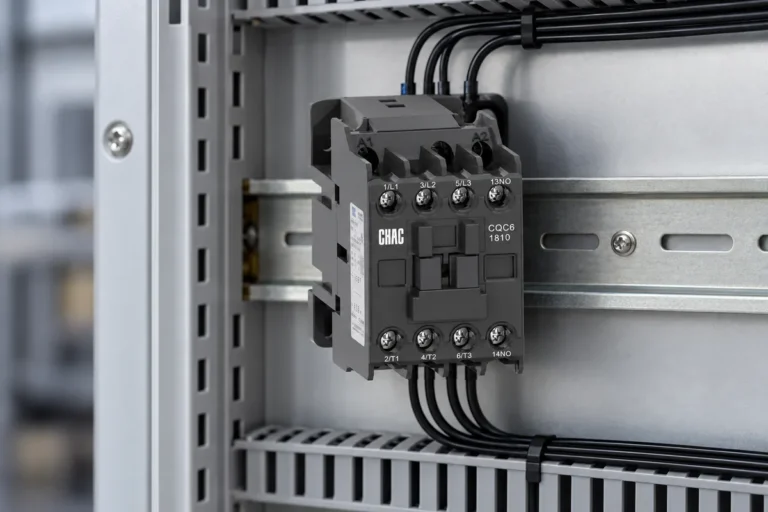
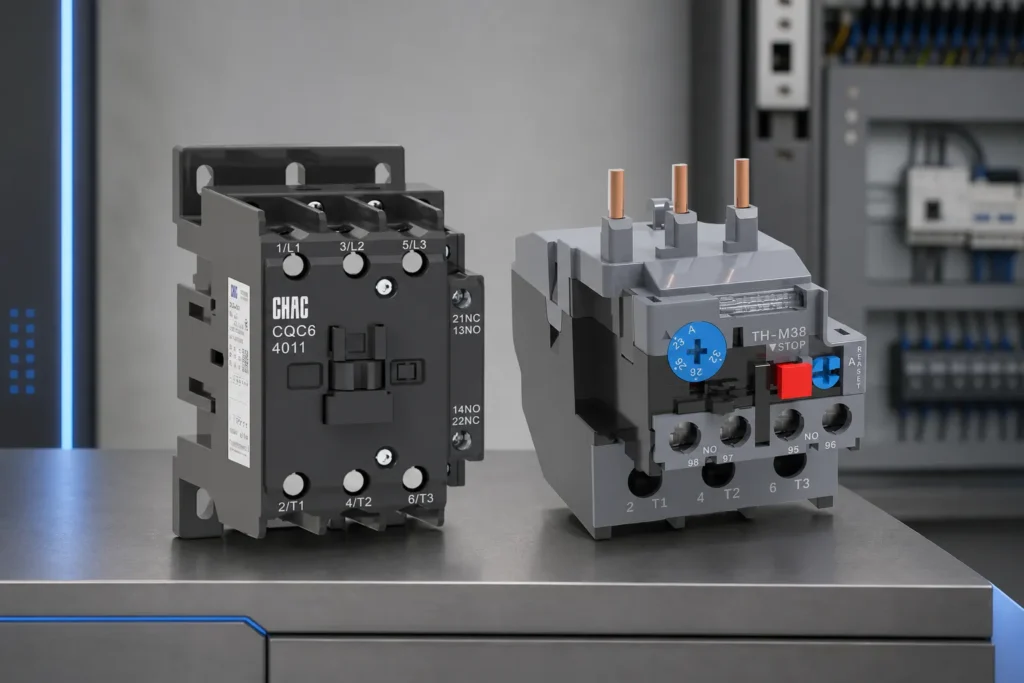
An AC contactor is built for frequent make-and-break operation on power circuits — typically motor, heater, or capacitor loads on a DIN rail or panel bus. A control relay (or auxiliary relay) switches smaller control circuits: interlocks, indicator branches, remote enable chains, or pilot devices.
| Feature | AC contactor (typical) | Control relay (typical) |
|---|---|---|
| Primary duty | Power-circuit switching | Control-circuit switching |
| Contact rating | Higher continuous and making/breaking current | Lower contact rating |
| Arc handling | Designed for load breaking with proper duty class | Not intended for motor power breaking |
| Mounting | Often paired with overload relay or MPCB | Often grouped in relay banks |
| Typical use | Motor starter, HVAC compressor, lighting power branch | Logic, status, seal-in, multi-circuit interlock |
IEC 60947-4-1 frames contactor performance by utilization categories (for example AC-3 for squirrel-cage motor switching). Relays used in control panels are generally specified against control-circuit duty, not motor power categories.
Part 2. When Does Motor Control Require a Contactor?
Three-phase and larger single-phase motor branches normally need a magnetic contactor (or motor starter assembly) because:
- Switching frequency — motors start and stop many times over the equipment life.
- Inrush current — make contacts must tolerate starting peaks within the declared duty class.
- Coordination — contactors integrate with thermal overload relays or motor protection devices in a defined starter layout.
| Application signal | Usually contactor | Usually relay |
|---|---|---|
| 3-phase motor direct-on-line starter | Yes | No (power path) |
| Motor remote start/stop from PLC | Yes, with control relay for logic if needed | Logic only |
| Small fan or pump below relay rating | Sometimes relay if duty and standard allow | Possible with engineering review |
| HVAC compressor / chiller contactor duty | Yes | No for power contacts |
| Status feedback to BMS | Auxiliary contact on contactor | Standalone relay acceptable |
If the branch already uses an MCCB or MCB for short-circuit protection, the contactor still handles operational switching; the breaker is not a substitute for daily motor cycling duty.
Part 3. Where Do Relays Still Make Sense in the Same Panel?
Relays remain essential even when every motor has a contactor:
- Interlocking two motors or modes (hand/off/auto chains).
- Expanding auxiliary contacts when the contactor’s built-in auxiliaries are exhausted.
- Voltage adaptation between control power and field devices.
- Pilot-duty signaling where contactor auxiliary blocks would be oversized or unavailable.
| Panel function | Common device | Note |
|---|---|---|
| Motor power switching | Contactor | Size to load and duty class |
| Seal-in / latch logic | Control relay | Separate from power contacts |
| Alarm aggregation | Control relay | Multiple NO/NC combinations |
| Remote indication | Aux contact or relay | Match contact rating to signal circuit |
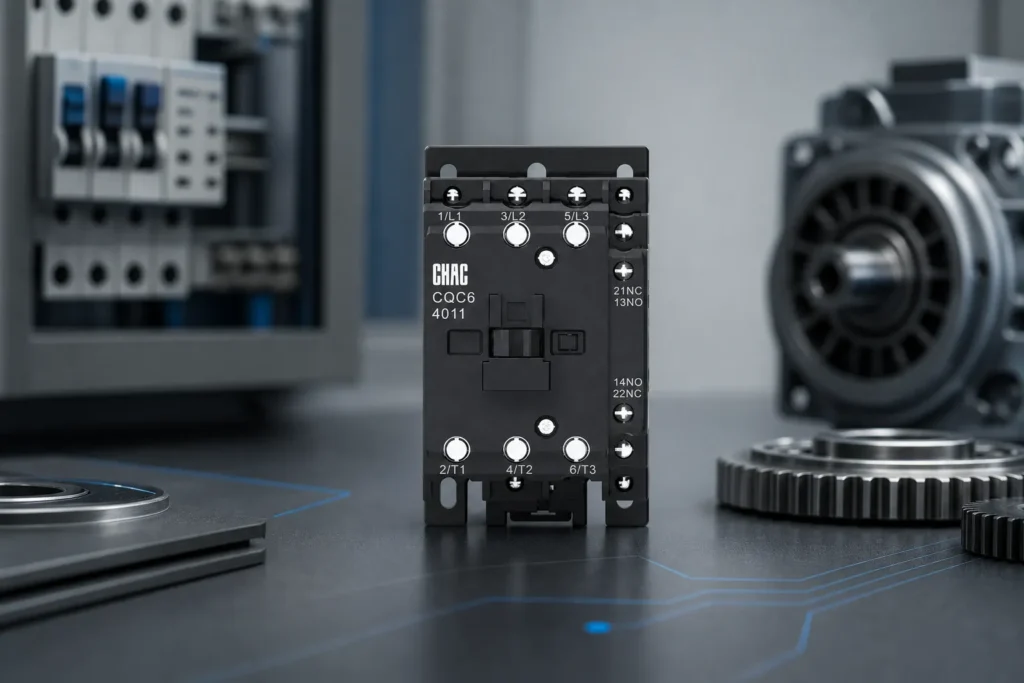
CHAC AC Contactor Recommended:
CQC6 Series Industrial AC Contactor OEM Manufacturer | CHAC Electric
Part 4. How Do Overload and Auxiliary Devices Change the Choice?
Contactor selection is rarely isolated. Panel engineers usually define a starter kit:
| Component | Role in motor branch | Selection note |
|---|---|---|
| Contactor | Switches motor power | Coil voltage, poles, auxiliaries |
| Thermal overload relay | Protects against sustained overcurrent | Heater or electronic range |
| MPCB / breaker | Short-circuit and isolation | Coordination with upstream device |
| Aux contact block | Status to PLC or indicator | NO/NC count and mounting style |
A relay alone does not provide overload protection. If the specification says “contactor with overload,” the RFQ should list motor full-load current, starting method, and ambient temperature — not only coil voltage.
Part 5. Common Selection Mistakes in Motor and HVAC Circuits
| Mistake | Field consequence | Review step |
|---|---|---|
| Using a control relay on motor power contacts | Welded or eroded contacts | Match device class to switched load |
| Omitting overload in the starter | Motor burn under sustained fault | Confirm protection chain |
| Mixing lighting and motor contactor categories | Nuisance trip or short life | Check utilization category |
| Undersizing coil control supply | Chatter or failure to pull in | Verify control circuit inrush |
| Copying a competitor BOM without duty data | Wrong pole/aux configuration | Reconcile with motor nameplate |
Industry Q&A threads often confuse “relay” with the auxiliary block mounted on a contactor. Clarify in the drawing whether the requirement is power switching or auxiliary signaling.
Part 6. Which CHAC Contactors Fit Typical OEM Motor Control Routes?
CHAC manufactures industrial control electrical appliances for OEM and private-label programs, including AC contactor platforms for motor-control panels.
| Buyer scenario | CHAC starting point | RFQ focus |
|---|---|---|
| Industrial motor-control OEM platform | CQC6 Series Industrial AC Contactor OEM Manufacturer | Poles, coil, auxiliaries, labeling |
| Starter with overload coordination | CQC5 AC contactor with overload protection route + thermal relay | Heater range, mounting |
| Private-label motor-control line | Industrial control customization | Branding, packaging, regional marks |
RFQ checklist for contactor vs relay decisions
| Buyer should provide | Why it matters |
|---|---|
| Motor or load type and voltage | Defines power contact requirement |
| Full-load and starting current | Overload and duty class |
| Expected starts per hour | Contact life review |
| Control voltage and wiring | Coil selection |
| Required aux NO/NC | Contactor block vs standalone relay |
| Target market and standard | Certification scope |
Part 7. What Are the Fit Boundaries?
This comparison supports device-class selection for low-voltage motor and power switching. It does not replace:
- Motor cable sizing or voltage-drop calculations
- Short-circuit coordination studies
- Local wiring-rule compliance by country
- Explosion-proof or medium-voltage switching outside CHAC’s published low-voltage range
Keep semiconductor soft-starter internals, VFD power stages, and protection-device coordination on their own specification paths. When project data is incomplete, request engineering review before locking the BOM.
Relevant CHAC starting points
- AC Contactor category
- CQC6 Series Industrial AC Contactor OEM Manufacturer
- Industrial control customization
- Contact CHAC Electric
FAQ
What is the difference between a contactor and a relay?
A contactor switches power circuits such as motors and heaters with duty ratings for frequent operation. A control relay switches smaller control circuits for logic, interlocking, and signaling. They may appear together in the same panel but serve different electrical roles.
When should I use a contactor instead of a relay for a motor?
Use a contactor when the device must make and break motor power under normal operating cycles. A relay alone is not a substitute for motor power switching unless a qualified engineering review confirms duty, standard, and contact rating for that specific load.
Can a relay replace a contactor on a three-phase motor?
Generally no for the power path. Three-phase motor branches need a contactor or starter assembly rated for the motor switching category. Relays may still control the coil circuit or provide auxiliary logic.
What is a magnetic contactor used for?
A magnetic contactor uses an electromagnet to close power contacts when the coil is energized. It is used in motor starters, HVAC equipment, pumps, compressors, and other applications that require remote or automatic switching of power loads.
Do contactors need overload protection separate from relays?
Yes for motor branches. The contactor switches power; overload protection (thermal relay, electronic overload, or MPCB function) protects against sustained overcurrent. Control relays do not replace overload devices.
How do lighting contactors differ from motor contactors?
Lighting contactors are selected for lamp or lighting-load categories and switching patterns, while motor contactors are selected for motor utilization categories such as AC-3. Mixing categories without engineering review risks contact life and compliance issues.
What coil voltage should I specify for an AC contactor?
Specify the control-circuit voltage actually present at the coil terminals in steady state — for example 230 V AC or 24 V DC control supplies — and note any supply variation, transformer loading, or PLC interface requirements in the RFQ.
How do panel builders choose between contactor and relay for HVAC loads?
HVAC compressors and fan motors typically use contactors on power circuits. Relays handle thermostat logic, mode interlocks, and auxiliary signals. Size the contactor to the compressor or motor load; use relays where only control-circuit switching is required.