Motor Starter Selection Calculator — DOL
Estimate three-phase DOL motor current and starting current, then compare CHAC CQC6 contactors and listed CQR2 overload relay ranges.
Build a three-phase direct-on-line starter reference using CQC6 AC-3 data and published CQR2 plug-in relay ranges.
Result
DOL starter reference
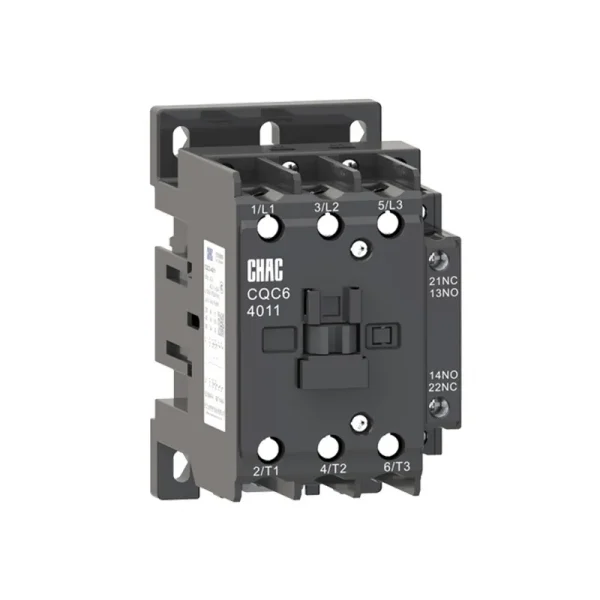
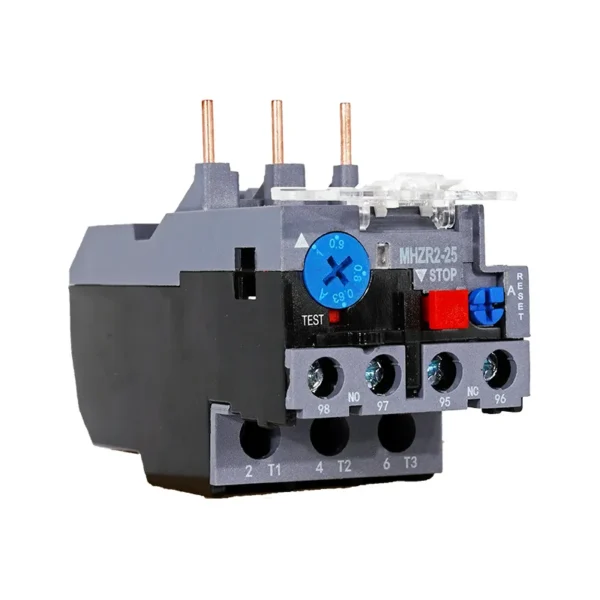
CQC6-25Entered numeric checks met; verify complete installationCQC6-25 with CQR2-25 (17–25 A) is the first listed pairing covering the current, motor power and proposed relay setting.
I = Pshaft × 1,000 / (√3 × V × PF × η); Istart = I × start multiple; relay range must contain proposed settingCurrent and kW table matching plus a listed plug-in relay range do not establish Type 1/Type 2 coordination. Check starting duration, trip class, breaker curve, coil voltage, control circuit and the exact tested combination.
Why this result?
At 400 V: contactor Ie ≥ 20.75 A (the greater of motor current and proposed setting); motor rating ≥ 11 kW; relay range must contain 20.75 A.
Selected reference and adjacent listed options. Values are rounded for display; checks use unrounded values.
| Contactor | AC-3 current / motor output | Listed overload relay | Reason |
|---|---|---|---|
| CQC6-18 | 18.00 A / 7.5 kW | CQR2-25 · 17–25 A | AC-3 current below requirement; Motor-power rating below requirement |
| CQC6-25Selected reference | 25.00 A / 11 kW | CQR2-25 · 17–25 A | First listed match for these checks |
| CQC6-32 | 32.00 A / 15 kW | CQR2-38 · no range contains 20.75 A | No listed relay range contains the setting |
View all 12 checked options
| Contactor | AC-3 current / motor output | Listed overload relay | Reason |
|---|---|---|---|
| CQC6-6 | 6.00 A / 2.2 kW | No listed plug-in pairing | AC-3 current below requirement; Motor-power rating below requirement; Plug-in compatibility not listed |
| CQC6-9 | 9.00 A / 4 kW | CQR2-25 · 17–25 A | AC-3 current below requirement; Motor-power rating below requirement |
| CQC6-12 | 12.00 A / 5.5 kW | CQR2-25 · 17–25 A | AC-3 current below requirement; Motor-power rating below requirement |
| CQC6-18 | 18.00 A / 7.5 kW | CQR2-25 · 17–25 A | AC-3 current below requirement; Motor-power rating below requirement |
| CQC6-25Selected reference | 25.00 A / 11 kW | CQR2-25 · 17–25 A | First listed match for these checks |
| CQC6-32 | 32.00 A / 15 kW | CQR2-38 · no range contains 20.75 A | No listed relay range contains the setting |
| CQC6-38 | 38.00 A / 18.5 kW | No listed plug-in pairing | Plug-in compatibility not listed |
| CQC6-40 | 40.00 A / 18.5 kW | CQR2-95 · 17–25 A | Checks met; later listed option |
| CQC6-50 | 50.00 A / 22 kW | CQR2-95 · 17–25 A | Checks met; later listed option |
| CQC6-65 | 65.00 A / 30 kW | CQR2-95 · 17–25 A | Checks met; later listed option |
| CQC6-80 | 80.00 A / 37 kW | CQR2-95 · 17–25 A | Checks met; later listed option |
| CQC6-95 | 95.00 A / 45 kW | CQR2-95 · 17–25 A | Checks met; later listed option |
Entered condition checks
| Check | Requirement | Entered value | Status |
|---|---|---|---|
| Motor current and protective device | Breaker In ≥ 20.75 A | 32.00 A | Entered check met |
| Cable capacity | Corrected Iz ≥ 32.00 A | 40.00 A | Entered check met |
| Short-circuit capability | Declared capability ≥ 6.00 kA | 10.00 kA | Entered check met |
Still to confirm
- The pairing is based on listed plug-in compatibility and adjustment range; Type 1/Type 2 coordination is not verified.
- Confirm starting duration, trip class, breaker curve, coil supply and the actual control circuit.
Data source: CHAC CQC6 AC-3 rating table (opens in a new tab) · CHAC CQR2 listed plug-in ranges (opens in a new tab)
Formula and method
Estimate three-phase DOL motor current and starting current, then compare CHAC CQC6 contactors and listed CQR2 overload relay ranges.
How to use this calculator
- Enter motor shaft output, line voltage, efficiency and power factor; actual nameplate current overrides the estimate.
- Enter a justified start-current multiple and proposed overload setting factor.
- Review the CQC6 and CQR2 references with the exact wiring, trip class and manufacturer coordination data.
Calculation limits
Direct-on-line three-phase motors only. Does not design star-delta, reversing, soft-starter or VFD arrangements. Plug-in compatibility is not proof of a tested short-circuit coordination combination.
DOL motor starter sizing and thermal overload relay selection
A DOL starter combines switching, overload protection and short-circuit protection. This tool uses CQC6 AC-3 columns for the contactor reference and the CQR2 table for a listed plug-in relay range that contains the proposed overload setting.
Input notes
| Input | What to check |
|---|---|
| Motor current | Use actual motor nameplate current when available. Otherwise the tool estimates current from shaft kW, efficiency, power factor and line voltage. |
| Starting duty and setting | Starting-current multiple and overload setting factor are project inputs. They do not replace start-duration and trip-class checks. |
| Protection and relay range | The tool checks entered breaker/cable/fault bounds and a listed plug-in relay range. This does not prove a tested coordinated combination. |
Worked example · initial form values
11 kW, 400 V direct-on-line starter reference
PF 0.85 · efficiency 90% · start multiple 6 · overload factor 1.00
Motor current = 20.75 A; assumed starting current = 20.7549 × 6 = 124.53 A.
CQC6-25 meets the loaded 400 V AC-3 columns. CQR2-25 has a listed 17–25 A range containing 20.75 A.
CQC6-25
This is a contactor and relay-range reference. The proposed setting, start duration, trip class and tested short-circuit protection combination still require verification.
DOL starter sizing starts with motor full-load current
A direct-on-line starter applies the line supply to the motor through a contactor. Use motor nameplate current for component checks whenever it is available. The power-based estimate is useful for preliminary work when shaft kW, efficiency, power factor and line voltage are known.
Starting current is a separate quantity. Here it is estimated as running current multiplied by your entered starting-current multiple. For the default 11 kW example, 20.75 A running current and a multiple of six give about 124.53 A during starting; the actual motor and driven load determine the starting profile.
Motor starter components: contactor, overload relay and fault protection
The contactor switches the motor. The thermal overload relay responds to sustained overload according to its setting and trip characteristic. A suitable short-circuit protective device handles the fault-protection duty. These functions need to work together in an electric motor starter.
The tool compares CQC6 AC-3 current and motor-kW ratings, then looks for an explicitly listed CQR2 plug-in relay range containing the proposed setting. Plug-in compatibility establishes a component pairing; it does not establish a tested Type 1 or Type 2 coordinated starter.
Thermal overload relay setting and starting time
Choose a relay range that contains the required setting, then confirm the setting against motor data and the relay instructions. In the default example, the proposed 20.75 A setting falls within the listed CQR2-25 range of 17–25 A paired with CQC6-25.
A relay can have a suitable adjustment range yet be unsuitable for a long acceleration time. Check trip class, hot and cold starting conditions, starts per hour and the driven load. A motor protection circuit breaker is another protection option, but its use still requires the applicable contactor and coordination data.
Compatibility and coordination are different checks
- The CQR2 source identifies plug-in contactor families. Mechanical plug-in compatibility is not evidence of Type 1 or Type 2 short-circuit coordination.
- An overload relay does not replace the necessary short-circuit protective device. A breaker that carries running current can still be unsuitable for starting duty or fault protection.
Frequently asked questions
Can this select a star-delta starter?
No. The topology and relay location change the component-current relationships. This version is limited to a three-phase DOL arrangement.
Is the calculated overload setting mandatory?
No. The setting factor is an entered proposal. Final settings must follow motor data, relay instructions, start conditions and applicable rules.
Why might there be no complete match?
The motor/current combination can exceed the loaded CQC6 columns, or the proposed setting may not fit a listed CQR2 range for that contactor.
Does the result prove Type 2 coordination?
No. It does not check a tested manufacturer combination or its stated prospective-fault limit. Obtain the applicable coordination data.
What is the difference between a motor starter and a contactor?
A contactor provides switching. A motor starter combines switching with the required motor-protection functions. For this DOL reference, the tool examines a contactor and overload relay, with separate checks still needed for short-circuit protection and coordination.
Can I choose a thermal overload relay only by its maximum ampere rating?
No. Its adjustment range must contain the required setting, and its trip class must suit the starting conditions. Confirm compatibility with the contactor and the manufacturer’s instructions as well.
Need help choosing a CHAC product?
Send the system voltage, load current, and installation conditions with your inquiry.
CQC6 contactor and CQR2 overload relay reference
Current adjustment ranges and plug-in contactors from the CHAC CQR2 product table. Each listed range is shown separately; the model names and range notation retain the source wording.
Reference data. Calculate to highlight the matching row.
CQR2-25
Plug-in contactors listed by CHAC:
Scroll horizontally on small screens to read all columns.
| Current adjustment range RC(A) | Calculator reference |
|---|---|
| 0.1~0.16 | Listed adjustment rangeCurrent calculated range |
| 0.16~0.25 | Listed adjustment rangeCurrent calculated range |
| 0.25~0.40 | Listed adjustment rangeCurrent calculated range |
| 0.40~0.63 | Listed adjustment rangeCurrent calculated range |
| 0.63~1 | Listed adjustment rangeCurrent calculated range |
| 1~1.6 | Listed adjustment rangeCurrent calculated range |
| 1.6~2.5 | Listed adjustment rangeCurrent calculated range |
| 2.5~4 | Listed adjustment rangeCurrent calculated range |
| 4~6 | Listed adjustment rangeCurrent calculated range |
| 5.5-8 | Listed adjustment rangeCurrent calculated range |
| 7~10 | Listed adjustment rangeCurrent calculated range |
| 9~13 | Listed adjustment rangeCurrent calculated range |
| 12~18 | Listed adjustment rangeCurrent calculated range |
| 17-25 | Listed adjustment rangeCurrent calculated range |
CQR2-38
Plug-in contactors listed by CHAC:
Scroll horizontally on small screens to read all columns.
| Current adjustment range RC(A) | Calculator reference |
|---|---|
| 23-32 | Listed adjustment rangeCurrent calculated range |
| 30~38 | Listed adjustment rangeCurrent calculated range |
CQR2-95
Plug-in contactors listed by CHAC:
Scroll horizontally on small screens to read all columns.
| Current adjustment range RC(A) | Calculator reference |
|---|---|
| 17~25 | Listed adjustment rangeCurrent calculated range |
| 23~32 | Listed adjustment rangeCurrent calculated range |
| 30~40 | Listed adjustment rangeCurrent calculated range |
| 37~50 | Listed adjustment rangeCurrent calculated range |
| 48~65 | Listed adjustment rangeCurrent calculated range |
| 55~70 | Listed adjustment rangeCurrent calculated range |
| 63~85 | Listed adjustment rangeCurrent calculated range |
| 80~95 | Listed adjustment rangeCurrent calculated range |
Reading this reference
- Plug-in compatibility and adjustment-range coverage do not establish a tested Type 1 or Type 2 short-circuit coordinated starter.
- The source lists CQR2-38 with CQC6(SM/KMNC1)-32. This reference does not add CQC6-38 to that pairing.
- Use the original product page for the separately listed protection data, relay characteristics and installation requirements.
Source: CHAC CQR2 adjustment-range and plug-in table (opens in a new tab) · CHAC CQC6 AC-3 ratings
Source checked: . This is the retrieval date, not a standard edition or product revision date.
Application example · Illustrative inputs
Pairing a pump contactor with a listed overload-relay range
For a 15 kW, 400 V DOL pump example with a 28 A motor-current input, the calculator shortlists CQC6-32 and a CQR2-38 relay range of 23–32 A. These come from CHAC’s published current, motor-power and plug-in pairing tables. An assumed six-times starting multiple gives 168 A, but does not establish starting duration or a breaker trip response. The proposed 28 A overload setting must be reviewed against the actual motor and relay instructions. Complete the selection with the exact protection and coordination data rather than presenting the table pairing as a tested starter combination.
Product data: CQC6 Series Industrial AC Contactor OEM Manufacturer · CQR2 Series Thermal overload relay
Related CHAC products
Review the contactor, overload relay and motor-protection options. These cards do not establish a coordinated starter combination.